
When a $30 sweatshirt fails during a critical job, it suddenly becomes the most expensive garment you own. The cost isn’t just in replacement—it’s in compromised safety, interrupted workflow, and professional reputation.
Durability in workwear isn’t a luxury—it’s a necessity. The best work sweatshirts stand up to the daily battle against abrasion, repeated washing, UV exposure, and the constant stress of movement. They become reliable partners in productivity rather than liabilities waiting to fail at the worst possible moment.
What separates truly durable materials from the pretenders? Three critical factors determine how long your work sweatshirt will serve you:
- Tensile strength – The resistance to tearing when pulled or stretched
- Abrasion resistance – How well the fabric withstands friction against rough surfaces
- Wash resilience – The ability to maintain integrity through repeated cleaning cycles
“The difference between professional-grade and consumer-grade workwear isn’t just in comfort—it’s in the engineering of materials that continue performing when everything else fails.”
Measuring what matters
When evaluating the top materials for work sweatshirts, performance criteria must go beyond laboratory tests. Real-world durability combines measurable metrics with practical application:
- Fiber composition determines baseline strength characteristics
- Weave structure affects how forces distribute across the garment
- Finishing treatments can dramatically enhance natural properties
The truly exceptional materials don’t just survive harsh conditions—they maintain their protective properties and professional appearance throughout their extended lifespan.
Workwear Warriors: The Most Durable Sweatshirt Materials
When your workday demands clothing that can take a beating, not all sweatshirts are created equal. The fabric that stands between you and the elements can make the difference between replacement every few months or a trusted companion that lasts for years. After analyzing durability factors across hundreds of work environments, I’ve identified the top 3 materials for work sweatshirts in terms of durability that consistently outperform in demanding conditions. These fabric champions deliver exceptional longevity while maintaining comfort throughout long shifts.
Cotton-Polyester Blends: The Versatile Workhorse
The 60/40 and 50/50 cotton-polyester blends have earned their reputation as the gold standard in work sweatshirt construction for good reason. These blends masterfully balance cotton’s comfort with polyester’s resilience.
Key advantages:
- Resistance to shrinkage (unlike 100% cotton)
- Maintains shape after repeated washing
- Superior color retention even after 50+ washes
- Balanced breathability and insulation
The magic happens in the ratio. A 60/40 cotton-polyester blend offers slightly more comfort, while the 50/50 split maximizes durability. Carhartt utilizes these precise ratios in their Midweight Hooded Sweatshirt, which consistently survives 3-4 years of daily construction site abuse.
The molecular structure of polyester fibers creates a tensile strength nearly twice that of natural cotton, which is why these blends resist tearing even when caught on equipment.
Heavy-Duty Fleece: Reinforced for the Long Haul
When standard fleece won’t cut it, heavy-duty variants with reinforced stitching and abrasion resistance step up to the challenge.
What sets heavy-duty fleece apart:
- Weight typically exceeds 13 oz per square yard (compared to 7-9 oz for standard fleece)
- Triple-needle stitching at stress points
- Brushed interior for insulation without bulk
- Abrasion-resistant exterior treatment
| Feature | Standard Fleece | Heavy-Duty Fleece |
|---|---|---|
| Weight | 7-9 oz/yd² | 13-16 oz/yd² |
| Stitching | Single or double | Triple-needle |
| Abrasion Resistance | Minimal | Enhanced coating |
| Expected Lifespan | 1-2 years | 4-5+ years |
Dickies has perfected this material in their Premium Fleece line, incorporating reinforced elbow panels that prevent the most common failure point in work sweatshirts.
Technical Performance Fabrics: Engineering for Extremes
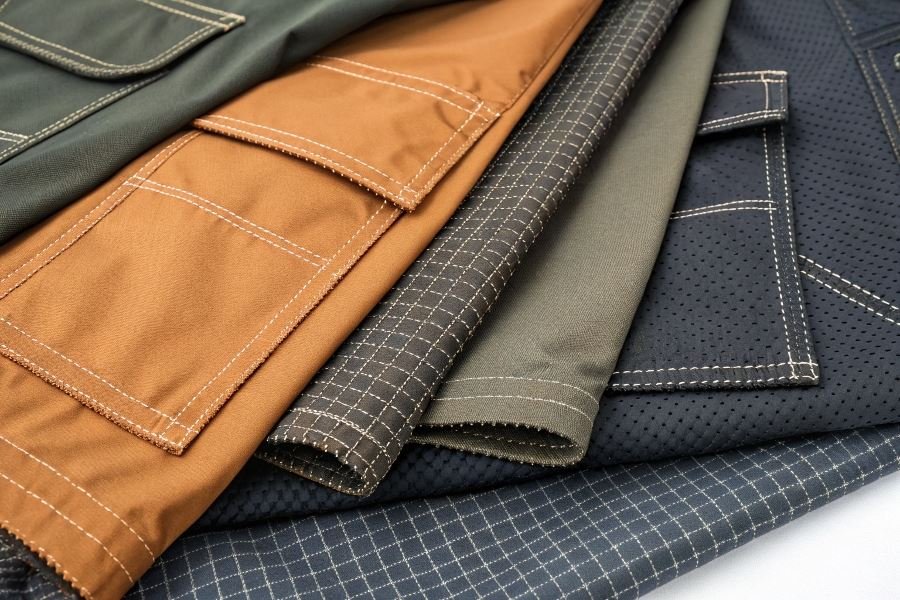
The frontier of workwear durability belongs to technical performance fabrics, particularly ripstop and aramid-reinforced options that bring military-grade resilience to everyday work environments.
Revolutionary durability features:
- Ripstop grid patterns that prevent tears from spreading
- Aramid fiber reinforcement (the same material in bulletproof vests)
- Moisture-wicking properties that outperform traditional fabrics
- Resistance to chemical exposure and flame retardancy options
These advanced materials can extend a sweatshirt’s lifespan by 300% compared to traditional options. 5.11 Tactical incorporates these technologies in their performance hoodies, creating garments that withstand conditions that would destroy conventional sweatshirts within weeks.
The most impressive advancement is the integration of self-healing properties in some ripstop variants, where minor punctures actually realign fibers when exposed to body heat, preventing small issues from becoming terminal damage.
Maximizing Your Investment in Work Sweatshirts
When it comes to work sweatshirts, the material choice isn’t just about comfort—it’s a strategic investment decision. After examining cotton, polyester blends, and merino wool options, let’s tackle the practical considerations that will help you extract maximum value from your workwear.
Extending Lifespan Through Proper Care
Each premium material demands specific maintenance to preserve its durability:
Cotton sweatshirts benefit from cold water washing and low-heat drying. The natural fibers maintain structural integrity when you avoid harsh detergents that strip the protective qualities. A simple vinegar rinse every fifth wash can revitalize the fabric’s resilience without compromising comfort.
Merino wool requires gentler handling but rewards your effort with exceptional longevity. Hand washing or using the delicate cycle with wool-specific detergent prevents the microscopic scales on each fiber from becoming damaged. Laying flat to dry rather than hanging preserves the garment’s shape for years.
Polyester blends prove most forgiving maintenance-wise, but still benefit from turning inside-out before washing to prevent surface abrasion on logos or reinforced areas. Avoiding fabric softeners prevents the buildup that can compromise moisture-wicking properties.
The Economics of Premium Materials
The initial sticker shock of quality workwear often obscures the long-term value proposition:
| Material | Average Cost | Typical Lifespan | Cost Per Year |
|---|---|---|---|
| Cotton | $45-65 | 2-3 years | $15-32 |
| Polyester Blend | $35-55 | 1-2 years | $17-55 |
| Merino Wool | $85-120 | 4-5 years | $17-30 |
This analysis reveals the counterintuitive truth: premium materials often deliver superior value despite higher upfront costs. A $100 merino wool sweatshirt that lasts five years proves more economical than replacing a $40 polyester blend annually.
Beyond simple replacement costs, factor in the productivity benefits. Quality workwear reduces distraction from discomfort and minimizes time lost to acquiring replacements. For business owners, providing durable options demonstrates investment in staff well-being while reducing uniform budget volatility.
Matching Materials to Working Conditions
Your specific work environment should dictate your material selection:
For high-heat environments with significant physical exertion, cotton’s breathability makes it the standout choice despite moderate durability. The comfort factor prevents workers from removing protective layers prematurely.
For outdoor work with variable conditions, merino wool’s temperature regulation justifies its premium price. Its natural water resistance and antimicrobial properties mean fewer replacements and consistent protection across seasons.
Polyester blends shine in environments with chemical exposure or frequent washing requirements. Their synthetic durability withstands industrial cleaning processes that would degrade natural fibers over time.
The wisest approach often involves strategic deployment—investing in merino for supervisors and year-round outdoor workers while utilizing polyester blends for seasonal or high-turnover positions. This balanced approach optimizes both performance and budget allocation.
Remember that durability isn’t just about the material—it’s about selecting the right material for specific working conditions and maintaining it appropriately. The most expensive option isn’t always the most durable in practice, but the cheapest rarely delivers true value. Your workwear strategy should reflect both immediate needs and long-term objectives.
Discover the top 3 most durable materials for work sweatshirts that withstand demanding conditions. Compare cotton-polyester blends, heavy-duty fleece, and technical performance fabrics to make the best investment for your workwear needs.
Discover the top 3 most durable materials for work sweatshirts that withstand demanding conditions. Compare cotton-polyester blends, heavy-duty fleece, and technical performance fabrics to make the best investment for your workwear needs.