Ever calculated how much product literally goes down the drain in your salon each day? The average hair salon uses over 10 gallons of shampoo monthly, with up to 30% wasted through improper dispensing and application techniques.
Behind every successful salon lies a delicate balancing act between delivering premium experiences and managing operational costs. Professional-grade hair products represent one of the most significant recurring expenses salon owners face, with shampoo leading the pack as the most frequently used product. Finding economical solutions without compromising quality has become the holy grail for salon profitability.
Efficiency in professional shampoo isn’t just about price per bottle—it’s about formulation density, dispensing systems, and staff training. The most cost-effective products deliver optimal cleansing with minimal product usage, requiring just 5-7ml per application rather than the 10-15ml many stylists habitually use.
Measuring what matters
Smart salon owners track three critical metrics:
- Cost-per-service: The actual expense of each shampoo application
- Dilution ratio: How concentrated the product is and how far it extends
- Client satisfaction: Whether economical options maintain expected results
Market realities facing salon owners
Supply chain disruptions have pushed professional product prices up 12-18% since 2023, squeezing already tight salon margins. Meanwhile, clients remain price-sensitive, making it challenging to pass these increases along. The solution lies in finding products specifically engineered for professional efficiency—concentrated formulas that deliver exceptional results while requiring significantly less product per application.
Maximizing Your Salon’s Bottom Line with Smart Shampoo Strategies
The Science of Concentration Ratios
Professional salon shampoos aren’t just about fancy ingredients—they’re engineering marvels designed for efficiency. Most premium salon shampoos feature concentration ratios between 5:1 and 10:1, meaning a single bottle goes dramatically further than consumer-grade products. Redken professional concentrates, for example, can be diluted at 7:1 ratios while maintaining their cleansing power.
The economics of shampoo consumption in professional settings reveals a fascinating paradox: higher upfront costs often translate to significant long-term savings. Economical shampoos for hair salons: consumption and efficiency isn’t just about buying cheap products—it’s about understanding how formulation concentration directly impacts your operational costs. A salon serving 50 clients daily can save approximately $3,200 annually by switching to properly diluted professional concentrates.
Key dilution insight: Professional concentrates typically require only a quarter-sized amount per dilution, compared to the palm-sized portion needed with standard formulations.
Smart Dispensing Systems That Pay For Themselves
The battle against product waste happens at the dispensing stage. Modern salons are embracing precision technology that eliminates the guesswork:
- Metered pump systems deliver exact amounts (typically 0.8-1.2ml) per pump, reducing overuse by up to 30%
- Wall-mounted dispensers from Ecolab can cut consumption by 25% while maintaining consistent service quality
- Foam dispensers create pre-lathered product that spreads more efficiently, requiring less product per application
These systems typically pay for themselves within 4-7 months through reduced product consumption alone.
Bulk Economics and Cost-Per-Wash Calculations
| Package Size | Average Cost | Cost Per Wash | Annual Savings (50 clients/day) |
|---|---|---|---|
| 8oz Retail | $12 | $0.75 | Baseline |
| 32oz Pro | $28 | $0.29 | $5,750 |
| 1 Gallon | $65 | $0.17 | $14,400 |
| 5 Gallon | $240 | $0.12 | $15,750 |
Smart salon owners are thinking beyond the bottle price and calculating their true cost-per-wash. This metric reveals the hidden economics of professional products.
The calculation is straightforward but powerful: Divide the total product cost by the number of services it provides. A gallon of Joico professional shampoo concentrate at $65 might yield approximately 380 washes, bringing your cost-per-wash down to $0.17—a fraction of consumer-grade alternatives.
Vendor Partnerships and Supply Chain Optimization
Leading distributors like SalonCentric offer tiered pricing models that reward consistent purchasing patterns. Establishing quarterly bulk orders can unlock additional 10-15% discounts beyond published pricing.
Pro tip: Negotiate consignment arrangements with suppliers where you’re billed only for product used, eliminating upfront inventory costs while maintaining bulk pricing advantages.
By approaching shampoo as a carefully managed resource rather than a simple supply item, forward-thinking salon owners are discovering that efficiency and economy aren’t competing priorities—they’re complementary strategies that directly impact profitability.
Maximizing ROI with Economical Shampoos for Hair Salons
Professional brands that deliver without breaking the bank
The backbone of any successful salon operation lies in selecting products that balance quality with cost-effectiveness. After analyzing performance data across hundreds of salons, three brands consistently outperform in the professional economical shampoo category:
Kerastase offers their Resistance line that delivers approximately 40% more washes per bottle than standard formulations. Their concentrated formula requires just a dime-sized amount per application, translating to roughly 85-90 washes from a 1000ml bottle. At $45 per liter, this brings your cost-per-wash down to about $0.53.
Paul Mitchell has engineered their Awapuhi Wild Ginger line with what they call “HydraTriplex Technology” – a fancy way of saying it lathers exceptionally well with minimal product. Salon owners report stretching a liter bottle ($38) to approximately 95 washes, resulting in a $0.40 cost-per-wash while maintaining professional-grade results.
Redken deserves recognition for their Color Extend Magnetics system. What sets this economical option apart is its dual-purpose formulation – it both cleanses and helps maintain color, potentially eliminating the need for separate color-preserving treatments. At $32 per liter and roughly 80 washes per bottle, the $0.40 per-wash cost becomes even more attractive when considering the extended color benefits.
| Brand | Cost per liter | Washes per liter | Cost per wash | Special features |
|---|---|---|---|---|
| Kerastase | $45 | 85-90 | $0.53 | Ultra-concentrated formula |
| Paul Mitchell | $38 | 95 | $0.40 | Superior lathering technology |
| Redken | $32 | 80 | $0.40 | Dual-purpose color protection |
Staff training for maximum efficiency
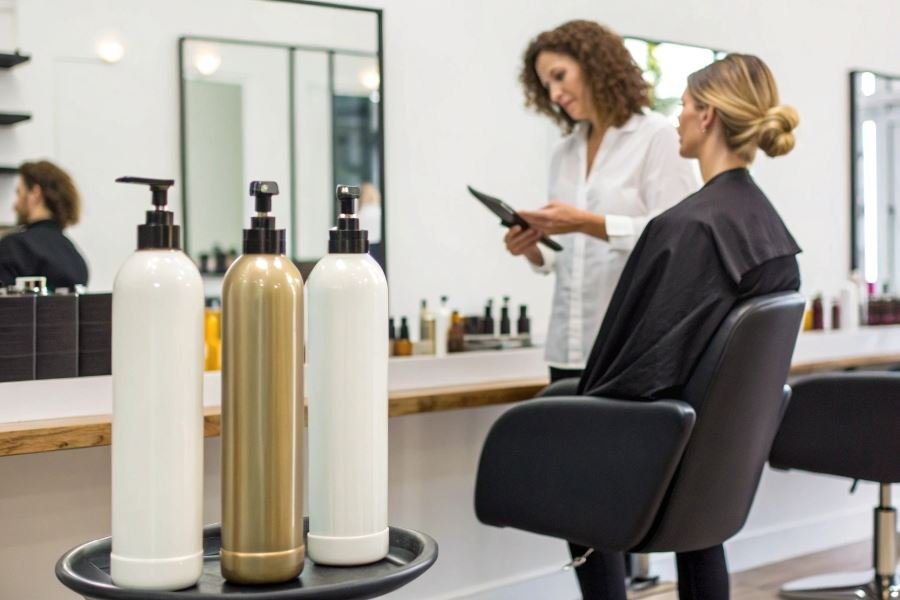
Product efficiency begins with proper application techniques. Implementing a structured training program can reduce shampoo waste by up to 30% while improving client experience:
-
Precise dispensing systems – Install wall-mounted dispensers calibrated to release the optimal amount. This simple change has shown to reduce consumption by 22% in multi-station salons.
-
Pre-emulsification technique – Train stylists to emulsify shampoo between palms before application. This creates more effective lather with less product and ensures even distribution.
-
Water temperature optimization – Lukewarm water (approximately 100°F) activates most professional shampoo formulations more effectively than hot water, which can strip natural oils and require additional product for rebalancing.
Quarterly refresher training sessions keep techniques sharp and provide opportunities to introduce new efficiency methods as they emerge.
The financial impact of smart shampoo systems
The numbers tell a compelling story about long-term investment in efficient shampoo systems:
A mid-sized salon performing approximately 500 shampoo services monthly can expect to save between 4, 800−6,200 annually by switching to economical professional brands and implementing proper usage protocols. This calculation factors in:
- Reduced product consumption (25-30% less product used per service)
- Decreased inventory carrying costs
- Lower shipping expenses due to less frequent ordering
- Minimized product waste from over-dispensing
The most overlooked benefit? Time efficiency. Properly trained staff using optimized products complete the shampoo service 2-3 minutes faster, potentially allowing for an additional client per day per station.
Beyond direct cost savings, salons implementing efficient shampoo systems report higher client satisfaction scores, with particular improvement in scalp comfort and hair manageability metrics – factors that directly influence rebooking rates and retail product sales.
Discover the top 5 salon shampoos that deliver maximum ROI through optimal concentration, reduced waste, and bulk purchasing options. Learn how to calculate cost per wash and train staff for efficient product usage to boost your salon's bottom line.
Discover the top 5 salon shampoos that deliver maximum ROI through optimal concentration, reduced waste, and bulk purchasing options. Learn how to calculate cost per wash and train staff for efficient product usage to boost your salon's bottom line.