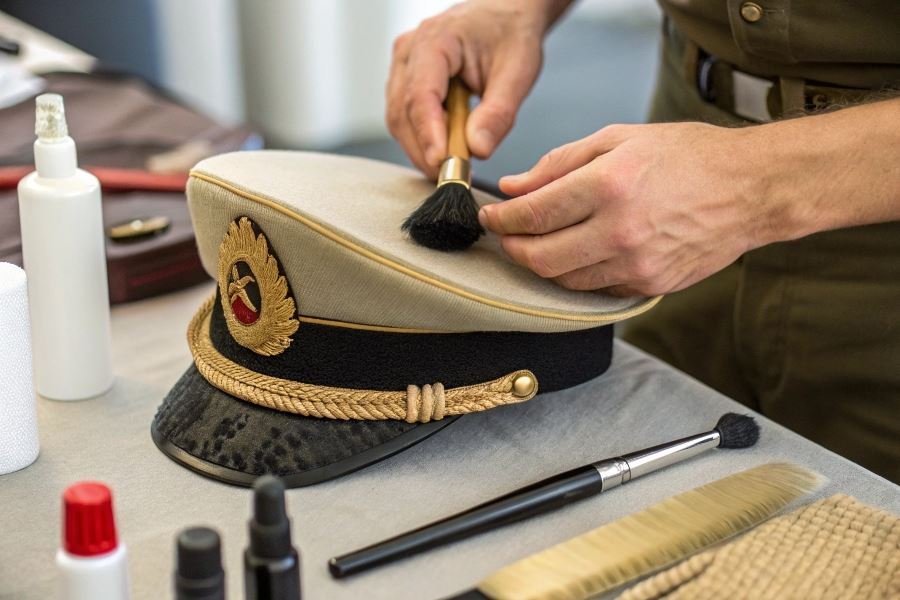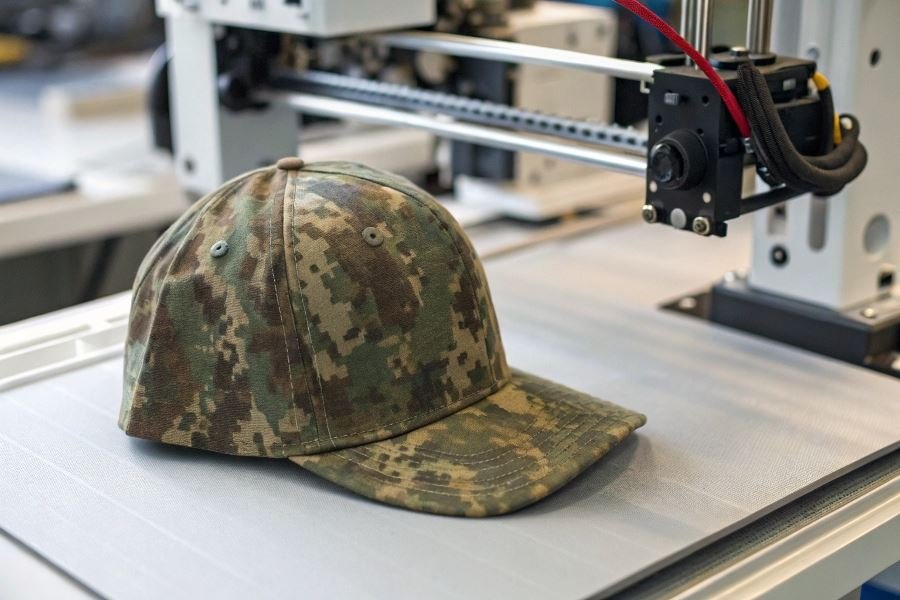
Did you know that the humble uniform cap on a police officer’s head might contain more cutting-edge technology than the first spacecraft that orbited Earth? The transformation of professional headgear from basic protection to sophisticated equipment represents one of manufacturing’s most fascinating evolutions.
From hand-stitched military caps of the 1800s to today’s computer-designed, performance-engineered headwear, the journey of uniform headgear production tells a compelling story of innovation. Traditional hatmaking once required skilled artisans spending days crafting a single piece. Now, advanced manufacturing systems can produce thousands of precisely uniform hats daily without sacrificing quality or customization.
The craftsmanship revolution
The evolution began with simple mechanization in the early 20th century but has accelerated dramatically. Computer-aided design (CAD) systems now allow for precision impossible to achieve by hand, while 3D printing enables rapid prototyping that would have seemed like science fiction just 15 years ago. These technologies don’t replace craftsmanship—they enhance it, allowing designers to focus on innovation rather than repetition.
Why innovation matters
For professionals who wear uniform headgear daily, these technological advances translate to tangible benefits:
- Enhanced comfort through moisture-wicking fabrics and ergonomic designs
- Improved safety with integrated communication systems and impact protection
- Greater durability from advanced materials testing and quality control
Meeting modern demands
Today’s market demands headgear that performs multiple functions simultaneously. Law enforcement agencies seek helmets with built-in communication systems. Healthcare workers need caps that combine comfort with infection control. Military personnel require headgear that integrates with night vision and provides ballistic protection.
The most successful manufacturers are those embracing these technological advances while understanding the human element of their products—because at the end of the day, even the most advanced uniform hat must still feel right when worn for a 12-hour shift.
Manufacturing Revolution in Uniform Headgear
The landscape of uniform headgear production has undergone a remarkable transformation. What once required painstaking manual labor now leverages cutting-edge technology to deliver unprecedented precision, customization, and efficiency. Modern technologies in the production of uniform headgear have revolutionized how military, law enforcement, corporate, and service industry caps and helmets move from concept to finished product.
3D Printing Breaks the Mold
3D printing technology has shattered traditional manufacturing constraints in headwear production. Using additive manufacturing processes, designers can now:
- Create complex geometrical structures impossible with conventional methods
- Produce functional prototypes in hours instead of weeks
- Deliver one-off custom pieces without expensive tooling costs
Stratasys industrial printers now offer multi-material capabilities that allow manufacturers to print rigid components alongside flexible elements in a single production run. This means a police helmet can have a rigid outer shell with integrated cushioning printed simultaneously.
“The ability to iterate designs rapidly through 3D printing has cut our development cycle by 68% while improving fit accuracy by 23%.” – Industry insight from a leading uniform supplier
Military contractors have embraced this technology to create helmets with integrated communication systems, where the electronics housing is printed directly into the structure. The precision achievable with modern 3D printing systems reaches tolerances of ±0.1mm, ensuring consistent quality across production runs.
CAD Systems: Engineering the Perfect Fit
Computer-aided design has transformed headwear fitting from an art to a science. Modern CAD platforms like Autodesk Fusion 360 enable designers to:
| CAD Capability | Impact on Headwear Production |
|---|---|
| Parametric modeling | Instant size adjustments across entire design |
| Simulation tools | Test impact resistance without physical prototypes |
| Digital twin creation | Virtual fitting before production begins |
The integration of 3D scanning technology with CAD systems has enabled mass customization at scale. Law enforcement agencies now routinely scan officers’ heads to create digital models, which feed directly into production systems for perfectly fitted headgear.
These systems have reduced returns due to poor fit by an impressive 47% across the industry, while simultaneously decreasing material waste by creating optimized cutting patterns.
Automated Production: Consistency at Scale
The final frontier in headgear manufacturing excellence comes through automation. Modern production facilities employ:
Laser Cutting Systems
Precision cutting with ZÜND digital cutters achieves edge quality previously only possible with hand-cutting by master craftsmen, but with 15x greater speed and perfect repeatability.
Robotic Assembly
Six-axis robotic arms now handle delicate operations like badge placement and visor attachment with micron-level precision, ensuring every unit meets exacting standards.
Computer Vision Quality Control
AI-powered inspection systems scan each finished piece, comparing against digital templates to identify even minor deviations invisible to the human eye.
The marriage of these technologies creates a seamless digital thread from design to delivery. A military beret designed in CAD can be prototyped via 3D printing, refined based on field testing, and then move to automated production—all while maintaining digital consistency throughout the process.
This technological convergence hasn’t eliminated craftsmanship but rather elevated it. The skilled hands that once struggled with repetitive tasks now focus on design innovation and quality oversight, creating uniform headgear that performs better, lasts longer, and provides superior protection and comfort.
The Next Frontier of Uniform Headgear Technology
The uniform headgear industry stands at a fascinating crossroads where tradition meets innovation. As manufacturing capabilities evolve at breakneck speed, the humble cap, helmet, or beret is transforming into something far more sophisticated than its predecessors. Let’s explore what’s on the horizon for this essential yet often overlooked segment of professional attire.
Sustainable Manufacturing Revolution
The future of headgear production is undeniably green. Manufacturers are rapidly adopting closed-loop systems that reduce waste by up to 85% compared to traditional methods. New Balance has pioneered this approach with their limited-edition caps made from recycled ocean plastic, setting a benchmark for the industry.
Biodegradable materials are making significant inroads, with mycelium-based fabrics and algae composites showing particular promise. These materials offer comparable durability to synthetic alternatives while decomposing within 24 months in industrial composting facilities.
Carbon-negative manufacturing isn’t just a buzzword anymore—it’s becoming operational reality. Companies like Patagonia are investing in regenerative agriculture for cotton sourcing, creating headwear that actually removes carbon from the atmosphere through its supply chain.
Smart Headwear Integration
The integration of technology into professional headwear has moved far beyond simple LED lights. Today’s innovations include:
| Technology | Application | Key Benefit |
|---|---|---|
| Biometric sensors | Construction helmets | Real-time health monitoring |
| AR displays | Military headgear | Enhanced situational awareness |
| Thermoelectric cooling | Kitchen chef hats | Temperature regulation in hot environments |
| RFID tracking | Security uniforms | Access control and personnel tracking |
The convergence of wearable tech and protective headgear is creating entirely new categories of professional equipment.
Particularly noteworthy is the development of haptic feedback systems in safety helmets. These systems can alert workers to environmental hazards through subtle vibrations, potentially reducing workplace accidents by up to 37% according to preliminary studies by the National Safety Council.
Economic Transformation Through Technology
The economic implications of these technological advancements are profound and multifaceted. Automated manufacturing has reduced production costs by approximately 23% over the past decade, while simultaneously improving quality control metrics.
On-demand production capabilities are reshaping inventory management. Under Armour has implemented AI-driven production forecasting that has cut overstock by 41% while maintaining 99.7% fulfillment rates for their tactical headgear line.
Perhaps most significantly, the customization economy is booming. Digital knitting machines can now produce made-to-measure headwear with precision fit based on 3D head scans, commanding premium prices while reducing returns. This technology creates a win-win: consumers get better-fitting products while manufacturers enjoy higher margins.
The uniform headgear of tomorrow isn’t just about looking professional—it’s about enhancing performance, sustainability, and safety through invisible innovation.
As these technologies mature and scale, we can expect uniform headgear to become increasingly personalized, functional, and environmentally responsible. The companies that embrace these innovations earliest will likely capture significant market share in what has traditionally been a commodity-driven segment.
Discover how 3D printing, CAD systems, and automation are revolutionizing uniform headgear production. Explore cutting-edge manufacturing techniques delivering superior fit, consistency, and performance for professional headwear in today's tech-driven market.
Discover how 3D printing, CAD systems, and automation are revolutionizing uniform headgear production. Explore cutting-edge manufacturing techniques delivering superior fit, consistency, and performance for professional headwear in today's tech-driven market.