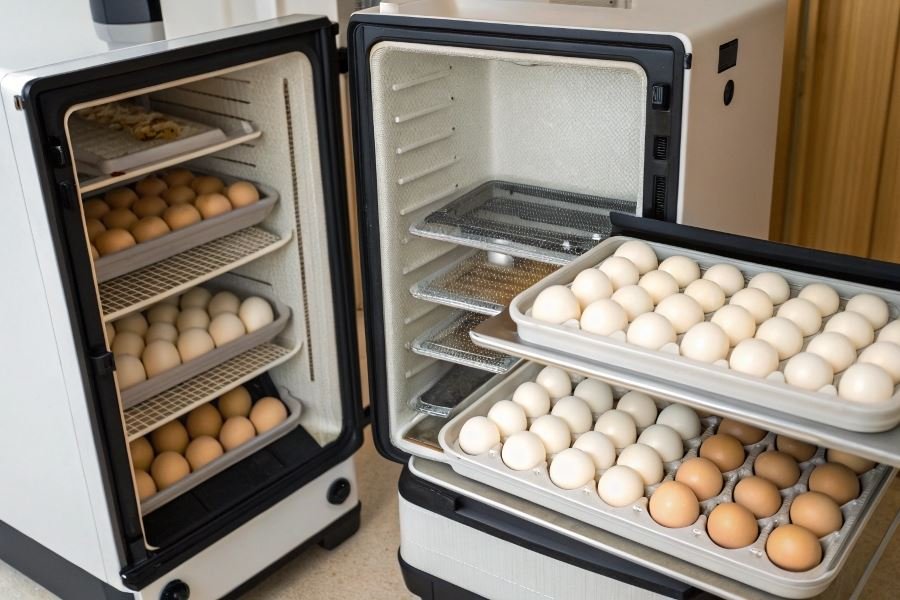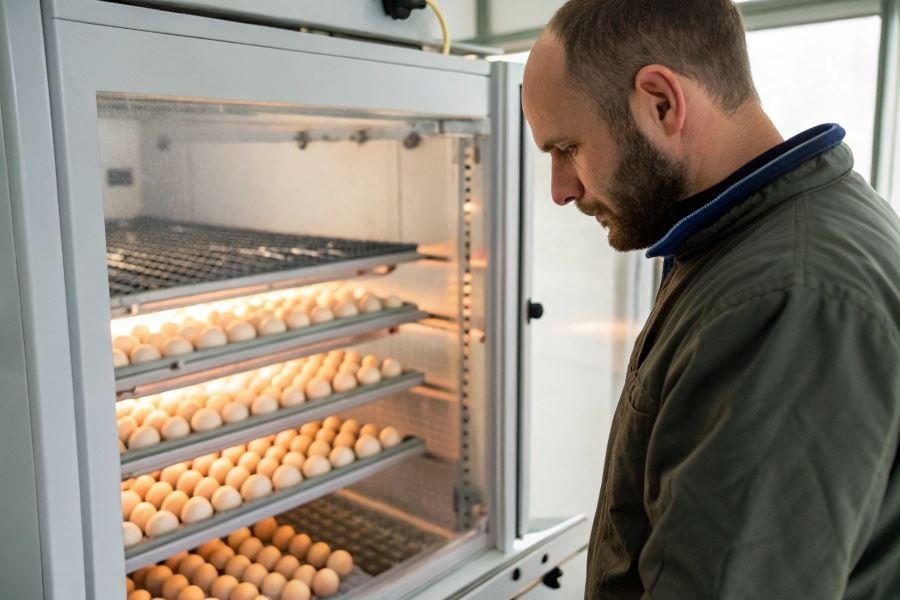
Ever watched a successful farmer pull out tray after tray of healthy chicks while you’re still struggling with disappointing hatch rates? The difference often isn’t luck—it’s equipment selection. The humble incubator, that temperature-controlled box that transforms eggs into livestock, might be the most underappreciated piece of farm equipment affecting your bottom line.
When selecting an incubator for your farm operation, you’re essentially choosing the birthplace for thousands of future animals. This decision directly impacts not just hatch rates but also the vigor of your newly hatched livestock and, ultimately, your farm’s profitability. A 5% improvement in hatch rates can translate to thousands of dollars in additional revenue for medium-sized operations.
Incubator types have evolved dramatically over the past decade. Today’s market offers everything from small cabinet models perfect for specialty breeders to massive industrial setups capable of handling 100,000+ eggs simultaneously. The spectrum includes:
- Forced-air incubators with powerful fans for consistent temperature distribution
- Still-air models preferred by heritage breed enthusiasts
- Automatic turning systems that mimic a mother hen’s natural behavior
- Smart incubators with remote monitoring capabilities
The profitability equation
The math is straightforward: Higher hatch rates + healthier hatchlings = greater farm productivity. What’s less obvious is how the right incubator creates a cascade of benefits. Properly hatched animals typically show improved feed conversion rates, better disease resistance, and ultimately command premium prices at market.
As one Nebraska poultry farmer discovered, upgrading from a basic model to a precision-controlled incubator increased his operation’s annual revenue by nearly $37,000—all from the same number of eggs.
Technical Essentials That Make or Break Your Incubator
When evaluating incubators for your farm operation, the technical specifications aren’t just numbers on a spec sheet—they’re the difference between consistent hatching success and frustrating failure. The most successful farmers understand that selecting the right incubation equipment requires careful consideration of several critical technical factors that directly impact hatch rates and overall efficiency.
Establishing proper criteria for choosing an incubator for a farm begins with understanding the technical capabilities that will support your specific production needs. Unlike household models, farm-scale incubators must deliver commercial-grade performance with precision that matches or exceeds what nature provides.
Temperature Regulation: The Non-Negotiable Factor
Temperature control is arguably the most critical aspect of any incubation system. Modern high-performance incubators like the Brinsea OvaEasy maintain temperature consistency within ±0.1°F throughout the incubation chamber—a remarkable feat of engineering that directly translates to improved hatch rates.
What separates premium models from basic units:
- Digital microprocessor control that makes thousands of minute adjustments hourly
- Multiple temperature sensors strategically positioned throughout the chamber
- Proportional heating systems that prevent harmful temperature spikes
- Automatic temperature calibration capabilities that maintain accuracy over time
Temperature uniformity matters as much as accuracy. In larger cabinet-style incubators, forced-air circulation systems ensure that every egg experiences identical conditions regardless of position within the chamber.
Humidity Management: The Moisture Balancing Act
Humidity control represents the second pillar of successful incubation. Eggs lose approximately 13-15% of their initial weight through moisture evaporation during incubation—a process that must be precisely managed.
Advanced humidity systems offer:
- Automatic water reservoirs with continuous monitoring
- Programmable humidity profiles for different species and stages
- Evaporation rate tracking to ensure proper weight loss
- Recovery mechanisms that quickly restore humidity after door openings
| Incubation Stage | Ideal Humidity Range | Critical Concerns |
|---|---|---|
| Early (Days 1-18) | 45-50% RH | Too dry: excessive weight loss |
| Late (Days 18-21) | 65-70% RH | Too humid: difficult hatching |
| Hatching | 70-75% RH | Fluctuations: sticky chicks |
The most sophisticated units incorporate ultrasonic humidifiers rather than passive evaporation systems, allowing for rapid humidity adjustments without temperature fluctuations—a significant advantage during critical hatching periods.
Capacity Planning: Matching Scale to Production Goals
Determining appropriate incubator capacity requires balancing current needs against future growth plans. Commercial producers typically calculate capacity requirements using this formula:
Required capacity = (Annual production goal ÷ Hatch cycles per year) × 1.2 (buffer)
The most versatile farm incubators offer:
- Modular expansion capabilities that grow with your operation
- Multi-stage hatching options for continuous production
- Efficient space utilization with high egg-to-footprint ratios
- Separate hatching compartments to prevent cross-contamination
When evaluating capacity, consider not just egg quantity but handling ergonomics. The GQF Manufacturing cabinet incubators feature sliding trays that reduce handling stress and improve workflow efficiency—a crucial consideration for operations processing thousands of eggs weekly.
Remember that oversizing incubation capacity typically proves less problematic than undersizing, particularly for growing operations. The most successful farm incubation systems allow for production scalability without requiring complete equipment replacement as your operation expands.
Operational Excellence in Farm Incubation
When your farm’s future depends on successful hatching, the operational aspects of your incubator become mission-critical factors. Beyond basic specifications, how your incubator performs day-to-day determines both your sanity and your profit margins.
Energy efficiency that protects your bottom line
Modern incubators have made remarkable strides in energy consumption. The most efficient models now use up to 40% less electricity than their predecessors from just a decade ago. This efficiency isn’t just good for the environment—it translates directly to your operational budget.
Premium incubators like the Brinsea OvaEasy series incorporate advanced insulation materials and precision-controlled heating elements that activate only when necessary. These smart systems maintain perfect temperature with minimal energy expenditure.
The math is simple: a 20% reduction in energy consumption for a commercial incubator running continuously can save upwards of $500 annually.
When evaluating energy efficiency, look beyond the manufacturer’s claims. Request actual consumption data in kilowatt-hours and calculate your projected costs based on local utility rates. Some manufacturers now include an estimated annual operating cost based on average usage patterns—a valuable metric for comparison shopping.
Maintenance requirements that won’t consume your day
Nothing derails productivity faster than equipment that demands constant attention. The best incubators are designed with cleaning and maintenance in mind.
Key maintenance-friendly features to prioritize:
- Removable trays with non-stick surfaces
- Smooth interior walls without crevices where bacteria can hide
- Water reservoirs that are accessible without disrupting the incubation environment
- Modular components that can be individually replaced if failures occur
The GQF Manufacturing commercial incubators feature tool-free access panels and antimicrobial interior coatings that significantly reduce cleaning time between batches. This design philosophy recognizes that every hour spent on maintenance is an hour not spent on more productive farm activities.
Automation that transforms monitoring into management
The difference between basic and advanced incubators often comes down to their automation capabilities. While entry-level models require manual adjustments and constant vigilance, sophisticated systems handle the minute-to-minute operations independently.
| Automation Feature | Benefit | Impact on Operations |
|---|---|---|
| Automatic egg turning | Eliminates manual turning 3-5 times daily | Saves 30+ minutes daily; improves hatch rates by 15-20% |
| Humidity regulation | Maintains optimal moisture levels | Reduces monitoring time; prevents shell adhesion issues |
| Temperature variance alarms | Immediate notification of potential problems | Prevents catastrophic batch losses from equipment failure |
| Remote monitoring via smartphone | Real-time status updates anywhere | Allows management from off-site; reduces stress during critical periods |
The Jamesway Platinum series exemplifies this approach with its integrated monitoring system that not only tracks current conditions but also analyzes performance trends over time. This predictive capability allows operators to identify and address potential issues before they impact hatch rates.
Advanced monitoring doesn’t just save time—it fundamentally changes how you interact with the incubation process. Rather than constantly checking and adjusting, you’re empowered to make data-driven decisions based on comprehensive performance metrics.
When selecting an incubator with these operational criteria in mind, remember that the initial purchase price represents only a fraction of your total investment over the equipment’s lifespan. The truly cost-effective choice balances acquisition cost against operational efficiency, maintenance requirements, and the value of your time.
Discover the 7 critical criteria for selecting the perfect farm incubator to maximize hatch rates and profitability. Learn about temperature regulation, humidity control, capacity considerations, and energy efficiency features that ensure successful hatching operations.
Discover the 7 critical criteria for selecting the perfect farm incubator to maximize hatch rates and profitability. Learn about temperature regulation, humidity control, capacity considerations, and energy efficiency features that ensure successful hatching operations.