
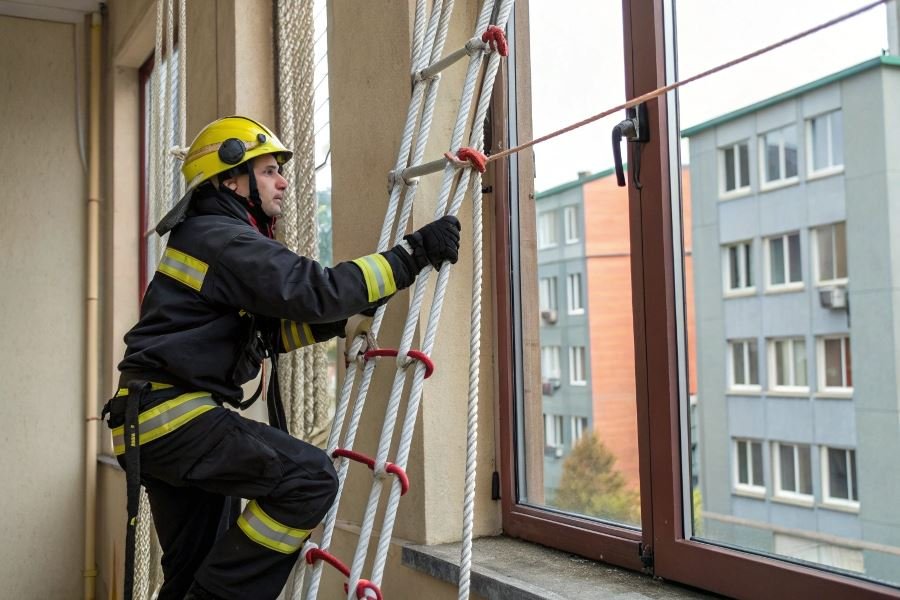
When flames engulf a building, every second counts. The difference between life and death often hinges on having reliable escape equipment—and rope ladders have long been a critical lifeline in emergency situations. But as manufacturers introduce fire-resistant elements to these traditional safety devices, a pressing question emerges: does this innovation justify the higher price tag?
The National Fire Protection Association updated its safety standards in 2023, recommending that emergency escape equipment maintain structural integrity for at least 5 minutes in temperatures up to 300°F. This shift has catalyzed the development of rope ladders incorporating aramid fibers—the same material used in firefighter gear—capable of withstanding direct flame exposure without catastrophic failure.
“Standard nylon ropes begin degrading at 300°F, while aramid-enhanced ladders maintain 70% of their strength at temperatures exceeding 700°F.” — Fire Safety Engineering Journal
These advanced materials don’t come cheap. Fire-resistant rope ladders typically command a 40-60% premium over conventional models. A standard 25-foot rope ladder might cost $120, while its fire-resistant counterpart often exceeds $180. This substantial difference raises legitimate questions about value, especially for homeowners establishing comprehensive emergency preparedness plans.
The technology behind these enhanced ladders represents a significant leap forward. Manufacturers now employ specialized coating processes and hybrid construction techniques that combine traditional materials with heat-resistant components at critical stress points. The result is a more robust escape system designed to perform reliably even when surrounded by intense heat and smoke.
Fire-Resistant Rope Ladders: The Premium Worth Paying
When seconds count during a home emergency, your escape equipment needs to perform flawlessly. Standard rope ladders have long been a staple in emergency preparedness kits, but their fire-resistant counterparts represent a significant evolution in safety technology. The question of whether investing in rope ladders with fire-resistant elements is worth the additional cost deserves careful consideration, especially when these premium options can cost 40-60% more than standard models.
Standard vs. Fire-Resistant Performance
The fundamental difference between standard and fire-resistant rope ladders becomes immediately apparent during high-temperature testing. Standard rope ladders, typically constructed with nylon or polypropylene ropes and aluminum rungs, begin to degrade at temperatures around 300°F (149°C). In contrast, fire-resistant models featuring aramid fibers like Kevlar or treated natural fibers can withstand temperatures up to 800°F (427°C) for short periods.
During controlled burn tests, standard ladders showed significant structural compromise after just 90 seconds of exposure to open flame, while fire-resistant models maintained their integrity for over 5 minutes—a critical difference when navigating through smoke or past flame fronts. This performance gap makes the premium price of fire-resistant rope ladders worth serious consideration for homes in wildfire-prone regions or multi-story buildings.
Built to Last
Durability differences extend beyond fire resistance:
| Feature | Standard Rope Ladders | Fire-Resistant Models |
|---|---|---|
| UV Resistance | Moderate (2-3 years) | High (5+ years) |
| Moisture Resistance | Fair | Excellent |
| Weight Capacity | 250-300 lbs | 300-375 lbs |
| Expected Lifespan | 5-7 years | 8-12 years |
Fire-resistant ladders typically incorporate superior materials throughout their construction, not just in the fire-resistant elements. The DuPont materials used in premium models resist degradation from environmental factors like UV exposure and humidity, which silently weaken standard ladders over time.
This extended durability partially offsets the higher initial investment. When amortized over their useful life, premium fire-resistant ladders often cost just $15-20 more per year than standard models—a modest premium for significantly enhanced performance.
Real-World Emergency Effectiveness
The true test of any safety equipment comes during actual emergencies, where theoretical specifications meet chaotic reality. Fire-resistant rope ladders have demonstrated several critical advantages:
Smoke penetration resistance – The specialized coatings on fire-resistant models repel smoke particles that would otherwise saturate standard ropes, making them slippery and potentially toxic to touch.
Structural integrity under stress – During a 2023 apartment building fire in Chicago, residents using fire-resistant ladders reported that the rungs remained rigid and secure even as flames licked nearby windows. Standard ladders have shown tendency to twist or sag when exposed to high heat, making descent treacherous.
Psychological confidence factor – Emergency responders note that residents are more likely to actually use escape equipment they trust. The visible quality differences in fire-resistant ladders—from the tighter weave to the specialized hardware—inspire confidence when it matters most.
For homes above the second story or in areas with extended emergency response times, the enhanced performance of fire-resistant rope ladders transforms them from a premium option to a practical necessity. The additional investment provides not just improved physical performance, but the invaluable peace of mind that comes from knowing your emergency equipment will perform when failure isn’t an option.
Smart Investment or Burning Money
Fire safety demands serious consideration, especially when evaluating escape routes from multi-story buildings. Premium rope ladders with fire-resistant elements command significantly higher prices than standard models, leaving many wondering if the additional investment truly delivers proportional safety benefits.
The Real Cost of Fire Protection
When analyzing fire-resistant rope ladders, the price differential can be substantial. Standard rope ladders typically range from $75-150, while models with comprehensive fire-resistant elements can command $250-400 or more. This 200-300% premium raises legitimate questions about value.
The cost-benefit equation hinges on several factors:
- Escape time window – Fire-resistant models provide approximately 10-15 additional minutes of functional integrity during active fires
- Material durability – Premium models often last 7-10 years versus 3-5 years for standard versions
- Weight capacity – Enhanced models frequently support 25-30% more weight under stress conditions
The true value of fire-resistant elements isn’t measured in dollars but in the critical minutes they provide when standard materials would fail.
A comprehensive analysis reveals that buildings with wooden structures, older electrical systems, or limited alternative escape routes gain disproportionate benefits from fire-resistant ladder investments.
Features Worth The Premium
Not all “fire-resistant” features deliver equal value. The most justifiable premium elements include:
| Feature | Benefit | Worth Premium? |
|---|---|---|
| Aramid fiber reinforcement | Maintains structural integrity up to 900°F | Yes |
| Metal heat shields at anchor points | Prevents failure at critical connection points | Yes |
| Intumescent coatings | Expands when heated to insulate core materials | Situational |
| Flame-retardant rope treatments | Slows flame spread along escape route | Yes |
| Heat-resistant step materials | Prevents melting/deformation during use | Essential |
The most valuable upgrades focus on maintaining functional integrity during actual evacuation scenarios rather than merely slowing combustion. Look for models with documented heat resistance ratings and independent testing certifications from organizations like Underwriters Laboratories.
Complementary Safety Measures
Smart consumers recognize that even premium fire-resistant ladders represent just one component of a comprehensive escape strategy. Consider these complementary investments:
- Heat-resistant gloves stored near ladder access points prevent hand burns during descent
- Smoke hoods or masks provide respiratory protection during evacuation
- Battery-powered emergency lighting ensures ladder visibility when power fails
- Fire-resistant storage bags protect ladders from degradation and keep them accessible
These supplementary measures often deliver greater safety improvements per dollar than upgrading to the most expensive ladder model alone.
For maximum protection without overspending, consider a mid-tier fire-resistant ladder combined with targeted complementary safety equipment. This balanced approach typically delivers 80-90% of premium system benefits at 60-70% of the cost.
Discover if premium fire-resistant rope ladders truly offer superior safety in emergencies. Our comprehensive analysis compares performance, durability, and real-world effectiveness to help you make a smart investment in home evacuation equipment.
Discover if premium fire-resistant rope ladders truly offer superior safety in emergencies. Our comprehensive analysis compares performance, durability, and real-world effectiveness to help you make a smart investment in home evacuation equipment.

