Did you know that a firearm is stolen in America approximately every two minutes? That’s over 250,000 guns falling into unauthorized hands annually—a statistic that should give every responsible gun owner pause.
Responsible gun ownership extends far beyond the purchase. It demands thoughtful, secure storage solutions that protect both your investment and your loved ones. Gun safes aren’t just metal boxes—they’re the critical infrastructure of responsible firearm ownership, combining legal compliance with practical protection.
The legal landscape for gun storage varies dramatically across the United States. While federal law primarily addresses dealer requirements and child access prevention, state regulations create a patchwork of obligations. California leads with some of the strictest requirements, mandating that all firearms be stored in locked containers or disabled with safety devices when not in use. Massachusetts similarly requires all firearms to be secured in locked containers when not under direct control. Meanwhile, states like Texas and Arizona take more permissive approaches, though liability concerns remain universal.
“Proper storage isn’t just about following laws—it’s about preventing tragedies before they happen.”
The numbers tell a compelling story:
| Statistic | Impact |
|---|---|
| 4.6 million | American children living in homes with unlocked, loaded firearms |
| 54% | Reduction in youth suicide risk with proper gun storage |
| 380,000+ | Guns stolen from private owners annually |
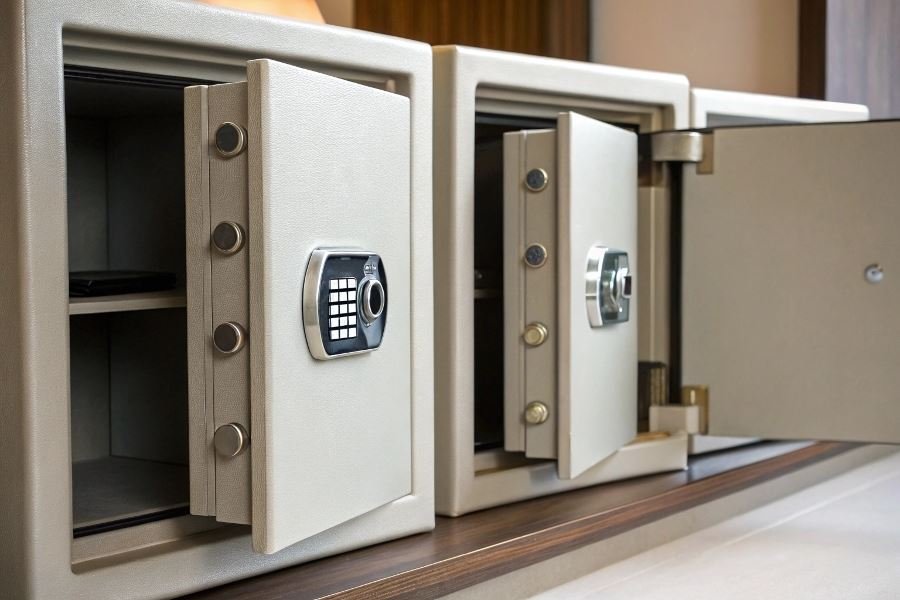
Beyond legal compliance, quality gun safes offer protection against fire damage, unauthorized access, and theft—preserving both your collection and peace of mind. Modern safes combine sophisticated locking mechanisms with fire-resistant construction, ensuring your firearms remain exactly where you placed them, accessible only to those you’ve authorized.
Building the Ultimate Fortress for Your Firearms
When securing your firearms, compromise isn’t an option. The market offers countless gun safe solutions, but understanding the technical requirements and recommendations separates adequate protection from exceptional security. Gun safes: requirements and recommendations encompass everything from fire resistance to biometric access, with each feature serving a critical role in protecting your valuable collection.
Fire Protection That Actually Works
Fire protection ratings in gun safes aren’t just marketing—they’re measured in minutes of survival at specific temperatures. Industry standards typically range from 30 minutes to 120 minutes at temperatures between 1200°F and 1850°F.
The Underwriters Laboratories (UL) Class 350 rating remains the gold standard, ensuring internal temperatures stay below 350°F—critical since gun damage begins at approximately 400°F and ammunition becomes unstable around 500°F.
A quality gun safe doesn’t just survive a fire—it shields your collection from the invisible enemy of humidity that follows firefighting efforts.
For serious collectors, look for safes with intumescent door seals that expand during fires and multiple layers of fireboard in the walls. Remember that a “fire-resistant” label without specific time and temperature ratings should raise immediate red flags.
Access Control: Balancing Security and Accessibility
Modern lock mechanisms offer three primary options, each with distinct advantages:
| Lock Type | Security Level | Access Speed | Power Dependency | Cost Range |
|---|---|---|---|---|
| Biometric | High | Fastest (1-2 sec) | Yes (with backup) | 300−1500+ |
| Electronic Combination | High | Medium (3-5 sec) | Yes (with backup) | 200−800 |
| Mechanical Combination | Very High | Slowest (8-15 sec) | None | 150−600 |
| Key | Medium | Medium | None | 100−300 |
Biometric systems from manufacturers like Liberty Safe have evolved dramatically, with false rejection rates below 1% and the ability to store multiple fingerprints. Many premium models now incorporate redundant access methods—fingerprint scanner primary with backup keypad or mechanical override.
Sizing Your Safe: Think Tomorrow, Not Today
The most common regret among gun safe owners? Insufficient capacity. Industry experts recommend purchasing a safe with at least 50% more capacity than your current collection requires.
Consider these practical guidelines:
- Long guns require approximately 4-6 inches of width each
- Scoped rifles need additional clearance
- Tactical firearms with attachments demand even more space
- Handguns can be stored on door organizers but count toward total capacity
Interior dimensions matter more than exterior measurements. Wall thickness in premium safes can reduce internal space by 4-8 inches in each dimension.
Construction That Defeats Determined Attacks
Steel gauge numbers work inversely—lower numbers mean thicker steel. Premium safes feature:
- Body construction: 10-gauge (3.4mm) or thicker steel
- Door construction: 1/4-inch to 1/2-inch solid steel plate
- Continuous welding (not spot welding)
- Relockers that trigger additional bolts if the lock is attacked
The Underwriters Laboratories also provides theft resistance ratings from RSC (Residential Security Container) through TL-30×6, with each level representing minutes of resistance against specific tools and attack methods.
Anti-pry protection deserves special attention—look for extended locking bolts (minimum 1-inch diameter) on all four sides of the door, with at least three bolts on the hinge side to prevent door removal if hinges are compromised.
When evaluating construction quality, weight serves as a reliable indicator—a truly secure full-size gun safe should weigh at least 500 pounds empty, making it difficult to remove without specialized equipment.
Gun Safe Solutions for Every Need
Home Defense Quick Access Options
When seconds count, your defensive firearm needs to be both secure and rapidly accessible. The Vaultek VT20i biometric safe represents the gold standard for bedside protection, featuring fingerprint recognition that works in under 2 seconds while maintaining robust security. Its compact design houses a single handgun while fitting discreetly in nightstands.
For those preferring mechanical reliability, the Fort Knox PB1 employs a Simplex push-button lock that never needs batteries yet opens in under 3 seconds. Its 10-gauge steel construction offers impressive durability despite its modest footprint.
The SecureIt Fast Box Model 47 provides a middle ground with its RFID card access system, accommodating a tactical shotgun or AR-15 while maintaining quick deployment capabilities.
Collection Protection Systems
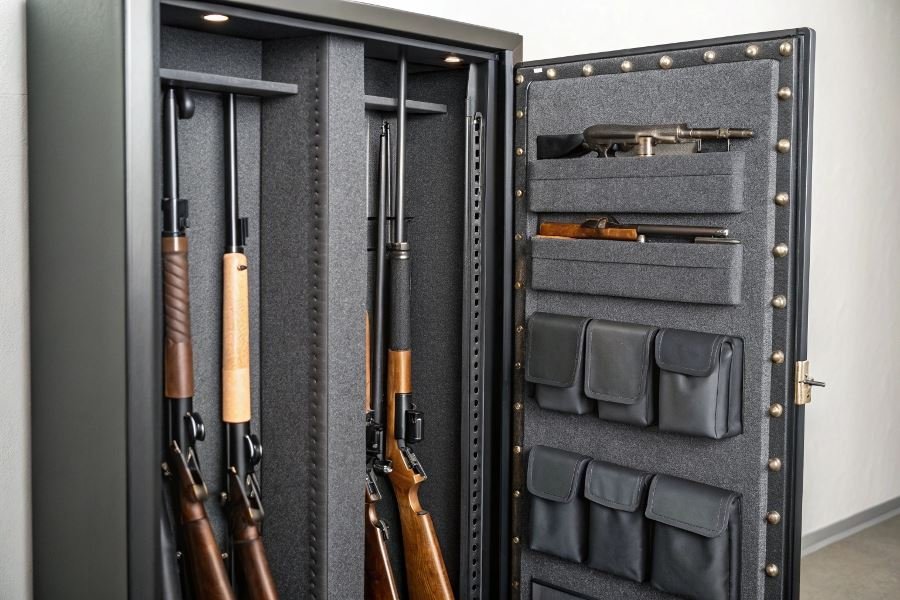
Serious collectors require substantial storage solutions that balance accessibility with comprehensive security. The Liberty Presidential 50 stands as a fortress for firearms, housing up to 45 long guns with adjustable shelving and door organizers. Its 90-minute fire protection and 11-gauge steel construction justify its premium positioning.
For dedicated enthusiasts with diverse collections, the Browning Prosteel Platinum Plus offers specialized storage for both modern and historical firearms with humidity control systems and customizable LED lighting that showcases prized possessions while keeping them secure.
The Winchester Ranger Deluxe provides an excellent middle-tier option with capacity for 26 long guns and convertible shelving for handguns and accessories, featuring a mechanical lock with electronic backup.
Budget-Conscious Security
Meeting safety requirements doesn’t demand emptying your bank account. The Stack-On 18-Gun Cabinet provides basic security at approximately $250, featuring key lock entry and welded steel construction that satisfies storage requirements in many jurisdictions.
For handgun owners, the Hornady RAPiD Safe offers RFID technology at around $175, providing quick access while maintaining child-resistant security features that exceed basic safety standards.
The Steelwater Standard Duty 16 delivers remarkable value at under $800, offering fire protection and drill-resistant hardplate that approaches premium features at mid-range pricing.
Strategic Placement Considerations
Location fundamentals should prioritize:
- Concealment from casual observation
- Structural support (floor joists for larger safes)
- Accessibility during emergency situations
- Protection from environmental factors
Anchoring requirements vary by safe type:
| Safe Type | Recommended Anchoring |
|---|---|
| Full-size | Concrete floor bolts (minimum 4) |
| Medium | Wall studs and floor bolts |
| Handgun | Secured to furniture or wall |
For maximum security, position larger safes in corner locations against two walls, preferably in basement areas where concrete floors provide optimal anchoring surfaces. Handgun safes benefit from bedside or office desk placement, balancing accessibility with discretion.
Remember that even the most advanced safe becomes compromised when improperly installed or positioned in vulnerable locations.
The ideal installation creates a balanced ecosystem of security, accessibility, and protection that aligns perfectly with your specific requirements and usage patterns.
Discover essential gun safe requirements for responsible firearm ownership. Learn about fire ratings, lock options, and top recommendations that meet legal standards while keeping your weapons secure from theft and accidents.
Discover essential gun safe requirements for responsible firearm ownership. Learn about fire ratings, lock options, and top recommendations that meet legal standards while keeping your weapons secure from theft and accidents.