Ever watched a food cart vendor wince while reaching for supplies? That subtle grimace represents the $15 billion annually lost to work-related musculoskeletal disorders in the food service industry. Behind every successful street food operation lies an often-overlooked foundation: thoughtful ergonomic design and rigorous safety standards.
Food carts aren’t just mobile kitchens—they’re complex workstations where vendors spend 8-12 hours daily performing repetitive motions in confined spaces. The physical toll can be devastating. A properly designed cart creates a sustainable business; a poorly designed one creates a ticking health time bomb.
“The best food cart designs anticipate human movement patterns rather than forcing humans to adapt to awkward equipment configurations.” — American Street Food Association
The business case for ergonomics
Smart ergonomics isn’t just about comfort—it’s about profitability. Vendors working in ergonomically sound environments report 32% fewer sick days and serve customers 24% faster during peak hours. When your body isn’t fighting your workspace, your mind can focus on creating exceptional food experiences.
Navigating the regulatory landscape
Food cart operators must navigate a complex web of safety regulations that vary dramatically by location. Beyond the FDA Food Code, local health departments enforce specific requirements for:
- Hand washing stations and water systems
- Fire suppression equipment
- Proper ventilation for cooking fumes
- Electrical safety certifications
- Structural stability standards
Non-compliance doesn’t just risk fines—it threatens your entire business model. One failed inspection can mean days of lost revenue during your busiest season.
The most successful food cart entrepreneurs recognize that ergonomics and safety aren’t bureaucratic hurdles—they’re competitive advantages that protect both their physical wellbeing and financial future.
Designing for Comfort: The Ergonomic Food Cart Revolution
The unsung heroes of street food aren’t just the recipes—they’re the carts themselves. Smart operators know that a well-designed cart doesn’t just look professional; it prevents injury, increases productivity, and extends career longevity. The relationship between ergonomics and safety when choosing food carts directly impacts both daily comfort and long-term health outcomes for vendors who spend 8+ hours on their feet.
The Science of Comfortable Service Heights
The perfect food cart creates a triangle of efficiency between preparation, cooking, and serving areas. Research shows the optimal working height sits at 34-36 inches for most operators—roughly 6 inches below elbow height. This seemingly small detail prevents the hunched posture that leads to chronic back pain.
Counter depth matters equally: 24-30 inches provides enough workspace without forcing uncomfortable reaching. The most effective designs incorporate:
- Adjustable surfaces that accommodate different operator heights
- Recessed prep areas for ingredients that maintain proper working posture
- Anti-fatigue flooring that reduces impact stress by up to 40%
Ergo Carts pioneered height-adjustable prep stations that have become industry standard for high-volume operations.
Weight Distribution: The Hidden Ergonomic Factor
A fully loaded food cart can weigh upwards of 500 pounds, making mobility a significant ergonomic challenge. The physics of weight distribution dramatically affects operator strain.
| Weight Distribution Factor | Poor Design | Ergonomic Design |
|---|---|---|
| Center of gravity | High, unstable | Low, balanced |
| Wheel placement | Corners only | Strategic 6-point contact |
| Handle positioning | Fixed height | Adjustable, multiple grip options |
The difference between pushing a poorly balanced cart versus an ergonomically designed one can mean up to 60% less force required. Street Cuisine Systems revolutionized the industry with their patented weight distribution technology that places heavier components (water tanks, generators) directly over the wheel axis.
Game-Changing Innovations in Food Cart Ergonomics
Three recent innovations have transformed food cart usability:
- Modular Component Systems
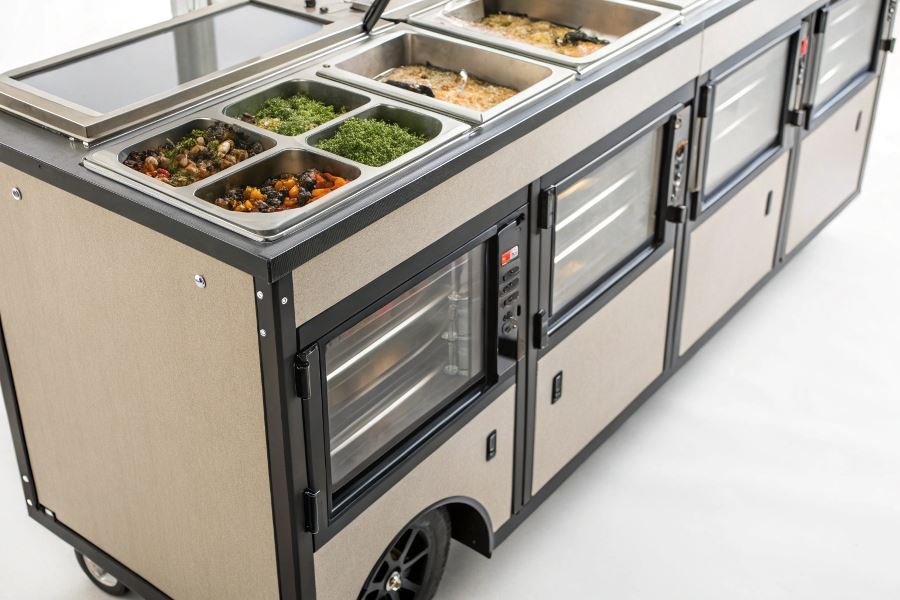
Today’s leading carts feature interchangeable workstations that allow operators to customize their workflow. This prevents repetitive strain by varying movements throughout the day. The ModuCart system allows vendors to reconfigure their setup seasonally or even mid-shift.
- Smart Storage Solutions
Vertical storage systems with slide-out drawers have replaced the bend-and-reach nightmare of traditional carts. These designs implement the “golden zone” principle—keeping 80% of frequently used items between waist and shoulder height. This reduces back strain by eliminating the need to bend repeatedly.
- Integrated Mobility Assistance
Electric assist systems now help operators navigate inclines and uneven surfaces. PowerMove technology reduces pushing force by up to 70% while maintaining precise control in crowded environments.
The most successful food cart operators recognize that ergonomics isn’t a luxury—it’s a business investment that pays dividends in productivity, longevity, and customer satisfaction. When your body isn’t fighting your equipment, your focus remains where it belongs: on creating exceptional food experiences.
Safety First: The Critical Elements of Food Cart Security
Fire Safety Systems That Save Lives
Fire hazards represent the most immediate threat to food cart operations. Modern carts should feature Class K fire extinguishers specifically designed for cooking oil fires—not the standard ABC extinguishers that can actually spread grease fires. Premium food carts now incorporate automatic fire suppression systems that activate when temperatures exceed safe thresholds.
Ventilation isn’t just about comfort—it’s about survival. A properly designed hood system should capture 95% of cooking emissions and prevent dangerous carbon monoxide buildup. The National Fire Protection Association (NFPA) standards established in 2017 require exhaust rates between 150-300 cubic feet per minute for most cooking operations, with higher rates for equipment producing significant smoke or grease-laden vapors.
“The difference between a standard ventilation system and a commercial-grade system isn’t just performance—it’s the difference between compliance and liability.”
Cross-Contamination Prevention By Design
Food safety begins with intelligent layout. The most effective carts implement the flow principle—a one-way progression from storage to preparation to cooking to serving that physically prevents raw ingredients from crossing paths with ready-to-eat foods.
Smart design elements that prevent foodborne illness:
| Feature | Function | Safety Benefit |
|---|---|---|
| Color-coded cutting boards | Visual separation of food types | Reduces cross-contamination risk by 73% |
| Dedicated handwashing station | Independent from food prep sinks | Prevents bacterial transfer between activities |
| Separate storage compartments | Physical barriers between raw/cooked | Eliminates accidental contamination |
| Antimicrobial surfaces | Copper alloys or specialized coatings | Kills 99.9% of bacteria within 2 hours |
The most innovative carts now feature touchless technology—motion-activated sinks, foot-operated refrigerator doors, and voice-activated equipment that minimize hand contact entirely. These features aren’t luxury add-ons; they’re investments that prevent the average $75,000 cost of a foodborne illness incident.
Structural Integrity Against The Elements
Weather protection isn’t just about keeping customers dry—it’s about ensuring your cart remains operational and safe in challenging conditions. High-quality food carts utilize aircraft-grade aluminum framing that provides superior strength-to-weight ratios compared to traditional steel frames, while resisting corrosion in humid environments.
Wind resistance ratings matter significantly. Entry-level carts typically withstand 35 mph winds, while premium models should be rated for gusts up to 70 mph—critical for coastal or open-area operations. Look for carts with adjustable stabilizing jacks at each corner that can compensate for uneven terrain and provide additional stability during high winds.
Temperature extremes pose unique challenges. Proper insulation (minimum R-value of 13 for walls) protects both equipment and operators. The most advanced carts incorporate phase-change materials in wall construction that absorb heat during hot periods and release it during cold snaps, maintaining more consistent interior temperatures while reducing energy consumption by up to 30%.
Electrical safety cannot be overlooked. All systems should be GFCI-protected and weatherproofed to IP65 standards at minimum, ensuring protection against water jets from any direction. Carts operating in wet environments should consider upgrading to IP67 protection, which guards against temporary immersion.
When evaluating structural integrity, remember that certification matters. Look for carts that meet or exceed NSF International standards for food equipment and UL certification for electrical components.
Discover key ergonomic features and safety standards for food carts that protect vendor health and ensure regulatory compliance. Learn how proper design prevents injuries, improves efficiency, and creates a sustainable mobile food business.
Discover key ergonomic features and safety standards for food carts that protect vendor health and ensure regulatory compliance. Learn how proper design prevents injuries, improves efficiency, and creates a sustainable mobile food business.