$42,000 – that’s the average annual revenue a food cart can generate. But for many operators, reaching that potential means overcoming a gauntlet of design limitations that have plagued the industry for years.
Food carts have transformed from simple hot dog stands into sophisticated mobile culinary platforms. The humble cart that once served basic fare has evolved into a compact powerhouse of culinary innovation. Today’s operators face a triple challenge: standing out in a crowded marketplace, maximizing limited space, and meeting increasingly stringent regulations while satisfying customer expectations for restaurant-quality experiences.
The struggle is real
Food cart operators battle daily with inadequate storage, inefficient workflows, and weather vulnerability. Many carts still use designs that haven’t fundamentally changed since the early 2000s, creating a disconnect between modern culinary ambitions and operational realities.
From pushcarts to culinary platforms
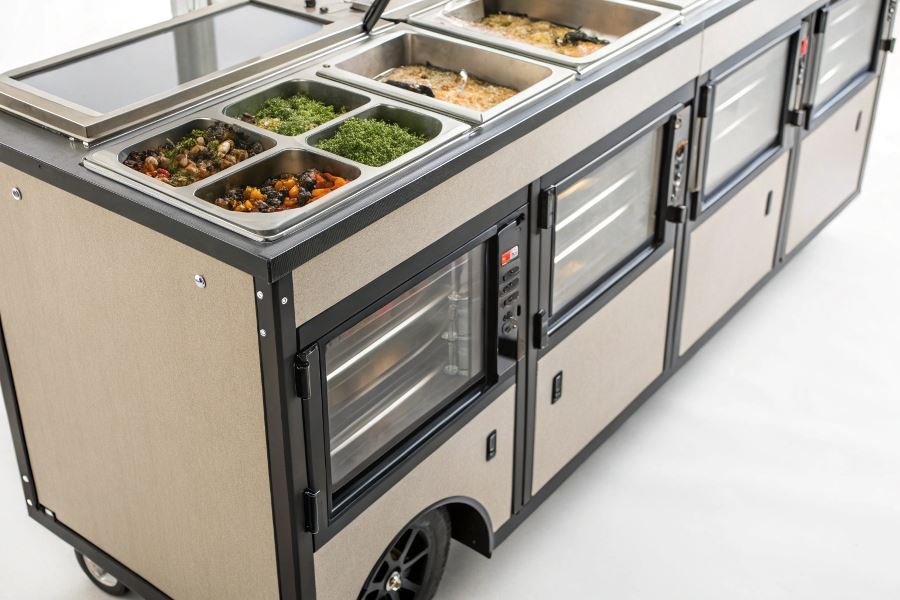
The evolution has been remarkable. Traditional pushcarts with basic heating elements have given way to specialized units featuring:
- Custom cooking stations with professional-grade equipment
- Modular components that transform for different service needs
- Digital integration for ordering and payment systems
- Sustainable power solutions reducing environmental impact
Why innovation matters now more than ever
With the mobile food industry growing at 7.5% annually, standing still means falling behind. Innovation isn’t just about aesthetics—it’s about survival. The most successful operators leverage design advances to create memorable brand experiences, optimize workflow efficiency, and adapt to changing consumer preferences.
The future belongs to carts that can deliver exceptional food and exceptional experiences in increasingly competitive urban environments.
Game-Changing Innovations Reshaping Food Cart Design
The humble food cart has undergone a remarkable transformation. What was once a simple vehicle for delivering quick meals has evolved into a sophisticated mobile culinary platform. Forward-thinking entrepreneurs are reimagining every aspect of these compact kitchens-on-wheels, creating spaces that maximize efficiency while minimizing environmental impact.
Innovative solutions in the design of food carts are revolutionizing the street food industry, allowing vendors to serve more customers with less space and fewer resources. These advancements aren’t just improving business operations—they’re fundamentally changing how mobile food service functions in urban environments.
Space-Maximizing Modular Systems
Today’s most impressive food carts feature ingenious modular designs that transform limited square footage into highly functional workspaces:
- Collapsible countertops that extend during peak hours and retract for transit
- Multi-tiered storage solutions that utilize vertical space
- Convertible preparation areas that adapt to different menu items
Craftable Kitchens has pioneered a system where every component serves at least two purposes. Their “FlexSpace” design includes cutting boards that slide to reveal refrigerated compartments and overhead racks that fold down to become serving platforms.
“The modern food cart is essentially a transformer—constantly shifting its configuration to meet the immediate needs of service, preparation, or transport.”
These modular systems allow vendors to customize their setup daily based on menu offerings or event requirements, without sacrificing workflow efficiency.
Sustainable Design Elements
Eco-conscious food cart design has moved far beyond basic recycling:
| Sustainable Feature | Benefit | Implementation Example |
|---|---|---|
| Solar panel arrays | Energy independence | Powers refrigeration and lighting |
| Rainwater collection | Reduced water consumption | Integrated roof design channels water to storage tanks |
| Biodegradable materials | Lower environmental impact | Bamboo countertops, recycled aluminum framing |
GreenCart Solutions has developed a fully sustainable cart that operates off-grid using a combination of solar power and propane. Their innovative insulation system, made from recycled denim, reduces energy needs by maintaining temperature with minimal power input.
The most impressive sustainable designs incorporate circular economy principles—materials that can be easily disassembled and reused when the cart reaches end-of-life, creating virtually zero waste.
Technology Integration
Smart technology has transformed food cart operations:
- POS systems specifically designed for mobile vendors with offline capabilities
- IoT sensors that monitor refrigeration temperatures and ingredient freshness
- Digital menu boards that update in real-time based on inventory
Square for Restaurants offers specialized software that helps food cart operators track inventory, manage orders, and analyze sales patterns—all from a tablet or smartphone.
Advanced carts now feature customer-facing technology that enhances the ordering experience. Self-service kiosks reduce wait times during rush periods, while mobile apps allow for pre-ordering and loyalty programs that were once exclusive to brick-and-mortar establishments.
The integration of kitchen automation technology has been particularly revolutionary. Precision cooking equipment with programmable settings ensures consistency across different operators, while smart ventilation systems adjust automatically to cooking conditions, improving air quality for both staff and customers.
These technological advancements don’t just improve efficiency—they fundamentally change the customer experience, bringing the convenience of modern restaurant technology to street food without sacrificing the personal touch that makes food carts special.
Revolutionizing Street Food: Innovative Design Solutions for Food Carts
The ROI of design innovation
Smart investments in food cart design aren’t just about aesthetics—they’re about profitability. The initial investment in innovative design elements typically ranges from $5,000 to $25,000 depending on complexity, but the returns can be substantial. Food carts with thoughtful, innovative designs report 30-40% higher customer engagement and an average 25% increase in sales within the first six months.
A standout example comes from Portland’s food cart scene, where vendors who invested in modular cooking stations saw their operational efficiency improve by 35%, directly translating to serving an additional 15-20 customers per hour during peak times. The math is compelling: an extra $150-200 in daily revenue can recoup even substantial design investments within 4-6 months.
“The most expensive design element isn’t the one with the highest price tag—it’s the one that doesn’t solve a real operational problem.”
The Square payment system integration with custom cart layouts has reduced transaction times by 45% for many vendors, demonstrating how technology-forward design choices deliver measurable ROI beyond mere aesthetics.
Cuisine-specific customization strategies
Different cuisine types demand radically different design approaches. Consider these specialized solutions:
Asian fusion carts benefit from visible wok stations and steam systems, creating both theater and efficiency. The most successful designs incorporate specialized ventilation that removes smoke while retaining the aromatic experience customers crave.
Artisanal pizza vendors are revolutionizing mobile operations with compact wood-fired ovens that reach 900°F while maintaining safe external temperatures. These specialized units typically add $3,000-7,000 to build costs but enable premium pricing strategies that boost profit margins by 15-20%.
Craft beverage carts require precise temperature control and specialized dispensing systems. Innovative designs now incorporate multi-zone refrigeration that maintains different temperatures for various ingredients—critical for quality control.
| Cuisine Type | Key Design Elements | Approximate Cost Premium | ROI Timeline |
|---|---|---|---|
| Tacos/Mexican | Modular prep stations, specialized warming drawers | $3,000-5,000 | 3-4 months |
| Gourmet Burgers | High-output ventilation, specialized grilling surfaces | $6,000-9,000 | 5-7 months |
| Specialty Coffee | Water filtration systems, power management for equipment | $4,000-8,000 | 4-6 months |
| Desserts/Ice Cream | Multi-zone cooling, condensation management | $7,000-12,000 | 6-9 months |
Tomorrow’s food cart innovations
The future of food cart design is being shaped by three powerful trends:
Sustainable self-sufficiency is transforming energy usage. Advanced solar integration with Tesla Powerwall storage systems allows carts to operate off-grid for 8+ hours, eliminating generator noise and reducing operating costs by up to $400 monthly.
Smart space utilization continues to evolve with hydraulic expansion systems that can double usable space during service hours. These systems add approximately $8,000-12,000 to build costs but enable expanded menus and simultaneous customer service points.
IoT integration is perhaps the most transformative trend. Connected carts using Square for Restaurants and similar platforms can adjust menu offerings based on real-time inventory, weather conditions, and even foot traffic patterns detected through proximity sensors.
The most forward-thinking designs now incorporate augmented reality elements that allow customers to visualize food preparation or view nutritional information through their smartphones, creating engagement that extends beyond the physical cart experience.
Discover revolutionary food cart design innovations transforming mobile dining in 2025. From space-maximizing modular systems to eco-friendly elements and smart technology integration, these solutions help operators overcome challenges and stay competitive.
Discover revolutionary food cart design innovations transforming mobile dining in 2025. From space-maximizing modular systems to eco-friendly elements and smart technology integration, these solutions help operators overcome challenges and stay competitive.