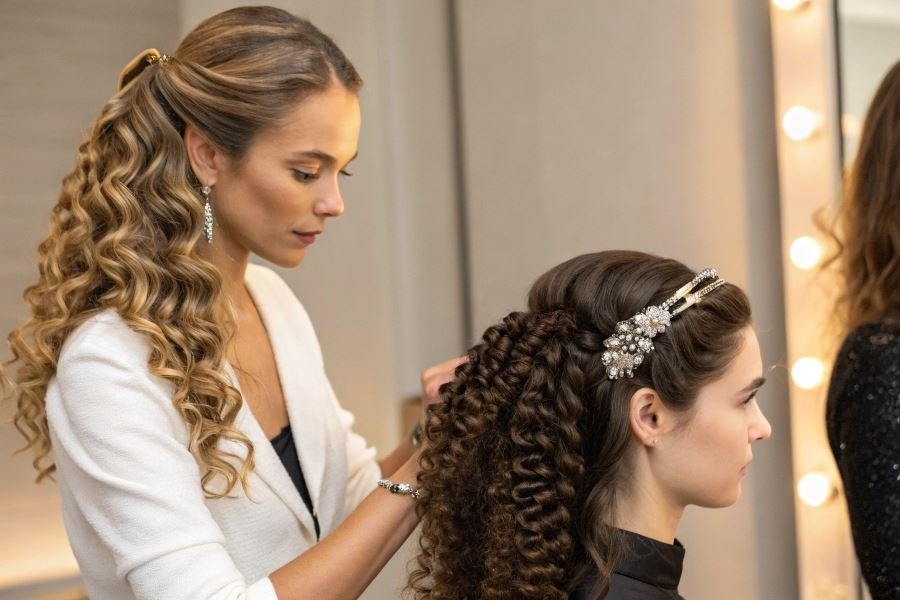
Ever wondered why that perfect salon updo stays flawless for hours while your at-home attempt collapses within minutes? The secret might be hiding in plain sight: hairpins. These tiny tools are the unsung heroes of hairstyling, with professional stylists treating their selection with the precision of a scientist choosing laboratory equipment.
Behind every successful hairstyle lies a deliberate decision about which hairpin will work best with your unique hair texture. Professional stylists don’t just grab random pins from a drawer—they conduct a thorough assessment of your hair’s density, texture, and natural movement before selecting the perfect fastener. This careful evaluation process is what separates amateur styling from salon-quality results that last.
“The relationship between hairpin and hair is symbiotic,” explains award-winning stylist Maria Chen. “The wrong match can cause breakage, slippage, or even long-term damage to the hair cuticle.”
The material matters tremendously: fine hair typically requires lightweight pins with smooth surfaces to prevent snagging, while coarser textures benefit from sturdier options that can maintain their grip without bending. Size isn’t arbitrary either—it’s a calculated choice based on:
- Hair thickness and density
- Style complexity and weight distribution
- Expected movement and activity level
- Desired hold duration
When professionals match the right pin to your hair type, the results aren’t just aesthetically superior—they’re healthier for your hair. The proper selection eliminates unnecessary tension, reduces breakage points, and distributes weight evenly across the style, protecting your strands while maintaining that coveted “just left the salon” look.
The Perfect Match: Hairpins for Every Hair Type
Finding the right hairpin for your specific hair type can transform your styling experience from frustrating to flawless. Professional stylists understand that selecting appropriate hair accessories based on texture, thickness, and curl pattern isn’t just about aesthetics—it’s about functionality and hair health. Let’s explore how to choose hairpins for different hair types in a beauty salon setting, where professionals consider each client’s unique hair characteristics before recommending the perfect pin.
Lightweight Solutions for Fine Hair
Fine hair requires special consideration when selecting hairpins. The delicate nature of thin strands means they can easily become damaged or weighed down by heavy accessories.
Key features to look for:
- Micro-grip technology that holds without heaviness
- Lightweight materials like coated aluminum or thin plastic
- Smaller size pins that remain discreet in the hair
Fine hair benefits tremendously from bobby pins with silicone tips or coated ends that create friction without snagging. The Kitsch Pro Bobby Pins offer an excellent example with their ultra-light construction and non-slip coating that grips even the silkiest strands without causing breakage.
Pro tip: Position pins with the wavy side against the scalp for maximum hold without visible hardware.
Strong Support for Thick Tresses
Thick hair presents the opposite challenge—finding pins sturdy enough to actually hold substantial sections in place throughout the day.
Essential qualities for thick hair pins:
- Reinforced construction that won’t bend under pressure
- Wider jaw span to accommodate more hair
- Heat-resistant materials for styling versatility
| Pin Type | Hold Strength | Visibility | Best For |
|---|---|---|---|
| U-shaped | Maximum | Medium | Updos & buns |
| Flat clips | Strong | Low | Sleek styles |
| Decorative pins | Medium-strong | High | Special occasions |
Thick-haired clients should gravitate toward professional-grade metal pins like those from Fromm Professional that feature extra-strong construction specifically engineered for dense hair types. These pins typically have a thicker gauge metal and reinforced tips that prevent bending even when securing substantial sections.
Specialized Solutions for Curly and Textured Hair
Curly and textured hair requires pins that work with—not against—natural curl patterns to prevent tangling and breakage.
Must-have features:
- Smooth, rounded edges that won’t catch on coils
- Wider spacing between prongs
- Anti-static properties to reduce frizz
The unique structure of curly hair means standard pins often become hopelessly entangled. Specialized options like DevaCurl DevaClips feature innovative designs with wider spacing and smooth surfaces specifically engineered to navigate through curls without disrupting their natural pattern.
For highly textured hair, sectioning clips with rounded teeth spaced further apart prevent the dreaded “stuck pin” scenario that can lead to breakage.
When selecting pins for textured hair, consider both the holding power and the exit strategy—how easily the pin can be removed without causing damage is equally important as how well it secures the style.
By matching hairpin characteristics to specific hair types, professionals ensure styles that not only look better but also protect the integrity of the hair—proving that even the smallest accessories deserve thoughtful consideration.
Professional Hairpin Mastery for Every Salon Client
When it comes to securing styles that last, professional stylists know that the right hairpin can make all the difference between a look that holds and one that falls flat. Let’s dive into the world of professional-grade hairpins that deliver consistent results across different hair types.
Elite Brands That Dominate Stylist Kits
The difference between drugstore hairpins and professional-grade options isn’t just marketing—it’s performance. These top three brands have earned their place in professional styling kits:
-
Amika – Known for their titanium-coated pins that grip without snagging, Amika’s professional line features heat-resistant coating that prevents warping even under hot styling tools. Their signature matte finish provides superior grip for even the silkiest hair types.
-
Y.S. Park – Japanese precision meets innovative design with Y.S. Park’s carbon fiber and resin-coated pins. Their color-coded system allows stylists to quickly select the right size for different sections and hair densities. The slightly textured surface creates friction without damaging the hair cuticle.
-
Cricket – With their patented silicone-tipped bobby pins, Cricket has revolutionized hold for fine hair types. Their professional line features reinforced steel cores with flexibility that adapts to movement without loosening.
What separates these professional brands from mass-market options is their consistent tension, precision manufacturing, and hair-friendly materials that prevent breakage.
Extending Hairpin Lifespan Through Proper Care
Professional hairpins represent an investment in your styling arsenal. Here’s how to make them last:
| Maintenance Task | Frequency | Benefit |
|---|---|---|
| Sanitize with alcohol | Weekly | Prevents product buildup and maintains grip |
| Remove hair strands | After each use | Prevents stretching and maintains tension |
| Store in dedicated container | Always | Prevents bending and maintains shape |
| Magnetic strip organization | Daily | Prevents loss and damage from loose storage |
The most overlooked aspect of hairpin maintenance? Proper drying after cleaning. Moisture is the enemy of metal pins, causing microscopic rust that can snag and tear hair. After sanitizing, always pat dry with a microfiber cloth before storing.
Recognizing When Replacement Is Non-Negotiable
Even the finest hairpins have a lifespan. Knowing when to retire them is crucial for maintaining hair health and style integrity.
Watch for these critical warning signs:
-
Visible coating flakes – Once the protective coating begins to chip, the exposed metal can catch and tear hair strands.
-
Decreased tension when bent – Professional pins should return to their original shape after being opened. When this spring-back action diminishes, the pin can no longer provide adequate hold.
-
Visible rust spots – These microscopic abrasions act like tiny saws against delicate hair shafts.
-
Bent or misaligned prongs – This creates uneven pressure that can cause breakage at stress points.
“The moment you find yourself using more pins than usual to achieve the same hold, it’s time for replacement. Your client’s hair health depends on it.”
For most busy salons, professional-grade hairpins should be replaced every 3-4 months with regular use. This schedule ensures optimal performance and prevents the subtle hair damage that can occur with worn tools.
Remember that different hair types accelerate wear differently—coarse, textured hair creates more friction against pins, potentially shortening their effective lifespan. Maintaining a rotation system for different hair textures can maximize your investment while ensuring every client receives the best possible care.
Discover how professional stylists match the perfect hairpins to your unique hair type. Learn about materials, sizes, and specialized designs that prevent damage while maximizing hold for fine, thick, or curly hair. Expert recommendations for salon-quality results.
Discover how professional stylists match the perfect hairpins to your unique hair type. Learn about materials, sizes, and specialized designs that prevent damage while maximizing hold for fine, thick, or curly hair. Expert recommendations for salon-quality results.