
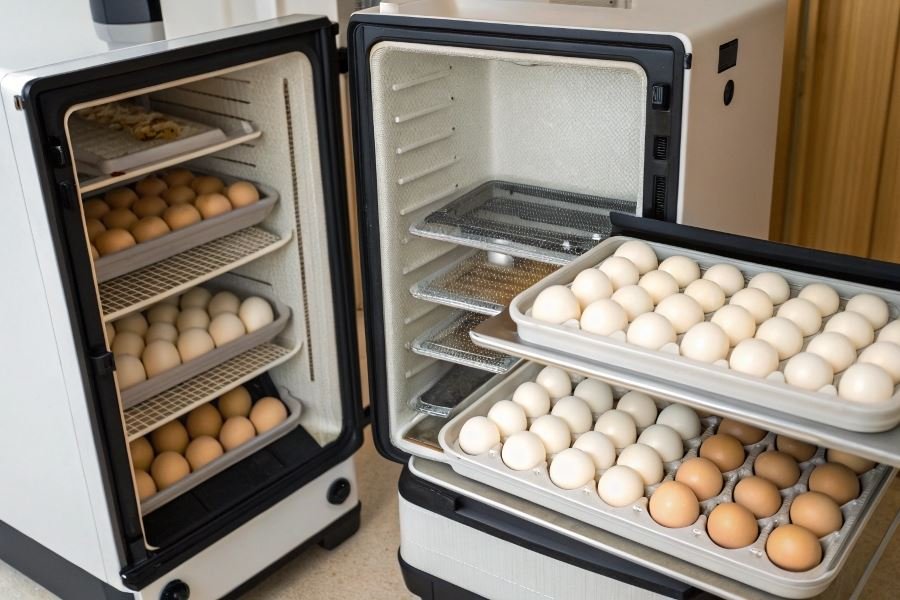
Ever wondered how a simple device can transform ordinary eggs into chirping chicks right in your living room? Household incubators have revolutionized small-scale hatching, making what was once exclusively agricultural technology accessible to homesteaders, hobbyists, and educational settings.
At their core, household incubators are controlled environments designed to mimic the conditions a brooding hen would naturally provide. These remarkable devices maintain precise temperature, humidity, and ventilation while automatically turning eggs—replacing the mother bird’s instinctive behaviors with technology that can often achieve even better hatch rates.
When evaluating different models, capacity stands as the most immediate consideration. Small units accommodate 7-12 eggs, making them perfect for beginners or those with limited space. Mid-range incubators typically handle 24-60 eggs, while larger household models can nurture 100+ eggs simultaneously. Your choice should align with both your ambitions and available space.
Beyond size, functionality determines success. Essential features include:
- Temperature control: The difference between 99.5°F and 101°F can mean life or death for developing embryos
- Humidity regulation: Critical during different development stages
- Egg turning mechanism: Automatic systems prevent embryo sticking and ensure even development
- Viewing windows: Allow monitoring without disrupting the internal environment
The most sophisticated models now include digital displays, programmable settings, and even smartphone connectivity for remote monitoring—transforming what was once guesswork into precision science.
The perfect incubator balances capacity needs with functionality requirements, creating your ideal hatching ecosystem.
Household Incubator Showdown: Size Matters
When diving into the world of home hatching, choosing the right incubator can make all the difference between disappointing results and a backyard full of fluffy chicks. The household incubators comparison by capacity and functionality reveals that size isn’t just about how many eggs you can hatch—it’s about the features, precision, and reliability that come with different capacity ranges.
Small but mighty: Under 50 eggs
Small-capacity incubators pack impressive technology into compact packages, perfect for beginners or those with limited space.
Key advantages:
- Lower initial investment ($75-150 for quality models)
- Minimal power consumption (typically 30-60 watts)
- Easier to place in homes with limited space
- Simpler operation for first-time hatchers
Most small incubators like the Hovabator 1588 feature basic temperature controls and manual egg turning, though premium models incorporate digital displays and semi-automatic functions. The Brinsea Mini II Advance stands out with programmable turning cycles and humidity alarms despite holding just 7 eggs.
Pro tip: Small incubators excel for specialty breeding projects where you’re hatching rare or exotic breeds in small batches.
The limitations become apparent when hatching success rates enter the equation. Manual humidity control in budget models can lead to inconsistent results, with success rates hovering around 60-70% compared to 80%+ in higher-end units.
| Model Type | Avg. Price | Power Usage | Typical Success Rate |
|---|---|---|---|
| Basic Manual | $75-100 | 30-40W | 60-70% |
| Digital Small | $120-150 | 40-60W | 70-80% |
Middle of the road: 50-100 eggs
Medium-capacity incubators represent the sweet spot for serious hobbyists and small-scale producers, balancing capacity with advanced functionality.
These models typically incorporate:
- Automatic egg turning (crucial for development)
- Digital temperature and humidity controls
- Multiple viewing windows
- Integrated humidity reservoirs
The Farm Innovators Model 4250 exemplifies this category with its 41-egg capacity, programmable turning cycles, and digital humidity readout. Medium incubators typically consume 80-150 watts but deliver significantly improved hatching consistency.
What separates premium models in this range is their ability to maintain microclimate stability. The GQF 1502 Sportsman features multi-point heating elements that eliminate hot spots—a common issue in cheaper units that can reduce hatch rates by up to 15%.
Going pro: 100+ eggs
Large-capacity household incubators blur the line between hobby and small business equipment, offering professional-grade features that dramatically improve results.
Standout capabilities include:
- Independently controlled hatching trays
- Precision digital humidity injection systems
- Automatic cooling cycles (mimicking natural brooding behavior)
- Data logging and smartphone connectivity
The Brinsea Ovation 56 EX represents the premium end with its 56-egg capacity and fully automated operation. For truly large operations, the GQF 1502 Cabinet Incubator can handle 270+ eggs with commercial-grade reliability.
These systems typically require dedicated space and higher power consumption (150-400 watts), but deliver professional results with success rates consistently above 85% when properly operated.
The investment scales accordingly—expect to pay $350-800 for quality large-capacity models—but the return on investment becomes compelling when hatching valuable breeds or producing consistently for small-scale sales.
Household Incubator Selection Guide for Breeding Success
Aligning Capacity with Your Breeding Ambitions
Selecting the right household incubator begins with an honest assessment of your breeding goals. Are you hatching a handful of specialty birds for a small farm operation, or planning a more substantial breeding program? The capacity you need directly correlates with your ambitions.
Small-capacity incubators (12-24 eggs) excel for hobbyists and specialty breeders focusing on quality over quantity. Mid-range models (48-70 eggs) strike the balance for small-scale producers, while large-capacity units (100+ eggs) serve serious breeders with commercial aspirations.
Functionality requirements evolve with scale. For smaller operations, manual turning might suffice, but as your egg count increases, automatic turning becomes essential. Similarly, basic humidity control works for modest batches, while precision digital humidity regulation becomes critical at scale.
The most common mistake new breeders make is purchasing an incubator based on current needs rather than anticipating growth. Consider where your breeding program will be in 18-24 months.
Your species diversity also dictates functionality needs. Hatching multiple species simultaneously requires independently controlled sections or multiple specialized incubators, as optimal humidity and temperature settings vary significantly between quail, chickens, ducks, and exotic birds.
Top Performers in the Price-Value Matrix
After analyzing dozens of models, three household incubators consistently deliver exceptional value relative to their functionality:
1. Brinsea Mini II Advance
This compact powerhouse handles 7 chicken eggs (or 12 quail eggs) with digital temperature control accurate to ±0.1°F. At $169.99, the Brinsea Mini II Advance offers programmable automatic turning and humidity alarms—features typically found in models twice the price.
2. Farm Innovators Model 4250
For mid-range capacity, the Farm Innovators Model 4250 accommodates 41 chicken eggs with digital temperature/humidity display and automatic turning. Priced at $189.99, it includes a built-in candler and programmable turning intervals—exceptional value for small-scale producers.
3. GQF 1502 Sportsman Cabinet Incubator
When scaling up, the GQF 1502 Sportsman delivers commercial-grade performance at a household price point. At $425, this 270-egg capacity unit features digital controls, automatic humidity regulation, and separate hatching trays. Its modular design allows for future expansion.
| Model | Capacity | Key Features | Price | Value Rating |
|---|---|---|---|---|
| Brinsea Mini II | 7 chicken eggs | Digital control, programmable turning | $169.99 | ★★★★★ |
| Farm Innovators 4250 | 41 chicken eggs | Digital display, built-in candler | $189.99 | ★★★★☆ |
| GQF 1502 Sportsman | 270 eggs | Commercial grade, expandable | $425.00 | ★★★★★ |
Maintenance Economics and Long-Term Value
The true cost of an incubator extends far beyond the purchase price. Energy efficiency varies dramatically between models, with premium units consuming up to 60% less electricity over their lifespan.
Replacement parts availability should factor heavily into your decision. Budget models often become obsolete within 3-5 years, while premium manufacturers like Brinsea and GQF maintain parts inventories for 10+ years. This difference can transform a “budget” purchase into an expensive mistake.
Cleaning requirements impact long-term satisfaction significantly. Models with removable trays and smooth, non-porous surfaces dramatically reduce maintenance time. The labor cost of maintaining difficult-to-clean units often exceeds their initial price advantage within two hatching seasons.
Consider warranty terms as a manufacturer’s statement of confidence. One-year warranties suggest expected obsolescence, while 3-5 year coverage indicates engineering designed for longevity. The Brinsea Mini II’s 3-year warranty speaks volumes about its expected service life compared to similarly priced competitors offering 90-day coverage.
The most valuable incubator isn’t necessarily the cheapest or most expensive—it’s the one that aligns perfectly with your breeding goals while delivering consistent results year after year.
Discover the top 10 household incubators ranked by egg capacity and functionality. Compare small, medium, and large models to find the perfect match for your home hatching needs with our comprehensive guide.
Discover the top 10 household incubators ranked by egg capacity and functionality. Compare small, medium, and large models to find the perfect match for your home hatching needs with our comprehensive guide.