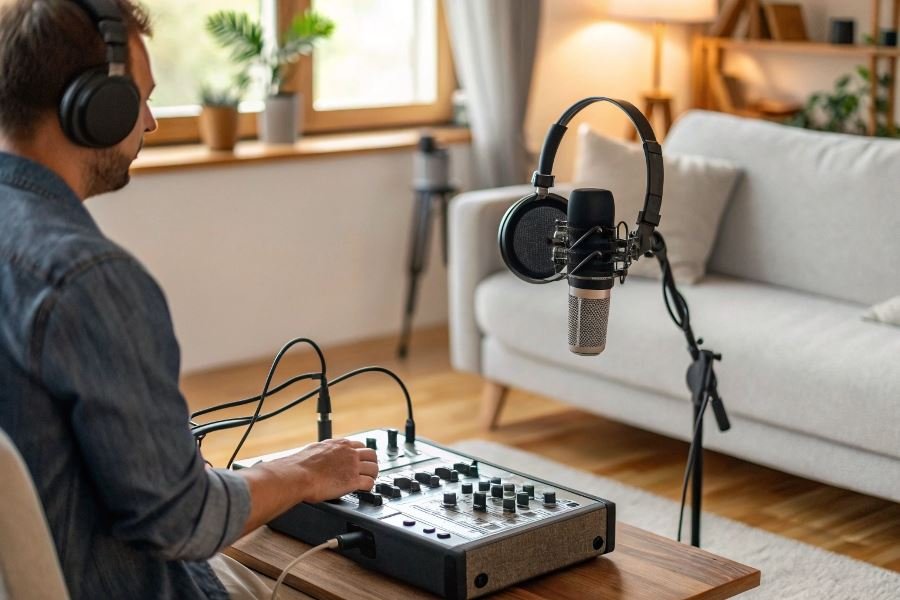
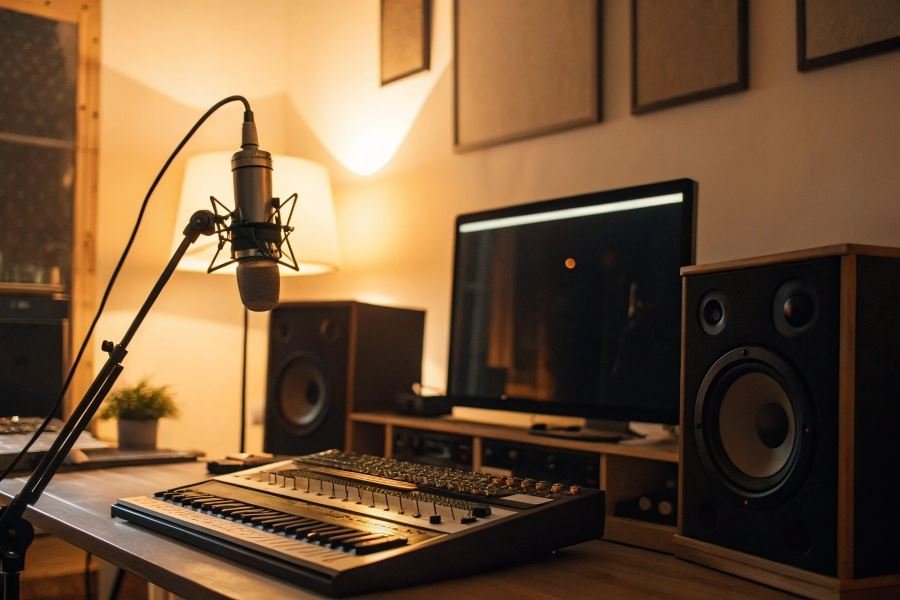
Ever wondered why some home recordings sound like they were made in a professional studio while others sound like they were captured in a tin can? The difference often lies not in talent, but in thoughtful equipment selection and setup.
Creating a home recording studio isn’t just about buying gear—it’s about crafting a personal creative sanctuary where your sonic visions come to life. Whether you’re recording vocals, instruments, podcasts, or producing beats, the right foundation makes all the difference.
Define your purpose with laser focus
Before spending a single dollar, ask yourself: What exactly will I be recording? A podcast requires different equipment than a metal band. Solo acoustic performances need different tools than electronic music production.
“The most expensive mistake in home studio building is buying gear that doesn’t match your actual needs.”
Are you primarily recording vocals? Instruments? Full bands? Will you be mixing and mastering? Your answers dramatically narrow your equipment options and help prevent costly mistakes.
Space and acoustics: The invisible equipment
Your room is actually your first piece of equipment. A spacious, acoustically treated basement will yield better results than expensive gear in a tiny, reflective bathroom.
Assess your available space honestly:
- Small bedroom/office: Focus on near-field monitoring, acoustic treatment, and headphones
- Garage/basement: Consider isolation, temperature control, and more extensive acoustic treatment
- Dedicated space: Plan zones for recording, mixing, and possibly live tracking
Remember that untreated acoustics can ruin even the most expensive equipment setup. Budget for acoustic panels, bass traps, and diffusers as essential components, not afterthoughts.
Budget reality: Investment tiers that make sense
Establishing a realistic budget prevents both overspending and the frustration of inadequate equipment. Consider these typical investment tiers:
| Level | Budget Range | Focus Areas |
|---|---|---|
| Entry | $500-1,500 | Interface, microphone, headphones, basic treatment |
| Intermediate | $1,500-5,000 | Better mics, monitors, treatment, plugins |
| Advanced | $5,000+ | Multiple mics, premium monitors, extensive treatment |
The good news? Today’s entry-level equipment delivers quality that would have cost thousands just a decade ago. Start with fewer, better pieces rather than many mediocre ones.
Essential Equipment for Your Home Recording Studio
Audio Interfaces: Your Digital Gateway
The foundation of any home recording setup begins with a quality audio interface. This critical component bridges your analog sound sources with your digital workspace. When selecting an interface for your home recording studio, prioritize one with low-latency monitoring, high-quality preamps, and sufficient I/O for your needs.
The Focusrite Scarlett 2i2 remains a popular entry point, offering two combination inputs and impressive 24-bit/192kHz resolution. For more demanding projects, the Universal Audio Apollo Twin delivers professional-grade conversion and real-time processing capabilities.
Your computer specifications matter tremendously when building a functional recording environment. How to choose a set of equipment for a home recording studio often hinges on understanding these technical requirements. At minimum, aim for:
- 8GB RAM (16GB recommended for larger projects)
- Multi-core processor (i5/i7 or AMD equivalent)
- SSD storage for faster loading and processing
- USB-C or Thunderbolt connectivity for modern interfaces
Microphones: Capturing Your Sound
Microphones represent perhaps the most crucial investment in your signal chain. Different recording scenarios demand different microphone types:
| Microphone Type | Best For | Price Range | Notable Example |
|---|---|---|---|
| Large Diaphragm Condenser | Vocals, acoustic instruments | $100-1000+ | Audio-Technica AT2020 |
| Dynamic | Loud sources, live recording | $100-400 | Shure SM58 |
| Ribbon | Warm, vintage sound | $300-3000 | Royer R-121 |
For monitoring, invest in both quality headphones and studio monitors. Closed-back headphones like the Beyerdynamic DT 770 Pro provide isolation for recording, while open-back models offer more accurate mixing references.
Studio monitors should be selected based on room size. The KRK Rokit 5 works well in smaller spaces, while the Yamaha HS8 delivers extended bass response for larger rooms.
DAW and Software: Your Creative Headquarters
Your Digital Audio Workstation (DAW) serves as command central for your recording projects. Each platform offers distinct workflows and capabilities:
- Pro Tools: Industry standard with robust recording and editing tools
- Logic Pro: Mac-only with exceptional virtual instruments
- Ableton Live: Ideal for electronic music production and performance
- Reaper: Affordable option with professional capabilities
Beyond your DAW, consider essential plugins for:
- Dynamic processing (compressors, limiters)
- Equalization (parametric EQs, channel strips)
- Time-based effects (reverb, delay)
- Virtual instruments (depending on your production style)
The Waves Gold Bundle provides excellent value for beginners, while the iZotope Music Production Suite offers advanced tools for mixing and mastering.
Remember that while quality equipment matters, understanding how to use it effectively matters more. Invest in learning resources alongside your gear purchases to maximize your studio’s potential.
Building Your Home Studio Arsenal Strategically
Core Equipment Essentials First
The foundation of any home recording studio begins with essential gear that delivers immediate recording capability. Start with a quality audio interface like the Focusrite Scarlett 2i2 (169)or[PreSonusAudioBoxUSB96](https : //www.presonus.com/products/AudioBox − USB − 96)(99) to convert analog signals to digital. These interfaces offer excellent preamps and conversion at entry-level prices.
For monitoring, invest in a pair of studio reference headphones before speakers. The Audio-Technica ATH-M50x (149)providesflatfrequencyresponsecrucialforaccuratemixingdecisions.Adda * *condensermicrophone * *likethe[RodeNT1](https : //rode.com/en/microphones/studio − condenser/nt1)(269) that captures vocals and acoustic instruments with remarkable clarity.
The quality of your recordings will never exceed the quality of your weakest signal chain component.
Complete your core setup with Digital Audio Workstation (DAW) software. Reaper (60)offersprofessionalcapabilitiesatafractionofcompetitors′prices, while[AbletonLiveIntro](https : //www.ableton.com/en/live/)(99) provides an intuitive workflow for electronic music production.
Strategic Upgrade Pathways
Once your foundation is established, prioritize upgrades that address your specific bottlenecks. If room acoustics are problematic, invest in acoustic treatment before buying expensive monitors. Basic acoustic panels from Primacoustic ($299 for a starter room kit) will dramatically improve your recording and mixing environment.
For monitoring upgrades, follow this progression:
- Entry-level studio monitors (KRK Rokit 5 – $179 each)
- Monitor isolation pads (Auralex MoPADs – $45)
- Room correction software (Sonarworks SoundID Reference – $299)
For microphone expansion, consider these priorities:
| Recording Need | Recommended Microphone | Approximate Cost |
|---|---|---|
| Vocals | Shure SM7B | $399 |
| Acoustic Guitar | AKG C214 | $349 |
| Drum Overheads | Rode M5 Pair | $199 |
Balancing Quality and Compatibility
Future-proofing your studio requires strategic thinking about interconnectivity and expandability. Invest in universal connection standards like USB-C and Thunderbolt interfaces that will remain compatible with future computers. The Universal Audio Apollo Twin X ($899) offers exceptional preamps plus future expansion via optical inputs.
Consider modular systems that grow with your needs. The SSL 2+ ($279) provides room for expansion with additional inputs/outputs while maintaining professional sound quality.
Balance immediate needs against long-term value. A $400 microphone that lasts 20 years costs just $20 annually, while cheap cables might need frequent replacement. Invest in premium cables from brands like Mogami that ensure signal integrity and durability.
When selecting equipment, prioritize gear that serves multiple functions. The Universal Audio Volt 276 ($299) combines an interface with vintage preamp emulation and compression, eliminating the need for separate units while you’re starting out.
Remember that strategic studio building isn’t about acquiring everything at once—it’s about making each purchase count toward your ultimate recording goals.
Discover how to build the perfect home recording studio with our complete equipment guide. Learn to select essential audio interfaces, microphones, monitors, and software that match your budget and recording goals.
Discover how to build the perfect home recording studio with our complete equipment guide. Learn to select essential audio interfaces, microphones, monitors, and software that match your budget and recording goals.