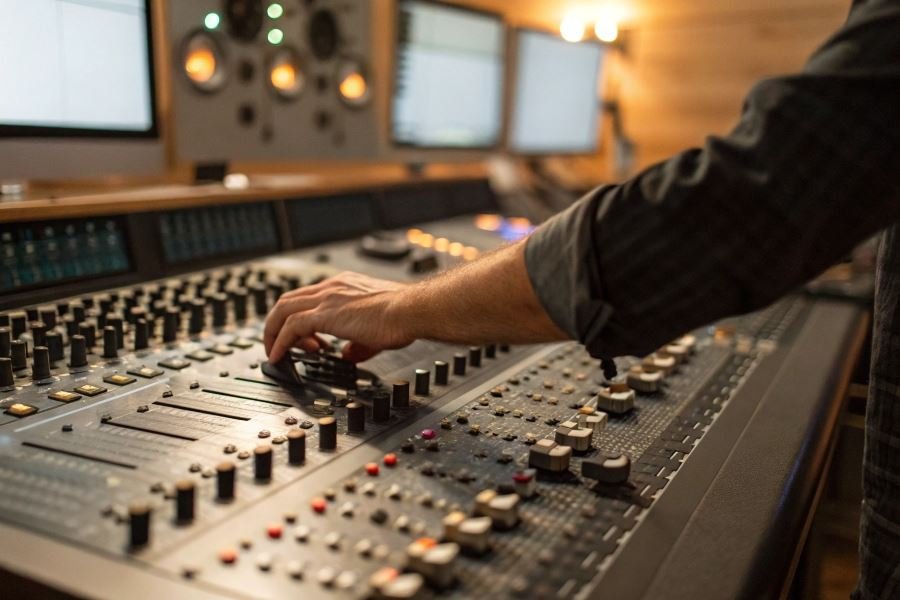
That perfect sound you hear on professional recordings? It’s not magic—it’s meticulous equalization. When the difference between amateur and professional sound often comes down to EQ decisions, understanding this critical tool becomes essential for any home studio setup.
Equalizers (EQs) are audio processors that allow you to adjust the balance between frequency components within an audio signal. Think of them as sophisticated tone controls that can boost bass, tame harsh treble, or carve out space for each instrument in your mix. Unlike basic bass and treble knobs on consumer equipment, studio equalizers offer precise control over specific frequency ranges, enabling you to shape sound with surgical precision.
The impact of proper equalization on recording quality cannot be overstated. A well-equalized track sits perfectly in a mix, with clarity and definition that makes listeners feel like they’re in the room with the performers. Poor equalization, conversely, can result in muddy, harsh, or thin recordings that fatigue the ear.
Types of equalizers for your studio arsenal
Home studio producers typically encounter three main equalizer types:
-
Parametric EQs: The Swiss Army knife of equalizers, offering control over frequency, bandwidth, and gain. These provide the most surgical precision for problem-solving.
-
Graphic EQs: Featuring multiple sliders representing fixed frequency bands, these visual equalizers make quick work of broad tonal shaping.
-
Dynamic EQs: The modern hybrid that applies equalization only when signals exceed a threshold—perfect for taming occasional harshness without affecting the overall tone.
Each type serves different purposes in your signal chain, from gentle tone-shaping to dramatic sound design. The right equalizer for your studio depends on your specific recording needs, musical genre, and workflow preferences.
Essential Factors for Choosing the Perfect Equalizer
When setting up a home recording studio, few tools impact your sound as profoundly as an equalizer. The right EQ can transform a muddy mix into crystal clarity, while the wrong choice might leave you endlessly tweaking without satisfaction. Let’s dive into the critical factors that should guide your equalizer selection process.
Understanding how to choose an equalizer for a home recording studio requires balancing technical needs, workflow preferences, and budget constraints. The decision you make will fundamentally shape your sound for years to come, so it’s worth investing time to understand your options.
Hardware vs Software: The Eternal Debate
The first crossroads you’ll encounter is whether to go physical or digital. Both paths offer distinct advantages:
Hardware Equalizers:
- Deliver genuine analog warmth and character
- Provide tactile, hands-on control
- Often feature proprietary circuitry that imparts signature sound
- Zero latency processing
- No computer required for operation
However, hardware comes with limitations: fixed channel counts, higher price points, and physical space requirements that might challenge smaller studio setups.
Software Equalizers:
- Unlimited instances (CPU permitting)
- Significantly lower cost per channel
- Preset saving and recall
- Visual feedback and analysis tools
- Automation capabilities
The Waves API 550 plugin might cost $50 during a sale, while its hardware counterpart from API Audio commands $2,000+. For most home studios, software EQs provide the best value proposition, though many professionals incorporate both types.
EQ Types: Finding Your Perfect Match
| EQ Type | Precision | Ease of Use | Best For |
|---|---|---|---|
| Parametric | Highest | Moderate | Surgical corrections |
| Graphic | Fixed | Very Easy | Quick adjustments |
| Dynamic | Adaptive | Complex | Problem-solving |
Parametric equalizers offer surgical precision with adjustable Q (bandwidth), frequency, and gain controls. The FabFilter Pro-Q 3 exemplifies this category with its intuitive interface and powerful capabilities. These EQs excel when you need to target specific frequency issues without affecting neighboring sounds.
Graphic equalizers provide visual simplicity with fixed frequency bands. They’re intuitive for beginners but less precise for complex tasks. The dbx 231s remains a popular hardware option for quick, broad-stroke adjustments.
Dynamic equalizers represent the cutting edge, applying processing only when signals cross user-defined thresholds. Tools like TDR Nova combine the precision of parametric EQ with compression-like behavior, making them ideal for taming problematic frequencies only when they become excessive.
Budget Considerations and Value Assessment
Quality equalizers span from free plugins to multi-thousand-dollar hardware units. Consider these value factors:
- Sound quality – Does it achieve the sonic result you need?
- Workflow efficiency – Will it slow down or enhance your creative process?
- Longevity – Will this tool grow with your skills or quickly become limiting?
Starting recommendations:
- Budget-conscious: TDR Nova (free) and ReaEQ offer exceptional value
- Mid-range investment: FabFilter Pro-Q 3 ($179) provides professional-grade capabilities
- Premium hardware: Warm Audio EQP-WA ($699) delivers Pultec-style analog processing at a fraction of vintage prices
Remember that the best equalizer isn’t necessarily the most expensive—it’s the one that helps you achieve your desired sound with minimal frustration. Start with quality fundamentals and expand your collection as your ears and skills develop.
Sealing the Deal: Your Equalizer Endgame
Choosing the right equalizer for your home recording studio isn’t just about finding a piece of gear—it’s about discovering a long-term creative partner. After exploring the technical specifications and features, it’s time to make that final, informed decision that will shape your sonic signature for years to come.
Tailoring to Your Sonic Palette
The perfect equalizer is the one that solves your specific audio challenges. Consider what you’re actually recording:
- Vocal-focused content benefits from equalizers with precise mid-range control and gentle high-frequency shelving
- Guitar-heavy productions require equalizers that can tame harsh frequencies while preserving character
- Electronic music producers need surgical precision in problem frequency areas and creative EQ options
A mastering engineer might require the transparency of the Dangerous BAX EQ, while a podcaster could find everything they need in a simple channel strip like the Focusrite ISA One.
The best equalizer isn’t necessarily the most expensive one—it’s the one that solves your specific recording challenges while inspiring creativity.
Match your equalizer’s capabilities to your workflow. If you’re constantly battling room resonances, an equalizer with analyzation tools and notch filtering will save countless hours. If you’re primarily adding “character” to recordings, a vintage-inspired EQ with musical curves might be your perfect match.
Ecosystem Integration
Your equalizer doesn’t exist in isolation—it’s part of a carefully curated signal chain. Consider:
| Integration Factor | Questions to Ask |
|---|---|
| Physical Connectivity | Does it offer the I/O formats your studio uses? (Balanced XLR, TRS, ADAT, etc.) |
| Digital Compatibility | If digital, does it support your DAW’s sample rates and plugin format? |
| Signal Flow | Where will it sit in your chain? (Pre-compression? Post-recording?) |
| Control Surface | Do you need hardware control or is software manipulation sufficient? |
The Universal Audio Apollo ecosystem offers tight integration between hardware and software equalizers, while standalone units like the Rupert Neve Designs Portico II demand thoughtful consideration of how they’ll connect to your existing gear.
Future-Proofing Your Investment
Quality equalizers aren’t impulse purchases—they’re investments. Consider these future-proofing factors:
-
Expandability: Can the equalizer grow with your studio? Look for units with firmware update capabilities or modular designs.
-
Longevity: Hardware equalizers from companies like Manley Labs or Pultec have maintained their value for decades, while software equalizers benefit from regular updates.
-
Versatility: Will this equalizer serve multiple purposes? The Fabfilter Pro-Q 3 offers everything from mastering-grade precision to creative sound design.
-
Resale Value: Premium brands hold value remarkably well, making them safer long-term investments.
The equalizer landscape continues evolving, but the fundamentals remain consistent. Investing in quality over quantity typically yields better long-term results. A single exceptional equalizer that perfectly matches your needs will outperform a collection of mediocre options.
Make your decision based on your current needs while keeping an eye on where your production style is heading. The right equalizer doesn’t just solve today’s problems—it opens creative doors you haven’t yet discovered.
Discover how to select the ideal equalizer for your home recording studio with our comprehensive guide covering hardware vs. software options, EQ types, and budget considerations for professional sound quality.
Discover how to select the ideal equalizer for your home recording studio with our comprehensive guide covering hardware vs. software options, EQ types, and budget considerations for professional sound quality.