What if I told you the difference between a thriving auto service and one that struggles often comes down to what’s beneath the vehicles they service?
The humble hydraulic lift has transformed from basic mechanical hoists of the 1940s into sophisticated systems that define workshop productivity today. Universal hydraulic lifts represent the culmination of decades of engineering refinement, offering versatility that accommodates everything from compact sedans to commercial trucks under a single system. This adaptability has revolutionized how service centers operate, eliminating the need for multiple specialized equipment investments.
The engineering journey
Hydraulic lift technology has undergone remarkable transformation since its widespread adoption. Early models relied on simple pressure systems with limited safety features and weight capacities. By comparison, today’s universal lifts incorporate advanced synchronization systems, electronic safety locks, and precision control mechanisms that prevent the catastrophic failures that once plagued the industry.
Operational impact beyond the obvious
Selecting the appropriate hydraulic lift system transcends mere vehicle elevation. The right system directly influences:
- Technician productivity – reducing strain and improving access angles
- Service bay throughput – with faster vehicle positioning and stability
- Workshop space utilization – through strategic lift placement and design
- Energy consumption – with newer systems requiring 30% less power than models from just a decade ago
Investment considerations that matter
When evaluating hydraulic lift systems, forward-thinking service centers prioritize:
“The cheapest lift often becomes the most expensive mistake a shop can make.” – Veteran shop owner with 35+ years experience
Look beyond initial cost to weight capacity versatility, maintenance requirements, and certification standards. The most successful operations choose systems that accommodate their current vehicle mix while anticipating future market shifts toward electric vehicles and larger SUVs.
Lifting Power: The Ultimate Guide to Universal Hydraulic Lifts
Two-post lifts: The workshop workhorse
Two-post hydraulic lifts stand as the backbone of professional auto service operations nationwide. These versatile powerhouses feature two parallel columns with adjustable arms that contact a vehicle’s frame at designated lifting points. With typical weight capacities ranging from 7,000 to 15,000 pounds, they’ve become the go-to solution for mechanics performing everything from oil changes to comprehensive drivetrain work.
What makes these lifts particularly valuable is their unobstructed access to vehicle undercarriages and wheel assemblies. Universal hydraulic lifts for different types of auto services must balance capability with practical application, and two-post models excel by providing mechanics with 360-degree access to suspension components, exhaust systems, and transmission assemblies. The Rotary SPO12 exemplifies this category with its asymmetric arm configuration that accommodates vehicles from compact sedans to full-size trucks.
Key advantages include:
- Smaller footprint compared to four-post alternatives
- Complete undercarriage access
- Adjustable swing arms for diverse vehicle types
- Higher lifting height for tall technicians
For service scenarios involving engine repairs, transmission work, or exhaust system replacements, two-post lifts deliver unmatched utility per square foot of shop space.
Four-post lifts: Alignment specialists and storage solutions
Four-post hydraulic lifts elevate the service game with their exceptional stability and specialized capabilities. Unlike their two-post counterparts, these systems support vehicles by their tires rather than frame contact points, distributing weight across four robust columns.
With weight capacities typically between 14,000 and 30,000 pounds, four-post lifts excel in two primary scenarios: wheel alignment services and long-term vehicle storage. The integrated runway design makes them ideal for alignment procedures, often featuring built-in turn plates and slip plates that enable precise steering component adjustments.
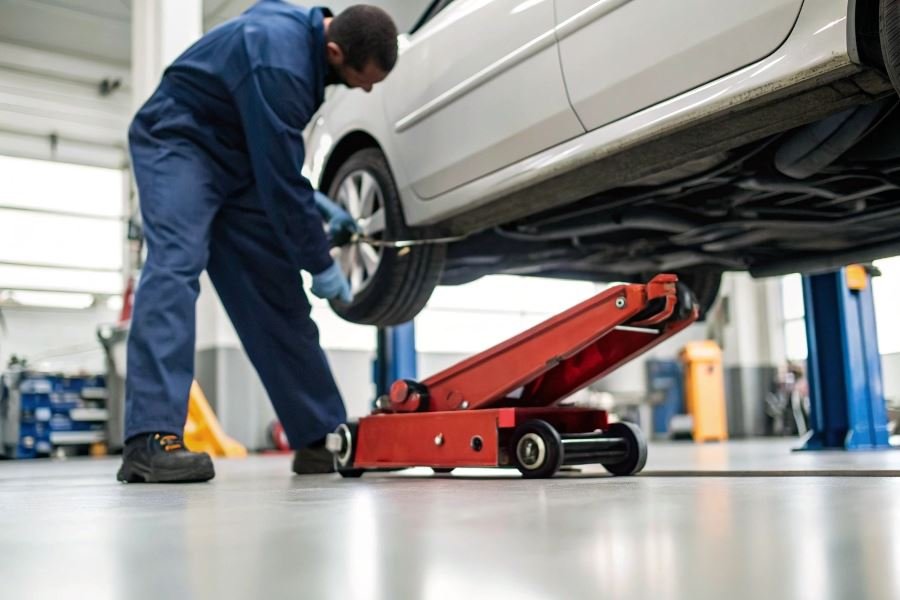
The storage benefits cannot be overstated for shops with limited floor space. When equipped with rolling jacks, a single BendPak HD-14T can transform into a multi-functional service station while doubling as a storage solution during off-hours.
| Feature | Two-Post Lift | Four-Post Lift |
|---|---|---|
| Footprint | 12-14 ft² | 20-24 ft² |
| Weight Capacity | 7,000-15,000 lbs | 14,000-30,000 lbs |
| Undercarriage Access | Complete | Limited without jacks |
| Alignment Capability | Limited | Excellent |
| Installation Complexity | Moderate | Simple |
Scissor and low-rise lifts: Maximum efficiency in minimal space
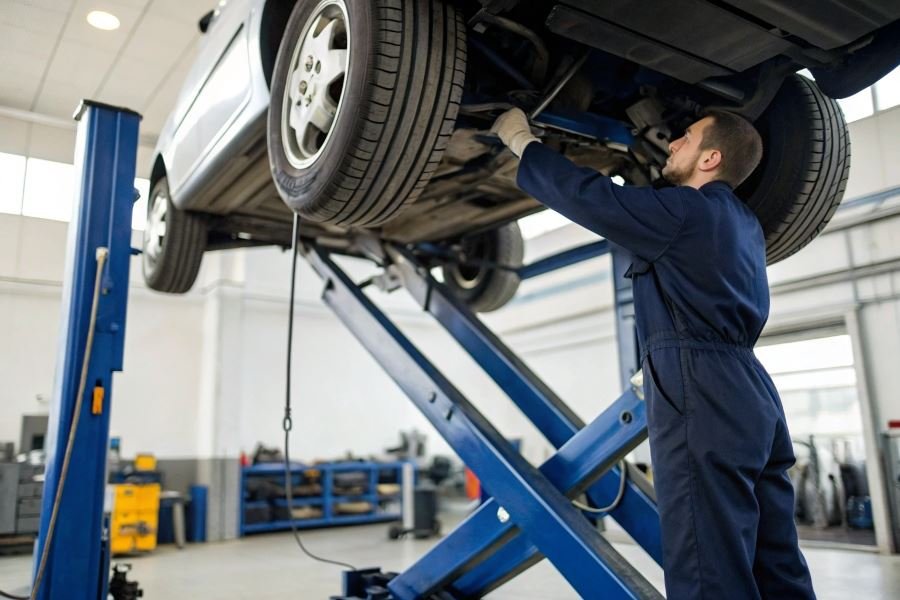
For quick service operations where space efficiency trumps all, scissor and low-rise hydraulic lifts deliver remarkable utility. These compact systems operate through expanding scissor mechanisms or parallelogram designs that lift vehicles from underneath.
Scissor lifts come in two primary configurations:
- Mid-rise models (lifting 24-36 inches)
- Full-rise versions (lifting 60+ inches)
With capacities typically between 6,000 and 10,000 pounds, these space-conscious options require no columns, making them perfect for express lube services, tire rotations, and brake work. The Challenger SL210 exemplifies this category with its rapid deployment and minimal footprint.
Low-rise lifts, meanwhile, elevate vehicles just 18-24 inches—perfect for quick-service tire shops and detail centers. Their portable nature allows for flexible shop configurations, and many models can be easily moved when not in use.
Both options shine in operations where throughput matters most. Their rapid lifting cycles (typically 30-45 seconds) and minimal setup requirements translate directly to increased service capacity and revenue potential for high-volume shops.
Maximizing ROI with Universal Hydraulic Lifts
The true cost equation of lift ownership
When evaluating universal hydraulic lifts for your auto service business, the sticker price is merely the tip of the financial iceberg. A comprehensive total cost of ownership (TCO) analysis reveals that initial investment typically represents only 40-60% of lifetime expenses.
Two-post hydraulic lifts from industry leaders like Rotary Lift range from $3,000 to $7,500, while four-post systems from BendPak command $4,500 to $12,000. However, the complete financial picture includes:
| Cost Component | Percentage of TCO | Considerations |
|---|---|---|
| Initial Purchase | 40-60% | Capacity, features, warranty |
| Installation | 5-15% | Concrete requirements, electrical work |
| Energy Consumption | 10-20% | Hydraulic vs. electro-hydraulic efficiency |
| Maintenance | 15-25% | Scheduled service, parts replacement |
| Downtime Costs | Variable | Revenue loss during repairs |
Premium models from Challenger Lifts may demand higher upfront investment but often deliver superior ROI through reduced energy consumption and maintenance requirements. Their commercial-grade systems typically recoup the price differential within 3-4 years through operational savings.
Safety features that protect both people and profits
Universal hydraulic lifts must comply with stringent safety standards, with the Automotive Lift Institute (ALI) certification representing the gold standard in the industry. This certification ensures lifts meet ANSI/ALI ALCTV standards for construction, testing, and validation.
Modern safety features that distinguish quality systems include:
- Automatic arm restraints that lock during operation
- Redundant hydraulic cylinders with synchronized movement
- Lowering speed control valves preventing sudden descent
- Thermal overload protection preventing motor burnout
- Tamper-resistant safety locks engaging at multiple heights
Forward Lift models incorporate pressure-relief valves that prevent hydraulic system overload—a feature that has prevented countless equipment failures and potential injuries. Meanwhile, Dannmar integrates acoustic warning systems that activate during lift descent, reducing workplace accidents by an estimated 30%.
The most expensive safety feature is the one you decided to forego right before an accident occurs.
Maintenance strategies that extend service life
The longevity of hydraulic lift systems varies dramatically based on maintenance practices. Well-maintained systems routinely deliver 15-20 years of reliable service, while neglected equipment may fail within 5-7 years.
Critical maintenance considerations include:
- Hydraulic fluid analysis and replacement every 3,000 operating hours or annually
- Cable and chain tension inspection quarterly
- Lubrication of pivot points and sliding surfaces monthly
- Load-bearing component inspection semi-annually
- Electrical system testing quarterly
Mohawk Lifts designs systems with easily accessible maintenance points, reducing service time by up to 40% compared to competitors. Their modular construction allows for component replacement rather than complete system overhaul when failures occur.
The most successful auto service businesses implement preventive maintenance programs that cost approximately 3-5% of the lift’s purchase price annually—an investment that extends operational life by 30-50% while preventing catastrophic failures that could idle service bays for weeks.
By selecting universal hydraulic lifts with superior TCO profiles, comprehensive safety features, and maintenance-friendly designs, auto service businesses can maximize both short-term productivity and long-term return on investment.
Discover the most efficient universal hydraulic lifts for auto service operations in 2025. Compare two-post, four-post, and scissor lift systems to maximize safety, productivity, and return on investment for your automotive business.
Discover the most efficient universal hydraulic lifts for auto service operations in 2025. Compare two-post, four-post, and scissor lift systems to maximize safety, productivity, and return on investment for your automotive business.