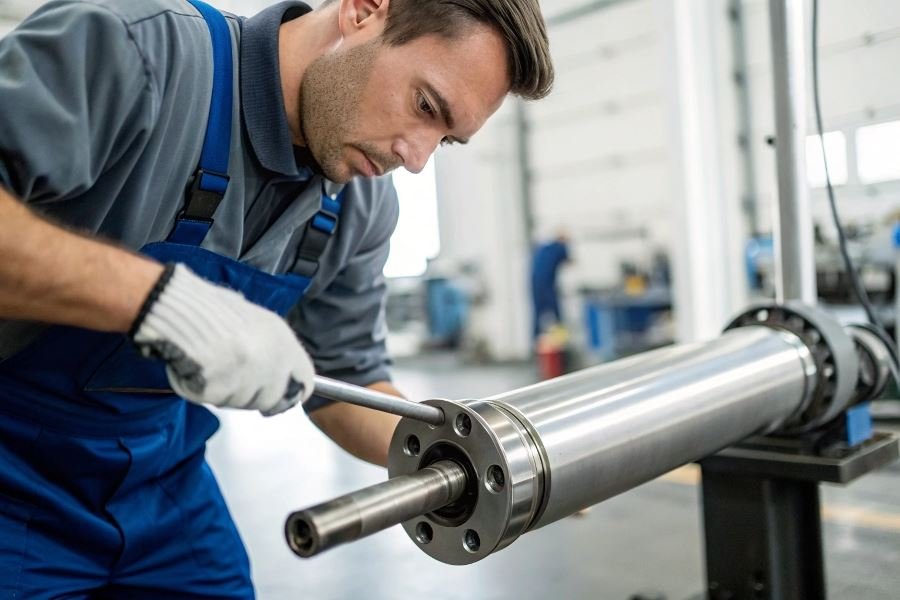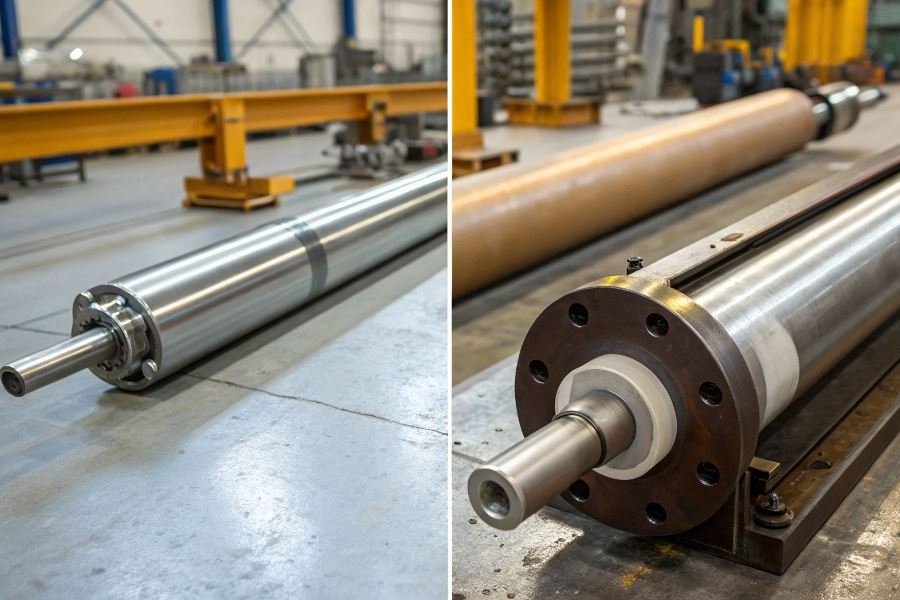
Ever watched a dump truck lift its massive load with seemingly effortless precision? Or marveled at how a modern excavator can extend its arm to remarkable distances? The secret lies in hydraulic cylinders—the unsung heroes of industrial power transmission.
Hydraulic cylinders convert fluid pressure into linear force and motion, essentially functioning as the muscles of heavy machinery. These mechanical marvels operate on Pascal’s principle: pressure applied to a confined fluid transmits equally in all directions. When this pressure acts on a piston within a cylinder, it creates powerful linear movement that can lift, push, pull, or position loads with exceptional control.
Single-stage hydraulic cylinders represent the classic design—a single piston rod extending from a barrel. They excel in applications requiring consistent force throughout the stroke length, like industrial presses or vehicle lifts. Their straightforward construction offers superior stability and load-bearing capacity, making them the go-to choice for heavy-duty applications where reliability trumps space considerations.
Telescopic hydraulic cylinders, by contrast, feature nested tubes that extend sequentially—much like a collapsible telescope. This ingenious design allows for dramatically extended reach while maintaining a compact retracted position. The trade-off? A more complex pressure distribution system and typically lower load capacity compared to their single-stage counterparts.
| Feature | Single-Stage Cylinders | Telescopic Cylinders |
|---|---|---|
| Design | One piston, one rod | Multiple nested stages |
| Stroke length | Limited to cylinder length | Can extend 3-5× retracted length |
| Load capacity | Higher, consistent | Decreases with extension |
| Stability | Excellent | Reduces at full extension |
| Applications | Presses, lifts, fixed equipment | Mobile equipment, space-constrained uses |
The choice between these designs ultimately depends on your specific application requirements—whether you need the brute strength of a single-stage cylinder or the space-saving versatility of a telescopic system.
The Engineering Marvel: Single-Stage vs Telescopic Hydraulic Cylinders
When power meets precision in industrial applications, hydraulic cylinders stand as the unsung heroes of motion control. These mechanical workhorses transform fluid pressure into linear force, but not all cylinders are created equal. The fundamental architecture of these devices creates a fascinating engineering dichotomy that affects everything from construction equipment to aerospace applications.
The comparison of single-stage and telescopic hydraulic cylinders reveals a world of trade-offs and specialized applications that engineers must navigate when selecting the optimal solution for their specific needs. Each design represents a different approach to solving the same basic problem: how to convert hydraulic pressure into controlled linear motion while managing space constraints and performance requirements.
Design architecture that defines performance
Single-stage hydraulic cylinders feature a straightforward construction: one piston rod moving within a single barrel. This elegant simplicity translates to robust performance characteristics and exceptional durability. The piston divides the cylinder into two chambers, with pressure differential creating movement.
Telescopic cylinders, by contrast, employ a nested design with multiple stages that extend sequentially—much like a collapsible telescope. Each stage consists of a hollow tube that serves as both cylinder and piston rod for the next stage.
| Feature | Single-Stage Cylinders | Telescopic Cylinders |
|---|---|---|
| Construction | One piston, one barrel | Multiple nested stages |
| Collapsed Length | Approximately twice stroke length | Significantly shorter than stroke |
| Maintenance | Simpler, fewer seals | Complex, multiple sealing points |
| Typical Applications | Fixed installations, heavy lifting | Mobile equipment, space-constrained areas |
Force dynamics and pressure capabilities
The force output equation for hydraulic cylinders is straightforward: Force = Pressure × Area. Single-stage cylinders maintain consistent force throughout their stroke, making them ideal for applications requiring steady power delivery. Their larger diameter pistons typically allow them to handle higher pressure ratings—often up to 5,000 PSI in industrial applications.
Telescopic cylinders present a more complex force profile. Each extending stage delivers progressively less force than the previous one due to decreasing effective areas. The smallest, final stage may deliver only 25% of the force of the first stage at the same pressure.
Space efficiency vs stroke length
The defining advantage of telescopic cylinders lies in their remarkable space efficiency. A telescopic cylinder with a 10-foot extension might collapse to just 2-3 feet, while a single-stage cylinder would require over 10 feet of installation space for the same stroke.
This space-saving characteristic makes telescopic cylinders indispensable in mobile equipment where compact retracted dimensions are critical, such as in dump trucks, garbage compactors, and mobile cranes.
Stability under load
Single-stage cylinders excel in stability metrics. Their solid construction and typically larger diameter rods resist bending moments and side loading with superior rigidity. This makes them the preferred choice for applications where precise positioning under variable loads is essential.
Telescopic designs introduce multiple points of potential deflection at each stage junction. This inherent characteristic requires careful engineering to manage side loading, particularly at full extension where the smallest diameter rod must support the entire load.
Speed control and precision movement
The hydraulic fluid dynamics in single-stage cylinders are straightforward, allowing for excellent control precision and consistent movement speeds. Their simpler design facilitates more predictable acceleration and deceleration profiles, critical in applications requiring synchronized movements.
Telescopic cylinders present unique challenges for precise control. The sequential extension of stages can create momentary speed variations as each new stage begins to move. Advanced control systems with proportional valves can mitigate these effects, but the physics of staged extension introduces inherent complexity to motion control.
Choosing the Right Hydraulic Muscle: Application-Based Cylinder Selection
Single-stage cylinders shine in straightforward tasks
Single-stage hydraulic cylinders excel in applications demanding consistent force throughout the stroke with minimal space constraints. These workhorses deliver exceptional performance in manufacturing equipment where cylinders can be mounted vertically without length restrictions. Their robust design makes them ideal for press operations, industrial compactors, and heavy lifting equipment where reliability trumps compactness.
The construction industry relies heavily on single-stage cylinders for applications like concrete formwork and structural support systems. Their superior side-load tolerance and straightforward maintenance requirements make them cost-effective solutions for predictable, repetitive operations.
The simplicity of single-stage cylinders translates directly to reliability—fewer moving parts means fewer potential failure points.
Material handling equipment frequently employs single-stage designs where the cylinder can be mounted in a fixed position. Forklifts, dock levelers, and industrial dumpers benefit from their higher pressure ratings (often exceeding 5,000 PSI) and exceptional durability under continuous use.
Telescopic cylinders conquer space limitations
When space constraints become the primary challenge, telescopic hydraulic cylinders demonstrate their remarkable versatility. These engineering marvels are the backbone of dump trucks, garbage collection vehicles, and mobile cranes where extended reach must combine with compact retracted length.
Agricultural equipment manufacturers increasingly favor telescopic designs for implements requiring significant extension without compromising the equipment’s maneuverability. Modern tractors and harvesters utilize these space-saving solutions to maximize functionality without increasing the machine’s footprint.
The aerospace industry employs precision-engineered telescopic cylinders in landing gear systems and cargo loading equipment where weight and space efficiency are paramount concerns. Their multi-stage design allows for dramatic extension ratios—some achieving 5:1 or greater—while maintaining reasonable retracted dimensions.
Industry demands drive cylinder selection
| Industry | Primary Selection Criteria | Typical Preference |
|---|---|---|
| Construction | Durability, load capacity | Single-stage |
| Transportation | Space efficiency, weight | Telescopic |
| Manufacturing | Precision, cycle life | Single-stage |
| Agriculture | Extension ratio, weather resistance | Telescopic |
| Material Handling | Reliability, maintenance access | Single-stage |
Oil and gas operations typically prioritize safety ratings and corrosion resistance, often selecting single-stage cylinders for wellhead equipment and telescopic variants for mobile drilling platforms. The mining sector generally favors single-stage designs for their superior load-bearing capabilities in extreme environments.
Cost considerations beyond purchase price
Initial acquisition costs typically favor single-stage cylinders, which can be 30-40% less expensive than comparable telescopic models. However, the total cost of ownership calculation must include installation requirements, operational efficiency, and maintenance expenses.
Telescopic cylinders generally require more frequent seal replacements due to their multiple sliding surfaces, but their space-saving benefits can dramatically reduce overall equipment design costs. The maintenance complexity increases with each additional stage, requiring more specialized technicians and potentially longer downtime periods.
Future innovations reshaping hydraulic technology
The hydraulic cylinder market is experiencing a technological renaissance with smart cylinders incorporating integrated position sensing and real-time performance monitoring. These innovations are particularly valuable in telescopic designs where precise stage deployment coordination is critical.
Material science advancements are producing cylinders with enhanced corrosion resistance and reduced weight. Carbon fiber components and composite materials are beginning to appear in high-performance applications where weight reduction delivers significant operational benefits.
Sustainability concerns are driving development of bio-based hydraulic fluids compatible with both cylinder types, though telescopic designs often require more stringent fluid cleanliness due to their tighter tolerances and multiple sealing surfaces.
Discover the key differences between single-stage and telescopic hydraulic cylinders in this comprehensive guide. Compare design features, performance capabilities, and ideal applications to make the right choice for your industrial or construction projects.
Discover the key differences between single-stage and telescopic hydraulic cylinders in this comprehensive guide. Compare design features, performance capabilities, and ideal applications to make the right choice for your industrial or construction projects.