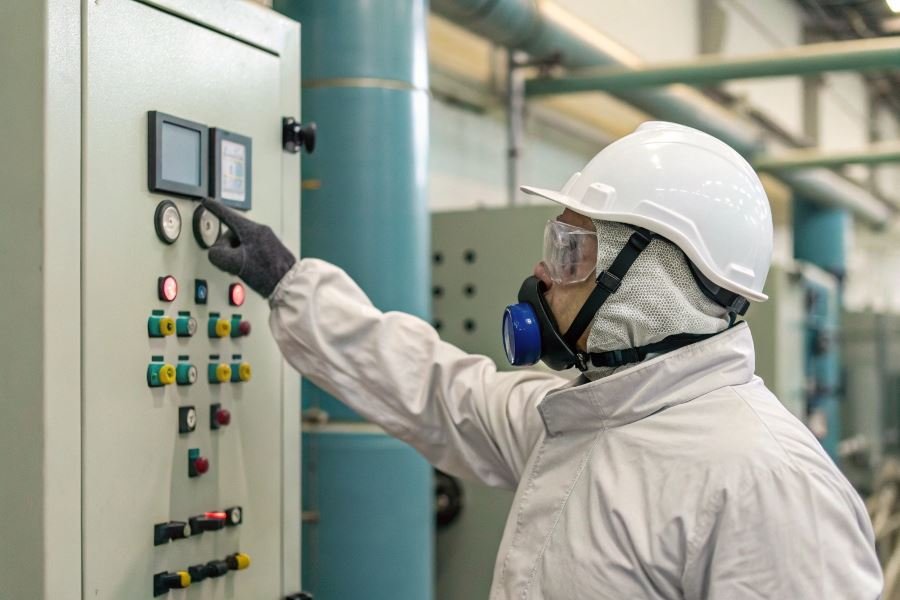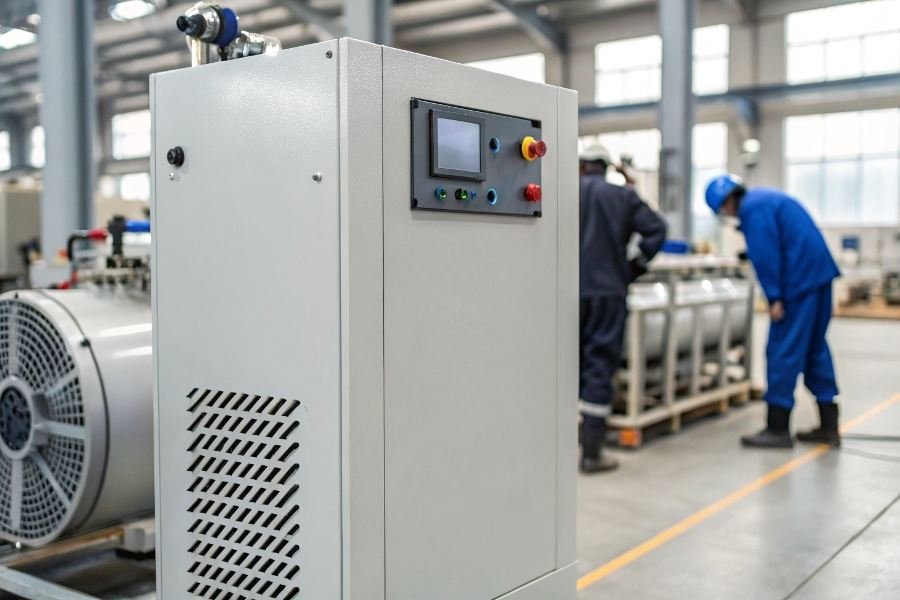
What if you could eliminate pathogens, neutralize odors, and reduce chemical contaminants in your industrial facility with a single technology? That’s exactly what modern ozonator-ionizers deliver—and selecting the right one could transform your operation’s efficiency, safety, and compliance profile.
Industrial ozonator-ionizers represent the frontline defense against airborne and waterborne contaminants in manufacturing environments. These sophisticated systems generate ozone (O₃)—a powerful oxidizing agent—that attacks and neutralizes bacteria, viruses, molds, and volatile organic compounds (VOCs) on contact. When paired with ionization technology, they also charge airborne particles, causing them to cluster and precipitate out of circulation.
The industrial advantage of ozonation
The benefits of implementing ozonation technology extend far beyond basic air purification:
- Reduced chemical dependency: Many facilities have cut disinfectant chemical usage by 40-60% after implementing comprehensive ozonation systems
- Enhanced product quality: Food processing plants report extended shelf life and reduced contamination rates
- Lower operational costs: Despite initial investment of $5,000-25,000 (depending on capacity), most systems deliver ROI within 18-36 months through reduced chemical purchases and waste management costs
- Improved regulatory compliance: Meets increasingly stringent air quality standards without introducing secondary contaminants
Selection fundamentals
When evaluating industrial ozonator-ionizers, focus on these critical factors:
“The right ozonator isn’t about maximum output—it’s about appropriate output for your specific industrial application, balanced with energy efficiency and maintenance requirements.”
Your selection process should prioritize treatment capacity (measured in mg/h or g/h), target contaminants, space dimensions, and integration with existing ventilation or water treatment systems. The most effective installations are those precisely calibrated to your facility’s unique contamination profile and operational patterns.
Technical Specifications That Make or Break Industrial Ozonators
When selecting equipment for industrial air and water treatment, the technical specifications of an ozonator-ionizer can mean the difference between optimal performance and wasted investment. The process of how to choose an ozonator-ionizer for an industrial facility requires careful analysis of three critical factors: output capacity, energy efficiency, and system integration capabilities. Let’s dive into these specifications with the precision they deserve.
Matching Output Capacity to Facility Demands
The cornerstone of any successful ozonator implementation is correctly sizing the unit’s output capacity. This isn’t merely about square footage—it’s about understanding your specific treatment requirements.
Output capacity is measured in grams per hour (g/h) and should be calculated based on:
- Volume of air/water requiring treatment
- Level of contamination present
- Required treatment time
- Safety factor (typically 15-20%)
For manufacturing facilities, a general rule suggests 1-2 g/h per 1,000 square feet for air treatment, while water treatment applications may require 3-5 g/h per 10,000 gallons processed hourly.
Undersizing leads to ineffective treatment, while oversizing wastes capital and operating expenses.
| Facility Type | Typical Size | Recommended Output |
|---|---|---|
| Small Warehouse | 10,000 sq ft | 10-20 g/h |
| Food Processing | 25,000 sq ft | 40-60 g/h |
| Water Treatment | 100,000 gal/day | 30-50 g/h |
| Medical Facility | 15,000 sq ft | 25-35 g/h |
Energy Efficiency Metrics That Matter
The most powerful ozonator isn’t necessarily the best choice if it consumes electricity like a hungry beast. Modern industrial ozonators from companies like Ozonetech and Ozone Solutions have made remarkable strides in energy efficiency.
When evaluating power consumption, consider:
Energy efficiency ratio (EER): Look for units delivering at least 20-25 g of ozone per kilowatt-hour.
Advanced corona discharge systems typically offer 30-40% better energy efficiency than older UV-based systems.
Three critical power specifications to evaluate:
- Startup power requirements – Initial power surge can affect electrical systems
- Operational wattage – Continuous power draw during normal operation
- Standby consumption – Power used during monitoring/non-generation periods
Integration With Existing Infrastructure
The finest ozonator on paper becomes a liability if it can’t properly integrate with your facility’s existing systems. This aspect of selection requires thorough evaluation of:
Physical installation requirements:
- Footprint dimensions and weight
- Mounting options (wall, floor, rack)
- Ventilation and cooling needs
- Access requirements for maintenance
System connectivity:
- Control interfaces (analog, digital, network)
- Monitoring capabilities
- Automation compatibility with SCADA or building management systems
- Data logging and reporting features
Plumbing and ducting considerations:
- Pipe/duct diameter compatibility
- Material compatibility (ozone-resistant materials required)
- Pressure ratings and flow requirements
- Injection methods for water applications
The most overlooked integration factor is often the control system compatibility, which can add 15-30% to total implementation costs if retrofitting is required.
For facilities with existing treatment systems, Xylem offers ozonators specifically designed for retrofit applications with flexible integration options.
Selecting the right ozonator-ionizer requires balancing these technical specifications against your facility’s specific needs. The investment in proper sizing, efficiency analysis, and integration planning pays dividends through improved performance, reduced operating costs, and extended equipment life.
Making the Final Decision on Your Industrial Ozonator-Ionizer
Selecting the right ozonator-ionizer for your industrial facility isn’t just a purchase—it’s a strategic investment in operational efficiency, workplace safety, and environmental compliance. After evaluating technical specifications and installation requirements, you’ve reached the critical decision-making phase. Let’s dive into the factors that will ultimately determine which system delivers the best long-term value.
Manufacturer reliability that stands the test of time
When comparing top manufacturers, three names consistently demonstrate exceptional reliability:
| Manufacturer | Warranty Period | Service Network | Replacement Parts Availability |
|---|---|---|---|
| Ozonetech | 5-year comprehensive | Global, 24/7 support | Same-day shipping guarantee |
| Xylem | 3-year standard, extendable to 7 years | Regional centers in 150+ countries | 10-year parts commitment |
| ProMinent | 2-year base, modular extensions available | Certified technicians in major industrial hubs | 15-year manufacturing continuity promise |
Ozonetech stands out with their comprehensive 5-year warranty that covers not just parts but also labor and emergency service calls. Their global support network means you’re never more than 24 hours from expert assistance—critical when production depends on continuous operation.
Xylem offers exceptional flexibility with their warranty structure, allowing facilities to customize coverage based on specific operational needs. Their “Predictive Maintenance Program” uses IoT sensors to detect potential issues before they cause downtime.
ProMinent’s warranty might appear shorter at first glance, but their modular extension options allow for targeted coverage of critical components, potentially reducing unnecessary warranty costs for more stable system elements.
ROI calculations that reveal the complete picture
The true cost of an ozonator-ionizer extends far beyond the purchase price. A comprehensive ROI analysis must include:
- Energy consumption (typically 0.8-2.4 kWh per pound of ozone generated)
- Maintenance requirements (scheduled service intervals and parts replacement)
- System lifespan (industry average: 8-12 years)
- Operational efficiency (ozone production per kWh)
- Downtime costs (both scheduled maintenance and unexpected failures)
A mid-range industrial ozonator priced at $45,000 might seem expensive compared to a $32,000 alternative, but the calculations change dramatically when you factor in the efficiency difference. The premium system operating at 85% efficiency versus 72% can save approximately $8,700 annually in energy costs alone for a facility requiring 50 pounds of ozone daily.
The most expensive system to purchase is rarely the most expensive to own.
When calculating ROI, don’t overlook the indirect benefits:
- Reduced chemical handling and storage costs
- Decreased waste treatment expenses
- Improved product quality and reduced rejection rates
- Enhanced workplace safety metrics
- Lower insurance premiums due to reduced chemical hazards
Navigating the regulatory landscape with confidence
Industrial ozonator-ionizers must comply with a complex web of regulations that vary by:
- Industry sector (food processing, pharmaceutical, water treatment)
- Geographic location (local, state, and federal requirements)
- Application specifics (ambient air treatment vs. process integration)
Key compliance considerations include:
The FDA’s Good Manufacturing Practices require specific validation protocols for ozone systems used in food and pharmaceutical applications. Systems from Anseros come pre-configured with validation packages that streamline this process.
OSHA workplace exposure limits for ozone (0.1 ppm over an 8-hour period) necessitate robust monitoring systems. Leading manufacturers now integrate real-time monitoring with automatic shutdown protocols if levels approach regulatory thresholds.
EPA regulations regarding ozone as a secondary pollutant require careful implementation in certain regions. Systems with catalytic destruction units can convert unused ozone back to oxygen, eliminating regulatory concerns about atmospheric release.
The decision ultimately comes down to finding the perfect intersection of reliability, long-term value, and regulatory compliance for your specific industrial application. The right ozonator-ionizer doesn’t just meet today’s requirements—it positions your facility for years of efficient, compliant operation.
Discover how to select the optimal industrial ozonator-ionizer based on output capacity, energy efficiency, and ROI. Learn key technical specifications, integration requirements, and compliance standards for maximum operational benefits.
Discover how to select the optimal industrial ozonator-ionizer based on output capacity, energy efficiency, and ROI. Learn key technical specifications, integration requirements, and compliance standards for maximum operational benefits.