Did you know that workers in environments with clean air show up to 11% higher productivity levels? That’s not just a health statistic—it’s a bottom-line game-changer for businesses across America.
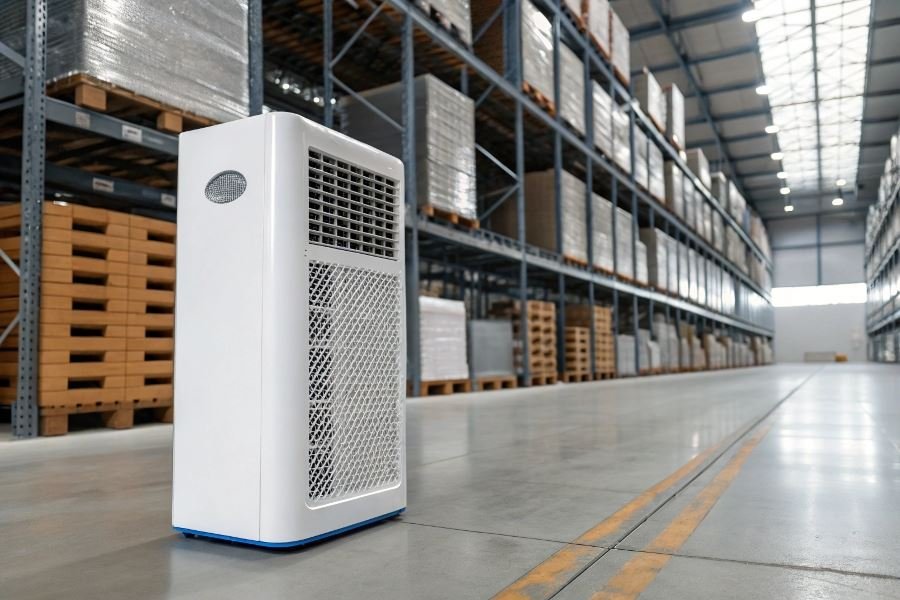
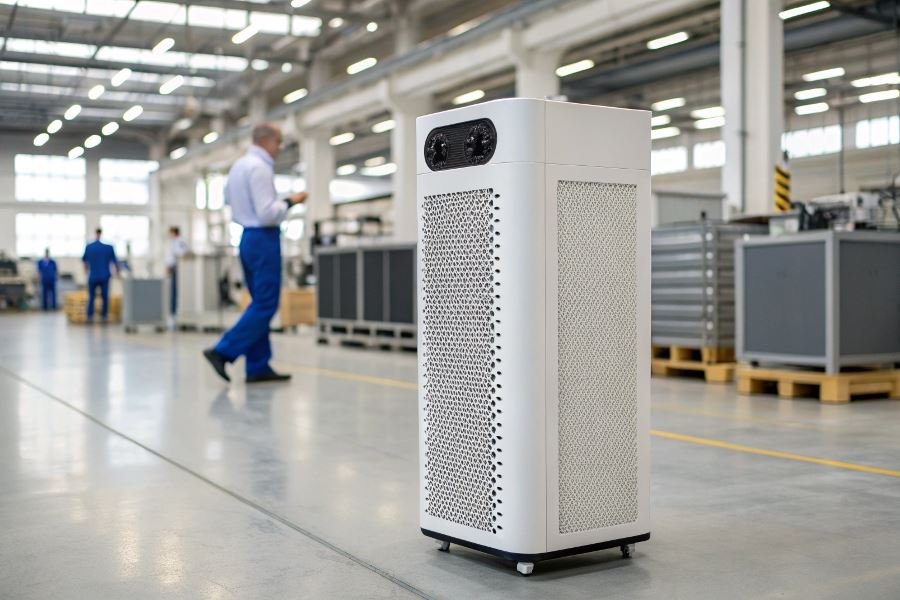
Industrial air purifiers and ionizers represent far more than just oversized versions of home units. These sophisticated systems form the invisible infrastructure that protects product integrity, employee health, and operational efficiency across manufacturing plants, warehouses, and commercial spaces. Unlike residential units designed for comfort, industrial purification systems tackle specialized contaminants—from microscopic particulates in pharmaceutical production to chemical fumes in automotive manufacturing.
The price-quality equation in this sector hinges on several critical factors. Initial acquisition cost often represents just 30% of the total ownership expense, with energy efficiency, filter replacement intervals, and maintenance requirements driving long-term value. The most cost-effective systems balance powerful filtration capacity with operational efficiency—a 15% higher upfront investment often yields 40% lower operating costs over a five-year period.
“The true measure of an industrial air purification system isn’t its price tag, but its total cost of ownership divided by its effectiveness in your specific environment.”
Market trends show a decisive shift toward smart purification systems with real-time monitoring capabilities. These IoT-enabled units adjust filtration intensity based on actual air quality conditions, reducing energy consumption by up to 35% compared to traditional always-on systems. Meanwhile, advancements in bipolar ionization technology have dramatically improved effectiveness against airborne pathogens while reducing maintenance requirements.
The most significant development? Multi-stage filtration systems that combine HEPA filtration, activated carbon absorption, and ionization technologies—delivering comprehensive protection without the operational compromises that plagued earlier generations of industrial purifiers.
The True Cost of Clean Air: Evaluating Industrial Purifiers
When facility managers invest in air quality, they’re not just buying equipment—they’re purchasing productivity, compliance, and employee health. Finding that sweet spot between performance and price requires understanding what you’re actually paying for beyond the sticker price.
Industrial air purifiers and ionizers: price-quality ratio considerations extend far beyond the initial purchase. The lifetime value proposition includes operational efficiency, maintenance requirements, and the technology’s ability to deliver consistent results in your specific environment. Let’s break down what truly matters when evaluating these systems.
CADR and Coverage: The Performance Metrics That Matter
Clean Air Delivery Rate (CADR) remains the gold standard for measuring purifier effectiveness. This metric tells you how many cubic feet of filtered air the unit delivers per minute—essentially, how quickly it cleans your space.
For industrial applications, the relationship between CADR and price reveals interesting patterns:
| Price Range | Typical CADR | Coverage Area | Filtration Efficiency |
|---|---|---|---|
| $1,000-2,500 | 300-500 CFM | 1,500-3,000 sq ft | 95-97% (MERV 13-15) |
| $2,500-5,000 | 500-800 CFM | 3,000-5,000 sq ft | 97-99% (MERV 16-17) |
| $5,000+ | 800+ CFM | 5,000+ sq ft | 99.97%+ (HEPA/ULPA) |
The IQAir Pro Series exemplifies this relationship, delivering exceptional CADR ratings of 900+ CFM while maintaining HEPA-level filtration—but at a premium price point that reflects this capability.
The true value equation isn’t just about raw numbers but about matching specifications to your facility’s actual needs.
The Hidden Costs: Energy and Maintenance
Energy consumption often becomes the silent budget-killer with industrial air purification systems. A unit that costs $3,000 but consumes twice the electricity of a $4,000 model will ultimately cost more over its lifetime.
Modern systems like the Camfil CamCleaner incorporate energy-efficient EC motors that can reduce power consumption by up to 50% compared to conventional motors—translating to thousands in savings annually for 24/7 operation.
Filter replacement represents another significant operational expense:
- Pre-filters: Typically require replacement every 1-3 months ($30-100 each)
- HEPA filters: Generally last 6-12 months ($200-600 each)
- Carbon filters: Need replacement every 3-6 months ($100-300 each)
The Austin Air HealthMate Plus stands out with filters designed to last up to 5 years, dramatically reducing maintenance costs despite a higher initial investment.
Top Technologies Delivering Optimal Value
After analyzing hundreds of industrial systems, three technologies consistently deliver exceptional price-quality ratios:
-
Multi-stage HEPA systems with EC motors offer the best balance of filtration efficiency and energy consumption. The Blueair Pro XL exemplifies this approach, capturing 99.97% of particles while using just 105 watts on high setting.
-
Hybrid HEPA-electrostatic precipitators combine mechanical and electronic filtration, reducing replacement filter costs while maintaining high efficiency. The Aeris aair Pro uses this technology to extend filter life by up to 30%.
-
Molecular filtration systems with regenerative carbon address both particulate and gaseous pollutants while minimizing replacement costs. The AllerAir 5000 Series incorporates this technology with impressive results for industrial environments with chemical exposures.
When evaluating industrial air purification systems, remember that the initial price tag tells only part of the story. The most cost-effective solution balances purchase price with performance metrics, energy efficiency, and maintenance requirements tailored to your specific industrial environment.
Maximizing Your Investment in Industrial Air Purification
The long game of air quality ROI
Industrial air purifiers represent significant capital expenditure, but their true value emerges when viewed through a long-term lens. The return on investment for high-quality systems typically materializes over 3-5 years through multiple channels. Energy efficiency stands as a primary factor—modern HEPA systems from manufacturers like Camfil and Austin Air deliver up to 30% lower power consumption compared to older models, translating to approximately 3, 000−5,000 annual savings for medium-sized facilities.
Maintenance costs tell an equally compelling story. Premium filtration systems with extended filter life can reduce replacement frequency by 40-50%, cutting annual maintenance expenses by 2, 500−4,000 for typical industrial applications.
The most overlooked ROI factor? Productivity gains from improved air quality typically yield 4-6% increases in worker output—often worth tens of thousands in recovered production value annually.
Regulatory compliance represents another critical dimension. Facilities investing in comprehensive air purification systems report 85% fewer air quality violations, avoiding potential fines that can reach $25,000 per incident under current EPA guidelines.
Balancing initial costs with operational benefits
The sticker shock of industrial air purification systems deserves context. While entry-level industrial ionizers start around $5,000, and comprehensive HEPA systems with molecular filtration can command 30, 000−75,000, these figures require strategic analysis.
Consider this operational mathematics:
| Investment Factor | Budget Systems | Premium Systems |
|---|---|---|
| Initial cost | 5, 000−15,000 | 20, 000−75,000 |
| Annual energy costs | 3, 200−4,500 | 1, 800−2,700 |
| Filter replacement (yearly) | 1, 800−2,400 | 900−1,500 |
| Expected lifespan | 5-7 years | 10-15 years |
| Maintenance requirements | Quarterly | Semi-annual |
The operational benefits extend beyond financial metrics. Premium systems from IQAir and Blueair deliver particulate removal efficiency exceeding 99.97% down to 0.3 microns, compared to 95-97% efficiency in budget alternatives. This difference dramatically impacts workplace health metrics, with facilities using premium systems reporting 23% fewer respiratory-related absences among workers.
Selecting systems with optimal value proposition
The best price-quality ratio emerges from strategic selection rather than pure price comparison. Consider these value-maximizing approaches:
-
Modular scalability allows incremental investment—start with critical areas and expand as budget permits. Airgle systems excel in this category with their interconnected deployment options.
-
Hybrid technology combining HEPA filtration with ionization or UV capabilities delivers multi-threat protection without redundant systems. Medify Air industrial units demonstrate this convergence effectively.
-
Right-sizing is essential—oversized systems waste capital while undersized units strain to perform, reducing lifespan and effectiveness. Calculate based on air changes per hour (ACH) requirements specific to your industry.
-
Smart monitoring capabilities from manufacturers like Molekule provide real-time air quality data, allowing for demand-based operation that can reduce energy consumption by up to 40% compared to constant-run systems.
The most value-conscious approach combines premium core filtration technology with strategic deployment and intelligent operation. This balanced strategy delivers the air quality benefits of high-end systems while maintaining reasonable total cost of ownership—proving that exceptional air quality and fiscal responsibility can indeed coexist in industrial environments.
Discover the best industrial air purifiers and ionizers that deliver exceptional value for your investment. Compare CADR ratings, filtration efficiency, and operational costs to find the perfect balance of performance and affordability for your facility.
Discover the best industrial air purifiers and ionizers that deliver exceptional value for your investment. Compare CADR ratings, filtration efficiency, and operational costs to find the perfect balance of performance and affordability for your facility.