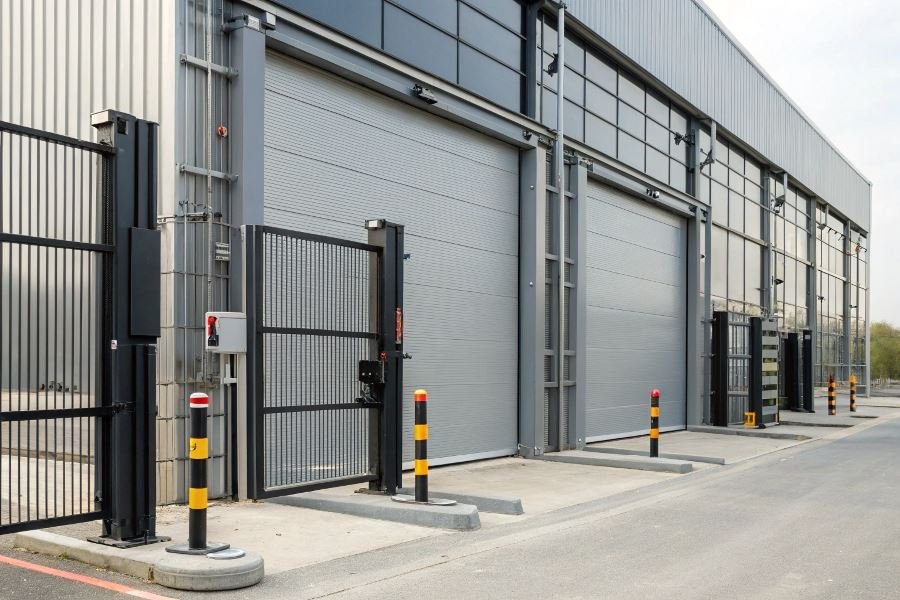
When a 40-ton truck approaches your facility at 5 AM, who’s manning the gate? The answer increasingly points to automation—not just as a convenience, but as a critical security and operational necessity.
Industrial facilities face unique challenges at their perimeters. Every unauthorized entry represents potential theft, safety hazards, or operational disruptions. Meanwhile, every minute a legitimate delivery idles at the entrance translates to lost productivity and frustrated partners. The right automatic gate system addresses both concerns simultaneously.
Recent technological advancements have transformed industrial gate systems from simple barriers to sophisticated access control ecosystems. Modern systems now integrate seamlessly with surveillance cameras, biometric scanners, and facility management software. The days of simple key card access have evolved into multi-factor authentication systems that can distinguish between authorized personnel, expected deliveries, and potential security threats.
When selecting an automatic gate for your industrial facility, three factors should dominate your decision-making process:
-
Traffic volume and type: A manufacturing plant with constant heavy vehicle movement requires fundamentally different gate specifications than a data center with primarily employee vehicles.
-
Security requirements: Consider what you’re protecting. High-value inventory, sensitive information, or dangerous materials demand more robust verification systems and physical barriers.
-
Environmental conditions: Gates in Minnesota face different challenges than those in Arizona. Wind loads, temperature extremes, and precipitation patterns all affect long-term performance.
The most successful industrial gate installations balance security imperatives with operational efficiency—creating protection without creating bottlenecks.
Industrial Gate Solutions for Every Facility Challenge
When securing industrial properties, choosing the right automatic gate system isn’t just about access control—it’s about operational efficiency, security posture, and long-term value. Each industrial facility presents unique challenges that demand specific gate configurations. Understanding which type of automatic gates is suitable for industrial facilities requires evaluating your space constraints, aesthetic requirements, and terrain conditions to make an informed decision that will serve your operation for years to come.
Sliding Gates: Space-Saving Security Champions
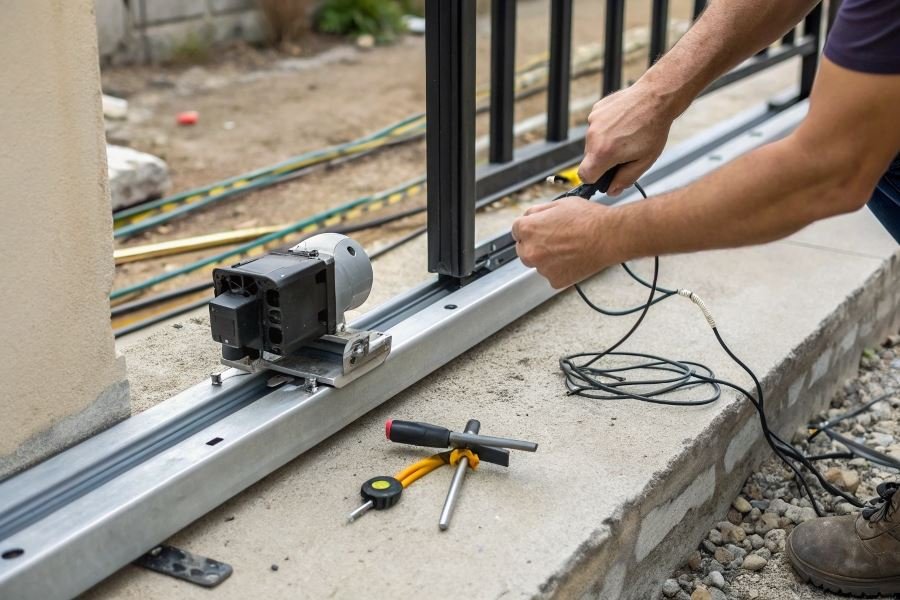
Sliding automatic gates have become the go-to solution for industrial facilities where space comes at a premium. These systems operate on a simple yet effective principle: the gate slides horizontally along a track parallel to your fence line, requiring minimal clearance space.
Key advantages include:
- Space efficiency (requires only the width of the gate panel plus a small overrun)
- Excellent stability for wider openings (up to 50 feet)
- Reduced mechanical stress compared to swing systems
- Wind resistance due to their supported design
Industrial facilities with limited setback from roadways particularly benefit from sliding gates manufactured by companies like Doorking and LiftMaster. These systems can handle heavy daily cycles—often 300+ operations per day—making them ideal for manufacturing plants, distribution centers, and logistics hubs.
Swing Gates: Traditional Security with Modern Controls
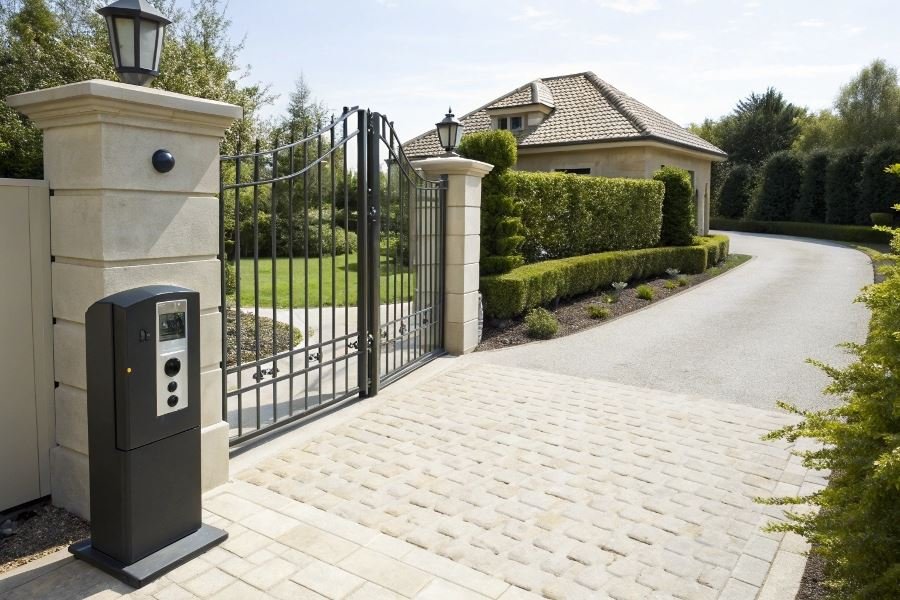
For industrial properties where aesthetics matter or where space permits a more traditional approach, swing automatic gates offer compelling advantages. These systems operate much like conventional doors, with single or double panels that pivot on hinges.
Swing gates shine in these industrial applications:
- Corporate headquarters where visual appeal matters
- Facilities with ample approach space
- Sites requiring occasional oversized vehicle access
- Locations with moderate traffic flow
The swing mechanism requires sufficient clearance both inside and outside the property line, typically equal to the width of the gate itself. Modern swing gate operators from Nice and HySecurity incorporate sophisticated obstacle detection, making them safer than earlier generations despite their sweeping motion.
Cantilever Gates: Conquering Challenging Terrain
When industrial facilities face uneven terrain, snow accumulation, or debris issues, cantilever automatic gates provide an elegant solution. Unlike traditional sliding gates, cantilever systems float above the ground without a bottom track.
Terrain challenges solved by cantilever gates:
| Challenge | How Cantilever Gates Address It |
|---|---|
| Uneven ground | Gate operates above surface variations |
| Snow buildup | No ground track to become obstructed |
| Debris collection | Eliminates track maintenance issues |
| Drainage problems | Allows water to flow naturally underneath |
The cantilever design uses counterbalance principles, requiring approximately 50% more space than the opening width. This extra space houses the counterbalance section that supports the gate when fully open. Tymetal and Ameristar offer industrial-grade cantilever systems capable of spanning openings up to 40 feet while maintaining smooth operation.
Each gate type offers distinct advantages for industrial applications, with selection ultimately depending on your specific operational requirements, available space, and environmental conditions. The right automatic gate becomes an asset that enhances both security and operational efficiency—paying dividends long after installation.
Making the Right Automatic Gate Decision
Matching Gates to Industrial Demands
Selecting the appropriate automatic gate for an industrial facility isn’t just about security—it’s about operational efficiency. The right gate becomes an asset; the wrong one, a daily frustration. Start by evaluating your facility’s specific traffic patterns. A manufacturing plant with constant heavy vehicle movement requires fundamentally different solutions than a warehouse with periodic deliveries.
Consider your space constraints carefully. Sliding gates excel in areas with limited swing clearance, while vertical lift gates make perfect sense for facilities with minimal side clearance but ample overhead space. For high-security installations like data centers or energy facilities, double-verification entry systems with cantilever gates provide both physical barriers and controlled access points.
Environmental factors demand equal attention. Facilities in northern regions should prioritize gates with cold-weather operational ratings and snow-clearing capabilities. Meanwhile, coastal industrial sites benefit from corrosion-resistant materials like marine-grade aluminum or galvanized steel from manufacturers like FAAC or LiftMaster.
The most expensive gate isn’t always the right gate—but the right gate always delivers the best long-term value.
Cost Considerations Beyond Purchase Price
Initial purchase price represents just one financial factor in the automatic gate equation. A comprehensive cost analysis must include:
| Cost Factor | Typical Range | Considerations |
|---|---|---|
| Initial Installation | 5, 000−25,000 | Gate type, size, automation complexity |
| Annual Energy Consumption | 200−800 | Motor size, cycles per day, efficiency rating |
| Maintenance | 500−2,000/year | Preventative service, parts replacement |
| Downtime Costs | Variable | Production delays during failures |
| Lifespan | 7-20 years | Material quality, usage intensity |
Hydraulic systems from Hy-Security might command premium pricing but deliver exceptional durability under extreme usage conditions—often operating for 15+ years with minimal maintenance. Meanwhile, chain-driven systems offer more economical entry points but typically require more frequent adjustment and component replacement.
The true ROI emerges when analyzing total ownership costs against operational benefits. A gate system that prevents unauthorized access while maintaining efficient traffic flow can pay for itself through reduced security staffing and minimized production interruptions.
Professional Support Systems
Even the most robust automatic gate requires professional installation and ongoing maintenance. When selecting installation partners, verify their industrial-specific experience—commercial installers often lack familiarity with the unique demands of industrial environments.
Establish a preventative maintenance schedule based on usage intensity. High-cycle facilities (100+ operations daily) benefit from quarterly professional inspections, while moderate-use facilities might manage with semi-annual service. Maintenance contracts from companies like Doorking often include priority emergency response—a critical consideration when downtime means lost production.
Document your gate’s performance metrics to identify patterns before they become problems. Increasing open/close times, unusual sounds, or intermittent operation all signal potential issues that, addressed early, prevent costly emergency repairs.
The ideal automatic gate selection process combines thorough requirement analysis, comprehensive cost evaluation, and establishment of professional support systems. When these elements align, your industrial facility gains not just a security barrier, but a genuine operational asset.
Discover the optimal automatic gate solutions for industrial facilities. Compare sliding, swing, and cantilever gates based on security needs, space constraints, and terrain conditions to maximize operational efficiency and site protection.
Discover the optimal automatic gate solutions for industrial facilities. Compare sliding, swing, and cantilever gates based on security needs, space constraints, and terrain conditions to maximize operational efficiency and site protection.