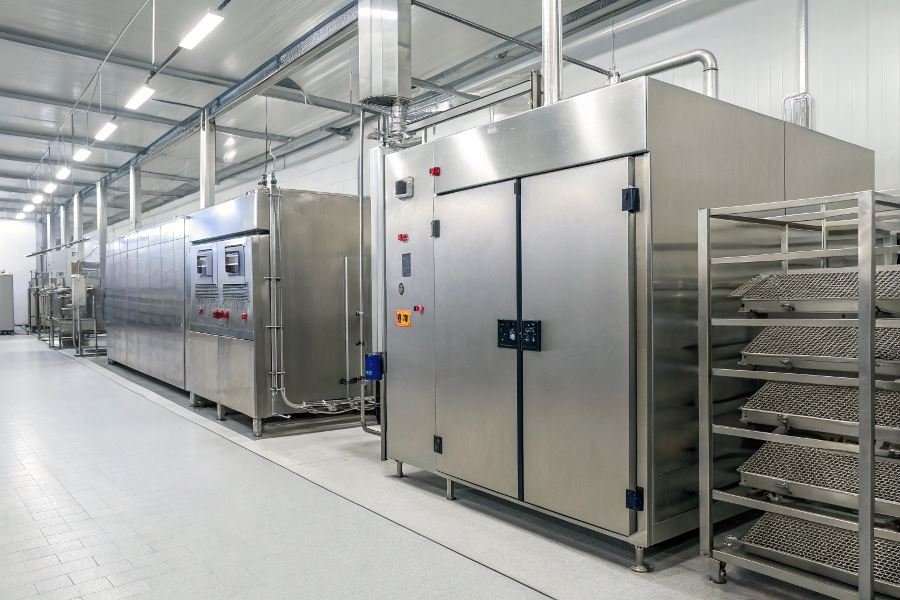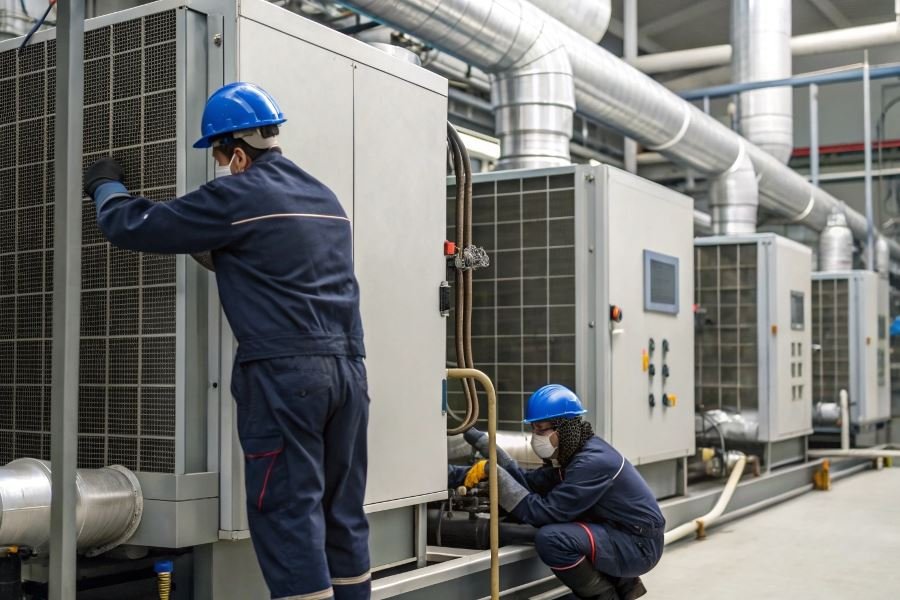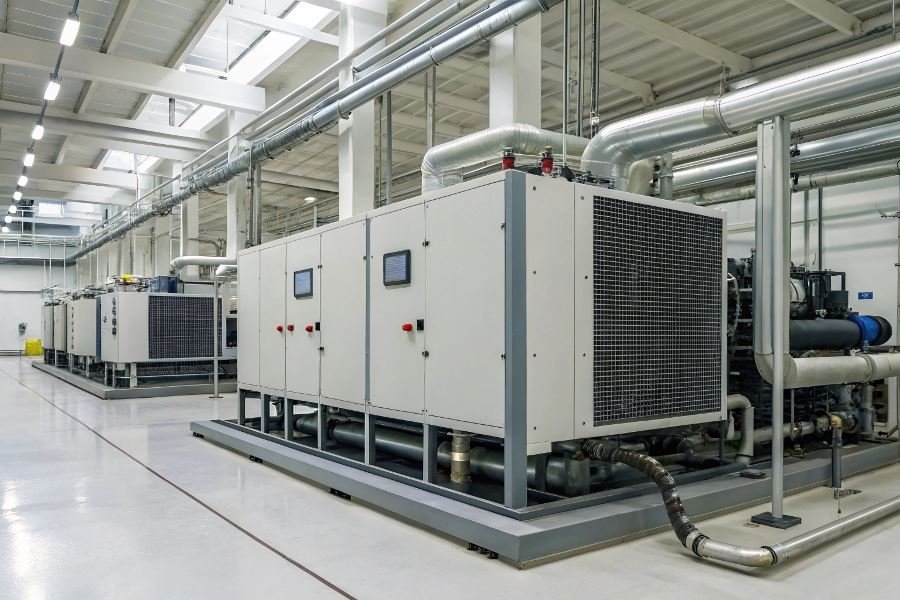
What’s the one system that can make or break your production line without ever being seen by customers? Industrial chillers silently power manufacturing across America, yet many plant managers struggle to select the right one—costing thousands in wasted energy and production delays.
Industrial chillers are specialized cooling systems that remove heat from machinery, materials, and processes in manufacturing environments. Unlike their commercial cousins, these robust systems maintain precise temperatures in the most demanding conditions, extending equipment life and ensuring product quality. When a pharmaceutical company needs to cool reaction vessels to exactly 41°F or a plastic injection molder requires consistent cooling for perfect parts, industrial chillers deliver that precision.
Every industrial chilling system relies on four key components working in harmony: the compressor (the powerhouse that pressurizes refrigerant), the condenser (where heat dissipates), the expansion valve (controlling refrigerant flow), and the evaporator (where the actual cooling happens). These components form a closed-loop system that continuously extracts heat from your production process.
The efficiency equation
Selecting the appropriate chiller isn’t just about cooling capacity—it’s about optimizing your entire operation. An undersized unit will struggle constantly, while an oversized one wastes energy through inefficient cycling. The right industrial chiller becomes a strategic asset, reducing downtime, improving product consistency, and cutting energy costs by up to 30% compared to outdated systems.
The Decision Maker’s Guide to Industrial Chillers
Selecting the right industrial chiller for your production facility isn’t just a purchasing decision—it’s a strategic investment that impacts everything from product quality to your bottom line. The process of how to choose an industrial chiller for production requires careful analysis of several critical factors that will determine whether your cooling system becomes an asset or a liability.
Calculating Your Cooling Requirements
The foundation of any successful chiller selection begins with precise load calculations. Your cooling capacity requirements, measured in tons or kilowatts, must match your production demands with room for future expansion.
Proper sizing is non-negotiable. Undersized chillers lead to production bottlenecks and equipment strain, while oversized units waste capital and energy. Industry experts recommend:
- Calculating your heat load based on all heat-generating equipment
- Adding a 10-15% safety factor (not more)
- Considering seasonal temperature fluctuations
- Accounting for future production increases
Air-Cooled vs. Water-Cooled: The Great Debate
The chiller type you select dramatically impacts installation requirements, efficiency, and maintenance needs.
| Feature | Air-Cooled Systems | Water-Cooled Systems |
|---|---|---|
| Installation | Simpler, requires outdoor space | More complex, needs cooling tower |
| Efficiency | Lower at high ambient temperatures | Higher efficiency year-round |
| Water Usage | None | Significant |
| Maintenance | Condenser cleaning, fan service | Requires water treatment, more components |
| Initial Cost | Lower | Higher |
| Operating Cost | Higher energy consumption | Lower energy but water costs apply |
Air-cooled chillers from Carrier offer plug-and-play simplicity but sacrifice efficiency when temperatures soar. Water-cooled systems from manufacturers like Trane deliver superior efficiency but demand more complex infrastructure.
Navigating Space and Installation Realities
Your facility’s physical constraints often dictate viable options. Consider:
- Clearance requirements for airflow (especially for air-cooled units)
- Floor loading capacity for equipment weight
- Access for maintenance and potential replacement
- Noise considerations for nearby work areas
- Vibration isolation needs
Indoor vs. outdoor placement creates another decision point. Indoor installations protect equipment but consume valuable floor space. Outdoor installations free up space but require weather protection and may face municipal noise restrictions.
The Economics of Efficiency
Energy consumption typically represents 60-80% of a chiller’s lifetime cost, dwarfing the initial purchase price. Modern chillers from Johnson Controls feature variable speed drives that can reduce energy consumption by up to 30% compared to fixed-speed alternatives.
Key efficiency indicators include:
- Coefficient of Performance (COP)
- Integrated Part Load Value (IPLV)
- kW/ton ratings at various loads
The most efficient system for your application depends on your load profile. A facility with consistent, full-load operation benefits from different technology than one with variable demands.
Precision Control for Quality Production
Temperature stability directly impacts product quality in many industries. Modern control systems offer:
- ±0.5°F temperature precision
- Remote monitoring capabilities
- Predictive maintenance alerts
- Integration with facility management systems
- Data logging for quality assurance
Daikin and York offer sophisticated control platforms that provide both precision and visibility into system performance.
The right industrial chiller balances these factors against your specific production requirements, creating a cooling solution that supports quality, efficiency, and reliability for years to come.
Sealing the Deal: Your Industrial Chiller Decision Framework
When you’ve analyzed cooling requirements, compared technologies, and narrowed down your options, you’re approaching the final stretch of your industrial chiller selection journey. This critical phase requires looking beyond specifications to ensure your investment delivers long-term value and performance reliability.
The manufacturer reputation advantage
The difference between a reliable cooling system and a production nightmare often comes down to who built it. Top-tier manufacturers like Trane, Carrier, and York have established their reputations through decades of engineering excellence and consistent performance.
When evaluating manufacturers, dig deeper than marketing materials:
- Investigate case studies from your specific industry
- Request references from facilities with similar production demands
- Check industry forums for unfiltered feedback on reliability
- Verify warranty terms and exclusions (the fine print matters)
The true measure of a manufacturer isn’t how their equipment performs on day one, but how it’s running in year seven.
Service support infrastructure deserves equal scrutiny. Even the most robust chiller will eventually require maintenance or repairs. Leading manufacturers maintain extensive service networks with rapid response capabilities and parts availability. Ask pointed questions about:
- Emergency response times (in hours, not days)
- Availability of factory-certified technicians in your region
- Remote monitoring capabilities
- Preventative maintenance programs
Beyond sticker shock: total cost of ownership
Initial purchase price represents just 10-15% of your chiller’s lifetime cost. Energy consumption typically accounts for 70-80%, with maintenance making up the remainder. A comprehensive TCO analysis should include:
| Cost Component | Typical Percentage | Considerations |
|---|---|---|
| Initial Investment | 10-15% | Equipment, installation, commissioning |
| Energy Consumption | 70-80% | Efficiency ratings, part-load performance |
| Maintenance | 10-15% | Preventative service, parts replacement |
| Downtime Risk | Variable | Production losses during failures |
A chiller with a $75,000 higher purchase price but 20% better efficiency can deliver ROI within 2-3 years in high-usage environments. Factor in reliability differences, and the premium option often becomes the clear financial winner.
Future-proofing for production evolution
Production requirements rarely remain static. The chiller you select today must accommodate tomorrow’s demands without premature replacement.
Smart future-proofing strategies include:
- Modular systems that allow capacity expansion without complete replacement
- Variable-speed technology that maintains efficiency across changing load profiles
- Compatibility with alternative refrigerants as regulations evolve
- Digital integration capabilities for advanced monitoring and predictive maintenance
Consider your production roadmap for the next 5-10 years. If you’re operating at 70% of your chiller’s capacity on day one, you’ve likely over-specified. Conversely, running at 95% capacity leaves little room for growth or unexpected demand spikes.
The most successful chiller implementations balance current needs with strategic headroom, typically targeting 80-85% of maximum capacity at installation. This approach provides operational efficiency while accommodating reasonable growth without immediate reinvestment.
By thoroughly evaluating manufacturer reputation, calculating true ownership costs, and strategically planning for future requirements, you’ll select an industrial chiller that delivers reliable performance, operational efficiency, and adaptability for years to come.
Discover how to select the optimal industrial chiller for your manufacturing needs with our comprehensive guide. Learn about cooling capacity requirements, system types, energy efficiency considerations, and key factors that maximize production efficiency and ROI.
Discover how to select the optimal industrial chiller for your manufacturing needs with our comprehensive guide. Learn about cooling capacity requirements, system types, energy efficiency considerations, and key factors that maximize production efficiency and ROI.