
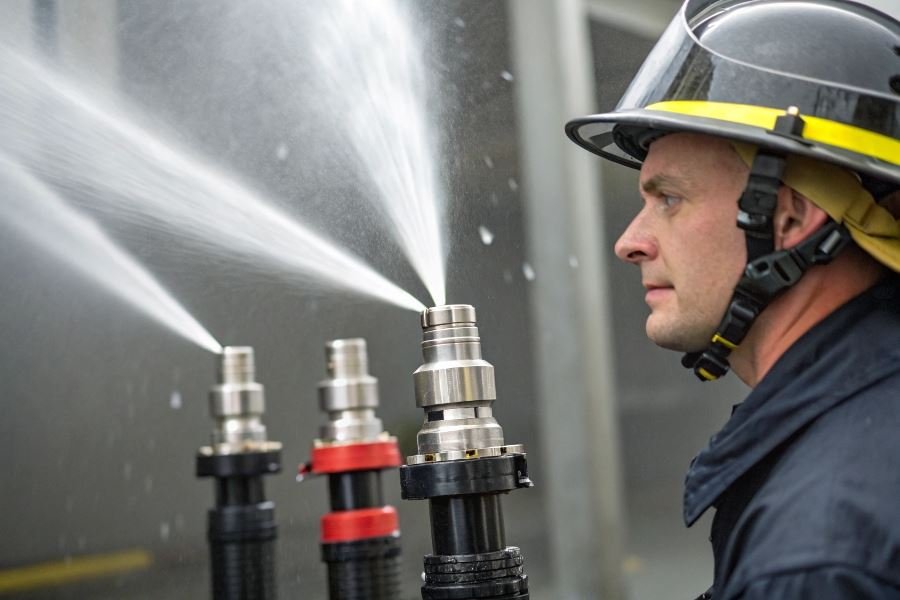
When flames erupt in an industrial setting, the difference between containment and catastrophe often comes down to one critical piece of equipment: the fire hose. These unassuming tools represent the frontline defense against potentially devastating industrial fires, yet many facility managers overlook their strategic importance until it’s too late.
Fire hoses in industrial environments face challenges residential systems never encounter—corrosive chemicals, extreme temperatures, and punishing physical conditions. Selecting the right hose isn’t merely about compliance; it’s about protecting lives, assets, and business continuity. The National Fire Protection Association reported that industrial fires cause over $1 billion in direct property damage annually, with inadequate fire suppression equipment cited as a contributing factor in many cases.
When evaluating industrial-grade fire hoses, three factors demand priority attention: pressure rating, material composition, and coupling compatibility. A hose rated for 300 PSI might excel in a warehouse setting but fail catastrophically in a chemical processing facility where higher pressures are required. Similarly, the material composition—whether rubber, polyurethane, or specialized polymers—determines resistance to oils, chemicals, and abrasion.
Current NFPA standards (particularly NFPA 1961) establish rigorous performance requirements for industrial fire hoses, with compliance verification through third-party testing. Beyond meeting these baseline standards, facility managers should consider their specific operational risks, environmental conditions, and response protocols when selecting fire hoses that truly protect their most valuable assets.
Fire Hose Showdown: The Elite Three for Industrial Protection
When facility safety hangs in the balance, your fire hose selection becomes a mission-critical decision. The marketplace offers countless options, but three distinct categories have emerged as the gold standard for industrial applications. Let’s dive into what makes these fire hoses the preferred choice for safety professionals who refuse to compromise.
Industrial facilities require specialized fire suppression equipment that can withstand extreme conditions while delivering reliable performance. The top 3 fire hoses for industrial facilities represent different approaches to the same challenge: delivering water or firefighting agents precisely where needed, when needed, without failure. Each type offers unique advantages that make them suitable for specific industrial environments and applications.
High-Pressure Rubber-Lined Hoses: The Heavyweight Champion
High-pressure rubber-lined fire hoses represent the pinnacle of durability in harsh industrial environments. These robust defenders feature:
- Multi-layer construction with an inner rubber lining, reinforced with multiple plies of synthetic or natural fibers
- Pressure ratings exceeding 300 PSI for standard models, with specialized variants reaching 800+ PSI
- Working temperature ranges from -40°F to 140°F in standard configurations
The secret to their exceptional performance lies in the vulcanized rubber lining that creates an impermeable water barrier while the outer jacket provides abrasion resistance. These hoses excel in chemical plants, refineries, and manufacturing facilities where exposure to oils, chemicals, and extreme temperatures is common.
The rubber lining’s resistance to petroleum products makes these hoses indispensable in oil and gas operations where other hose types would quickly deteriorate.
Maintenance requirements include regular pressure testing (typically annually) and proper drainage after use to prevent mildew growth between the layers.
Synthetic Double-Jacket Hoses: The Versatile Performer
When weight matters but performance can’t be compromised, synthetic double-jacket hoses deliver impressive results:
| Feature | Specification | Benefit |
|---|---|---|
| Weight | 40-50% lighter than rubber-lined | Reduced fatigue during deployment |
| Material | Polyester/nylon outer & inner jackets | Superior abrasion resistance |
| Pressure Rating | 200-300 PSI typical | Suitable for most industrial applications |
| Flexibility | Maintains flexibility at low temperatures | All-weather performance |
These hoses have revolutionized industrial firefighting by combining the durability of traditional hoses with advanced materials science. The double-jacket construction creates a remarkably resilient hose that resists both internal pressure and external damage.
Particularly well-suited for large manufacturing facilities, warehouses, and distribution centers, these hoses offer the ideal balance between durability and maneuverability. Their quick-drying properties also reduce maintenance time and extend service life.
Single-Jacket Industrial Hoses: The Practical Solution
For facilities with budget constraints or less severe hazard profiles, single-jacket industrial fire hoses deliver remarkable value:
- Cost-effective deployment across larger facilities without compromising basic safety requirements
- Simplified maintenance with single-layer construction allowing faster inspection and repair
- Lightweight design enabling faster deployment by smaller teams
These hoses typically feature a single-layer polyester jacket with a thin elastomer lining, providing adequate protection for light industrial applications, commercial buildings, and auxiliary systems.
The reduced material complexity translates to approximately 30-40% cost savings compared to double-jacket alternatives, making them ideal for secondary systems or facilities with lower risk profiles.
While they may not withstand the extreme conditions their more robust counterparts can handle, their practical balance of performance and affordability makes them an intelligent choice for many industrial applications.
Maximizing Your Fire Hose Investment
Installation and storage that saves lives
Proper installation of industrial fire hoses isn’t just about compliance—it’s about survival. The most sophisticated Angus Fire or Key Fire Hose products become useless when improperly installed or stored. Industry leaders recommend wall-mounted hose racks positioned at 5-foot intervals throughout facilities, ensuring accessibility within 15 seconds from any location.
Storage conditions dramatically impact hose longevity. Temperature-controlled environments between 40-70°F prevent rubber degradation, while humidity control systems maintain optimal 40-60% relative humidity. The difference? A properly stored hose lasts 8-10 years versus 2-3 years for improperly stored equipment.
The most expensive fire hose is the one that fails during an emergency because it was folded instead of rolled during storage.
For facilities with limited space, vertical hose reels offer 60% space savings compared to traditional storage methods while maintaining rapid deployment capability.
Maintenance schedules that prevent failure
Fire hose maintenance isn’t optional—it’s essential. Industry standards require:
| Inspection Type | Frequency | Key Components |
|---|---|---|
| Visual | Weekly | Visible damage, coupling integrity |
| Pressure Testing | Quarterly | Service test at 150% operating pressure |
| Comprehensive | Annually | Full disassembly, internal inspection |
| Recertification | Every 3 Years | Third-party testing and documentation |
Documentation proves particularly crucial for insurance compliance and liability protection. Digital maintenance tracking systems from providers like FireServicePlus automatically generate inspection reports and maintenance alerts, reducing oversight failures by 78%.
The most overlooked maintenance aspect? Proper drying after use or testing. Moisture trapped inside hoses accelerates deterioration and promotes mold growth, potentially reducing operational lifespan by 40%.
Cost considerations beyond the price tag
Initial purchase price represents only 23% of a fire hose’s lifetime cost. Facility managers must consider:
- Installation infrastructure – Proper mounting systems average $120-350 per station
- Maintenance equipment – Testing apparatus and cleaning systems cost $2,500-7,000
- Replacement parts – Couplings and gaskets require periodic replacement at $75-200 per instance
- Training costs – Staff certification for proper handling averages $1,200 annually
Premium hoses command higher upfront costs but deliver superior economics over time. A Potter Roemer industrial-grade hose might cost 40% more initially but requires 60% fewer replacements over a 10-year period.
For large facilities, implementing a rotating replacement schedule distributes costs evenly while maintaining optimal safety levels. Rather than replacing all hoses simultaneously, phasing replacements over 3-5 year cycles creates predictable budget requirements.
The most compelling investment consideration? Insurance premium reductions. Facilities with certified premium fire hose systems and documented maintenance protocols qualify for premium reductions averaging 7-12%, often offsetting the entire cost of a premium hose system within 36 months.
Discover the top 3 industrial fire hoses that meet rigorous safety standards while delivering exceptional performance. Compare high-pressure rubber-lined, synthetic double-jacket, and single-jacket options for optimal facility protection and compliance.
Discover the top 3 industrial fire hoses that meet rigorous safety standards while delivering exceptional performance. Compare high-pressure rubber-lined, synthetic double-jacket, and single-jacket options for optimal facility protection and compliance.
