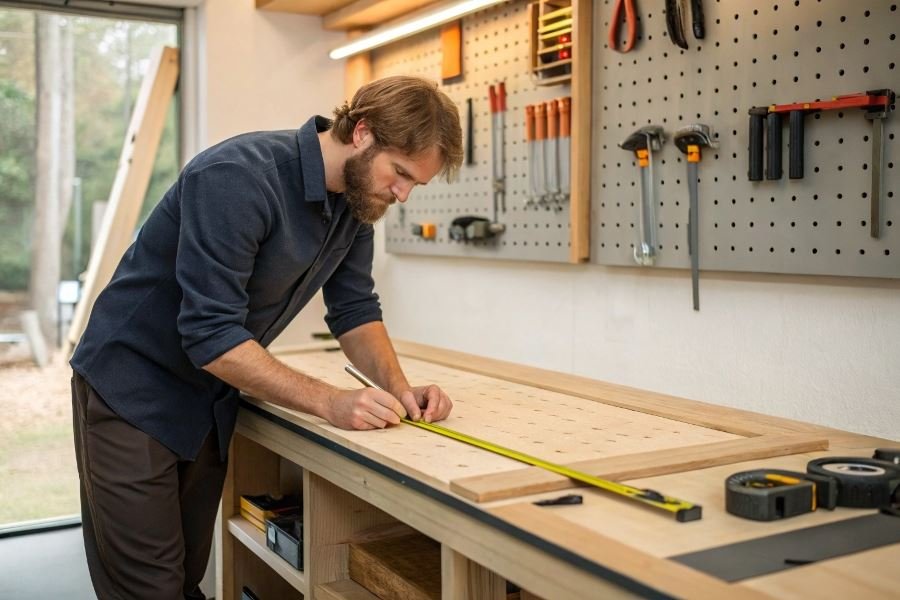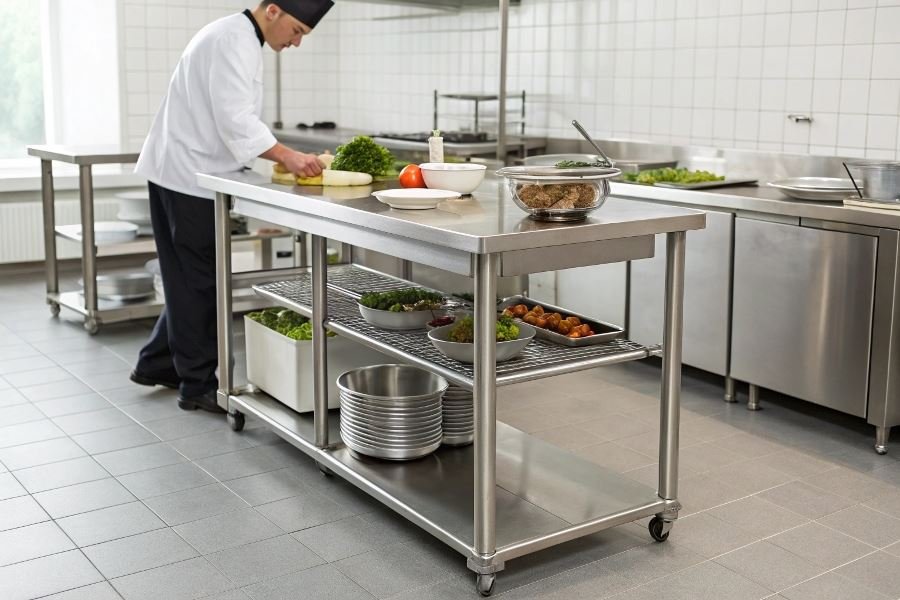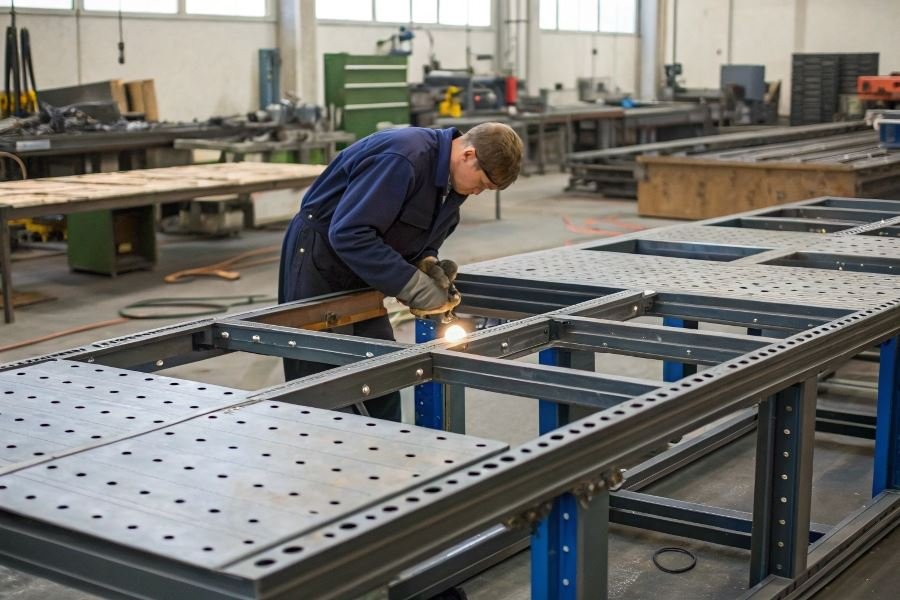
Ever watched a master craftsman transform raw materials into something extraordinary? Behind every perfect cut, precise weld, and flawless finish stands an unsung hero: the work table. But not all tables are created equal—and your choice between modular and welded designs could make or break your workflow.
When professionals debate workshop equipment, the “modular versus welded work table” question inevitably sparks passionate discussion. This fundamental choice affects everything from your initial investment to your workshop’s future flexibility.
Modular work tables: Building blocks of workshop freedom
Modular work tables represent the ultimate in adaptability. These systems feature components that connect through bolts, clamps, or other fastening mechanisms, allowing for:
- Reconfiguration on demand: Change layouts as projects evolve
- Scalability: Start small and expand as needs grow
- Transportability: Disassemble for relocation or storage
- Customization: Mix and match components from compatible systems
The defining characteristic? Freedom to evolve. Modular tables grow with your business, adapting to changing requirements without requiring complete replacement.
Welded work tables: Unwavering stability meets permanence
Welded work tables stand as monuments to stability. These one-piece behemoths feature:
- Superior rigidity: No movement or flex during heavy-duty operations
- Maximum load capacity: Support for substantial weight without compromise
- Longevity: Decades of service without loosening components
- Simplicity: No assembly or maintenance of connection points
The hallmark of welded tables is their rock-solid dependability. When absolute stability matters more than flexibility, welded tables deliver uncompromising performance.
Decision factors: Finding your perfect match
Your ideal choice hinges on several critical factors:
- Workshop permanence: Temporary space or forever home?
- Project diversity: Consistent work or constantly changing requirements?
- Budget considerations: Initial investment versus long-term value
- Space constraints: Fixed footprint or changing layout needs
The perfect table isn’t universal—it’s the one that aligns with your specific workflow demands and future vision.
The Ultimate Showdown: Modular vs Welded Work Tables
Durability That Stands the Test of Time
When evaluating industrial work surfaces, load capacity and structural integrity top the list of critical factors. Welded work tables traditionally dominate this category, offering impressive weight-bearing capabilities often exceeding 1,000 pounds. Their one-piece construction eliminates weak points, creating a rock-solid foundation for heavy machinery and intense applications.
Modular tables have dramatically closed this gap in recent years. High-quality modular systems now feature reinforced connection points and premium materials that can match many welded options. The decision between modular vs welded work tables: what to choose often hinges on specific load requirements rather than assuming one type universally outperforms the other. Modern modular tables from manufacturers like Festool can support 500-800 pounds, sufficient for most workshop applications.
Adaptability in Changing Environments
Flexibility represents the undisputed advantage of modular systems. These tables transform to meet evolving needs:
- Height adjustability for ergonomic customization
- Expandable surfaces for larger projects
- Reconfigurable layouts as workflow changes
- Component interchangeability for specialized tasks
Welded tables offer unwavering stability but remain permanently fixed in their original configuration. This limitation becomes particularly relevant for businesses experiencing growth or frequent process changes.
The True Cost Equation
Initial investment typically favors welded tables, which can cost 15-30% less than comparable modular systems. However, this simple comparison misses the complete financial picture:
| Cost Factor | Welded Tables | Modular Tables |
|---|---|---|
| Initial Purchase | Lower | Higher |
| Shipping/Delivery | Higher (pre-assembled) | Lower (flat-packed) |
| Replacement (if damaged) | Complete unit | Individual components |
| Expansion Capability | Additional tables required | Add-on components |
| Resale Value | Lower | Higher |
The long-term value proposition often tilts toward modular systems, especially for operations anticipating change or growth. Their ability to evolve eliminates the need for complete replacement when requirements shift.
From Delivery to Deployment
Assembly requirements create another significant distinction between these options. Welded tables arrive ready for immediate use—a considerable advantage for operations lacking technical staff or facing time constraints. This convenience comes with logistical challenges, as their fixed structure complicates transportation through narrow doorways or tight spaces.
Modular systems require initial assembly, typically taking 1-3 hours depending on complexity. This investment pays dividends in transportation flexibility and future adaptability. Many premium systems from companies like Festool and Kreg feature tool-free assembly, significantly reducing setup complexity.
Maintaining Operational Excellence
Maintenance considerations reveal another crucial difference. Welded tables, while exceptionally durable, present challenges when damage occurs. A compromised weld or bent frame often necessitates complete replacement or specialized repair services.
Modular tables offer a component-based approach to maintenance:
- Damaged sections can be individually replaced
- Worn surfaces can be upgraded without replacing the entire structure
- Connections can be tightened or reinforced as needed
This modular approach typically results in lower lifetime maintenance costs and reduced downtime when issues arise.
The ideal choice ultimately depends on your specific operational requirements, growth projections, and workspace constraints. Both options deliver exceptional performance when properly matched to their intended application.
Making the Right Choice for Your Workspace
Where Modular Tables Excel
Modular work tables shine in environments that demand flexibility and adaptability. These systems thrive in settings where workspace configurations change frequently or where future expansion is anticipated.
Research and development labs represent perfect candidates for modular solutions. Scientists and engineers often reconfigure their workspaces as projects evolve, requiring different equipment arrangements and collaborative setups. The ability to quickly adjust table height, add accessories, or reconfigure the entire layout makes modular systems invaluable in these dynamic environments.
Small manufacturing operations benefit tremendously from modular flexibility. As production needs shift or new product lines emerge, these businesses can adapt their workspace without investing in entirely new furniture. A modular system from companies like Treston or Lista allows for gradual scaling as the business grows.
Educational workshops represent another ideal application. These spaces serve multiple classes with varying needs, from electronics to woodworking. Modular tables can be reconfigured between sessions, maximizing the utility of limited space.
When Welded Tables Make Perfect Sense
Welded work tables deliver unmatched stability and durability in high-demand environments where configurations rarely change.
Heavy industrial settings with constant vibration, substantial weight loads, or harsh conditions demand welded construction. Manufacturing floors using equipment like hydraulic presses or CNC machines benefit from tables that won’t shift or wobble under extreme forces. Products from Strong Hold exemplify this industrial-grade construction.
Automotive repair shops represent textbook cases for welded tables. Mechanics regularly apply significant torque when working on components, requiring rock-solid work surfaces that won’t flex or shift. The permanence and stability of welded construction prevent accidents and ensure precision.
Long-term production lines benefit from welded tables’ consistency. When a process has been optimized and will remain unchanged for years, the fixed nature of welded tables becomes an advantage rather than a limitation.
Decision Framework for Your Industry
| Industry | Primary Consideration | Recommended Type |
|---|---|---|
| Electronics | ESD protection, frequent reconfiguration | Modular |
| Heavy Manufacturing | Load capacity, stability | Welded |
| Laboratory | Cleanability, adaptability | Modular |
| Automotive | Durability, heavy-duty use | Welded |
| Education | Versatility, storage options | Modular |
| Warehouse | Fixed workflow, durability | Welded |
When evaluating your specific needs, consider these critical factors:
-
Anticipated workspace changes: If your layout will evolve frequently, modular systems offer significant advantages.
-
Budget timeline: Modular systems typically require higher initial investment but offer long-term flexibility. Welded tables often cost less upfront but provide less adaptability.
-
Load requirements: For applications regularly handling items exceeding 500 pounds, welded tables typically provide superior stability.
-
Space constraints: In tight workspaces, modular systems with integrated storage solutions maximize efficiency.
-
Industry-specific requirements: Consider whether your field has unique needs like BIFMA compliance for office settings or NSF certification for food service.
The ideal choice ultimately depends on balancing immediate operational requirements against anticipated future needs. Organizations experiencing rapid growth or frequent process changes benefit most from modular flexibility, while established operations with consistent workflows often find welded tables’ durability and lower cost more advantageous.
Discover the key differences between modular and welded work tables to make the right choice for your workspace. Compare durability, flexibility, cost, and maintenance factors to find the perfect solution for your specific industry needs and operational requirements.
Discover the key differences between modular and welded work tables to make the right choice for your workspace. Compare durability, flexibility, cost, and maintenance factors to find the perfect solution for your specific industry needs and operational requirements.