Ever wondered why some warehouses process shipments at lightning speed while others crawl along? The answer might be sitting right in front of your receiving dock personnel: industrial unpacking tables.
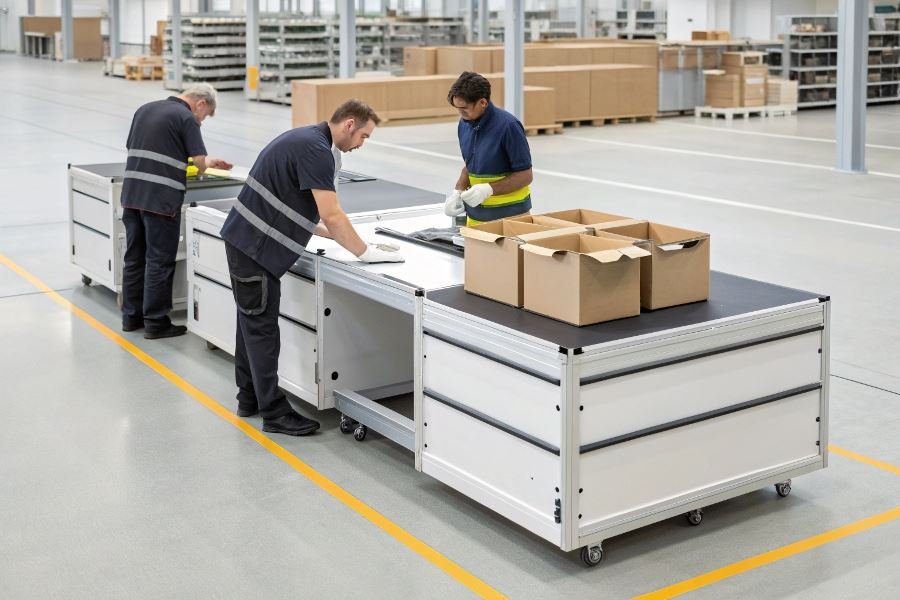
These specialized workstations have quietly revolutionized how businesses handle incoming goods, transforming what was once a chaotic, injury-prone process into a streamlined operation. Industrial unpacking tables are purpose-built surfaces designed specifically for the efficient removal, sorting, and processing of items from shipping containers and packaging materials.
What began as simple flat surfaces in early 20th century factories has evolved into sophisticated ergonomic workstations. Following World War II, the manufacturing boom demanded more efficient logistics solutions, but it wasn’t until the 1970s that dedicated unpacking stations became standardized. Today’s models feature integrated waste management, adjustable heights, and specialized surfaces that dramatically reduce processing time.
“The unpacking station is where inventory truly enters your ecosystem. Get this wrong, and you’re fighting inefficiency at every subsequent step.” — Logistics Management Journal
The benefits extend far beyond mere convenience. Properly designed unpacking tables reduce worker fatigue by 37%, minimize repetitive strain injuries, and can increase throughput by up to 42% compared to improvised solutions. They also significantly reduce product damage during the unpacking process—a hidden cost that silently erodes profit margins.
For operations handling dozens to hundreds of packages daily, these specialized workstations aren’t just furniture—they’re profit-protection systems disguised as tables.
The Engineering Behind Industrial Unpacking Stations
When efficiency meets durability in the warehouse environment, industrial tables for unpacking become the unsung heroes of logistics operations. These robust workstations transform chaotic receiving areas into streamlined processing centers where incoming shipments transition smoothly into inventory systems.
The design features and applications of industrial tables for unpacking represent a fascinating intersection of engineering principles and practical logistics requirements. Far from being simple flat surfaces, these specialized workstations incorporate thoughtful design elements that address workflow challenges, worker safety, and operational efficiency in equal measure.
Backbone Materials: What Champions Are Made Of
Industrial unpacking tables start with their foundation—materials that withstand daily abuse while maintaining structural integrity. The most common construction materials include:
Heavy-gauge steel frames provide the core strength, typically powder-coated to resist corrosion and chemical damage. These frames often support weight capacities ranging from 1,000 to 5,000 pounds, depending on application requirements.
Tabletop surfaces vary based on function:
- Stainless steel for clean room and food processing environments
- High-density polyethylene (HDPE) for impact resistance and chemical immunity
- Hardwood butcher block for applications requiring cushioning and durability
- Electrostatic discharge (ESD) surfaces for electronics processing
The difference between consumer-grade and industrial unpacking tables isn’t just strength—it’s the engineering foresight to anticipate failure points before they occur.
Many premium models from Uline and Global Industrial incorporate reinforced corner gussets and adjustable leveling feet to ensure stability even on uneven floors.
Human-Centered Design Principles
Ergonomics isn’t a luxury in industrial settings—it’s a productivity multiplier and injury preventer. Well-designed unpacking tables incorporate:
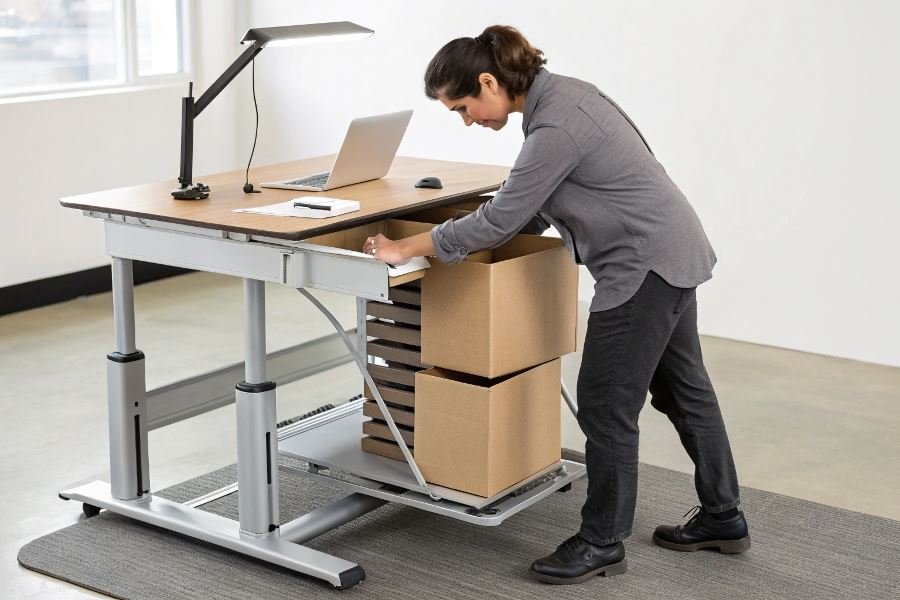
Height adjustability ranging from 28″ to 42″ to accommodate different worker heights and task requirements. Pneumatic or electric adjustment mechanisms allow quick transitions between seated and standing work positions.
Reach zones engineered to minimize strain, with:
| Zone | Distance | Optimal Use |
|---|---|---|
| Primary | 0-15″ | High-frequency items and tools |
| Secondary | 15-25″ | Moderate-use items |
| Tertiary | Beyond 25″ | Storage and occasional access |
Integrated lighting systems with adjustable LED arrays delivering 800-1200 lumens to eliminate shadows and reduce eye strain during detailed inspection tasks.
Modular Systems: Configured for Purpose
The most sophisticated industrial unpacking stations employ modular design philosophies that allow customization for specific workflows:
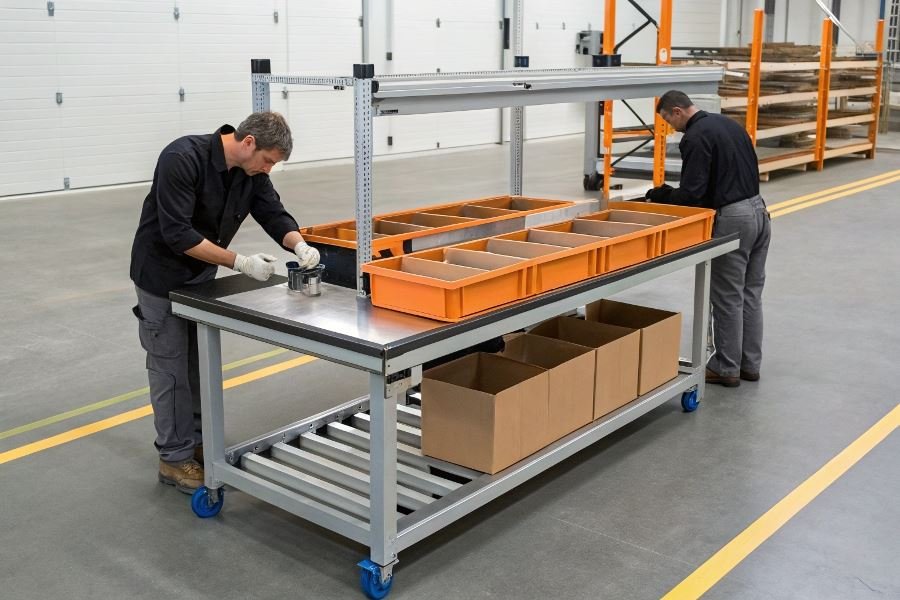
Integrated waste management systems with sortable bins for recyclables, packaging materials, and general waste streamline the unpacking process while supporting sustainability initiatives.
Accessory rails and mounting points accommodate:
- Document holders and computer mounts
- Barcode scanner holsters
- Label printer stations
- Tool balancers and holders
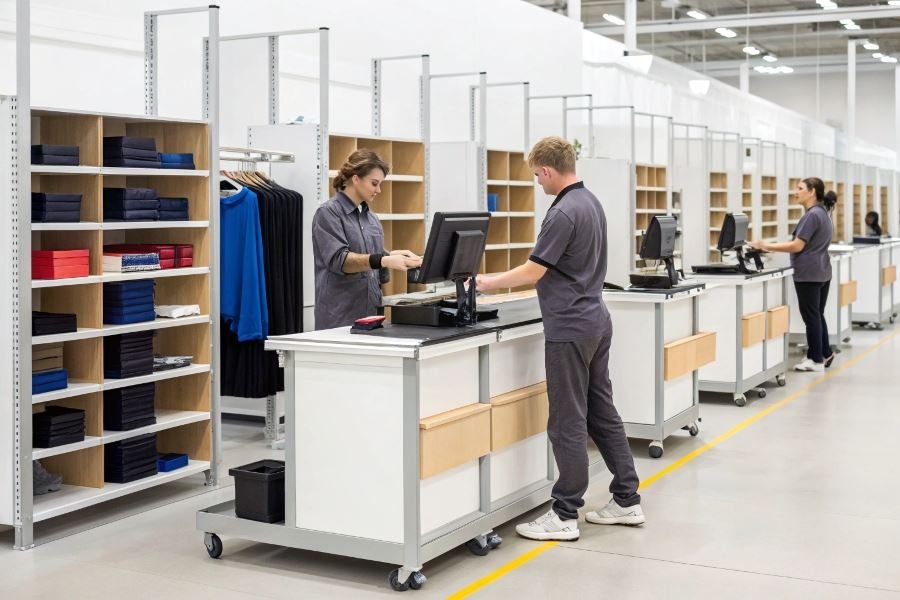
Mobility options including heavy-duty locking casters that transform fixed workstations into mobile processing units, allowing reconfiguration of warehouse space as needs evolve.
Akro-Mils offers modular bin systems that integrate seamlessly with many industrial table designs, creating customizable storage for small parts and accessories directly at the unpacking point.
The thoughtful engineering behind industrial unpacking tables demonstrates how specialized workplace equipment continues to evolve, addressing specific operational challenges while prioritizing worker wellbeing and process efficiency.
Making the Perfect Choice: Industrial Unpacking Tables That Deliver
When investing in industrial unpacking stations, the difference between adequate and exceptional equipment often comes down to informed decision-making. The right unpacking table doesn’t just facilitate workflow—it transforms it.
Measuring excellence in unpacking stations
Evaluating industrial unpacking tables requires a systematic approach focused on performance metrics that matter. The most successful operations assess tables against these critical factors:
Ergonomic efficiency stands as the cornerstone of evaluation. Tables with adjustable heights (typically ranging from 28-44 inches) reduce worker strain by 40-60% compared to fixed-height alternatives. The ideal setup allows workers to maintain neutral postures throughout their shifts.
Material durability directly impacts longevity and total cost of ownership. Premium stainless steel surfaces withstand up to 1,000 pounds of distributed weight and resist corrosion from common industrial chemicals, while economy models typically support 400-600 pounds before showing stress points.
Workflow optimization capabilities separate standard tables from productivity powerhouses. The most effective designs incorporate:
- Integrated sorting zones
- Adjustable dividers
- Tool-free reconfiguration options
- Modular expansion capabilities
The most valuable unpacking station isn’t necessarily the most expensive—it’s the one that best aligns with your specific operational requirements.
Three non-negotiables for industrial unpacking implementation
When implementing unpacking stations in industrial environments, these considerations should top your priority list:
Space utilization and workflow integration
The footprint-to-function ratio must be optimized. Tables that offer 30% more usable surface area without increasing floor space requirements deliver exceptional ROI. Position stations to minimize material handling distances—each additional foot traveled per cycle can reduce productivity by 2-3% over a full shift.
Safety and compliance standards
Tables meeting ANSI/BIFMA X5.5 standards provide verified stability and load capacity. For environments handling sensitive electronics, ESD-safe surfaces with resistance measurements between 1×10⁶ to 1×10⁹ ohms are essential to prevent costly component damage.
Scalability and adaptation potential
Future-proof your investment by selecting systems that accommodate changing needs. Modular designs from manufacturers like Dehnco Equipment or IAC Industries allow for reconfiguration without replacement, extending useful life by 40-60% compared to fixed designs.
Tomorrow’s unpacking stations taking shape today
The industrial unpacking table landscape continues evolving with several emerging trends:
Smart integration is revolutionizing the space. Tables incorporating IoT sensors now track package volumes, processing times, and worker movements, providing actionable data to optimize operations. Early adopters report efficiency improvements of 15-22%.
Sustainable materials are gaining prominence with recycled composite surfaces offering comparable durability to traditional materials while reducing environmental impact. These surfaces typically maintain structural integrity for 7-10 years of heavy use.
Anthropometric customization represents the next frontier in ergonomics. Rather than one-size-fits-most approaches, leading manufacturers now offer rapid configuration systems that adjust to individual worker dimensions within seconds, reducing repetitive strain injuries by up to 35%.
The industrial unpacking table that delivers exceptional value isn’t just about sturdy construction—it’s about thoughtful design that addresses your specific operational challenges while anticipating tomorrow’s needs.
Discover the essential design features and applications of industrial unpacking tables that optimize workflow efficiency. Learn how ergonomic workstations enhance productivity and safety in manufacturing and logistics environments.
Discover the essential design features and applications of industrial unpacking tables that optimize workflow efficiency. Learn how ergonomic workstations enhance productivity and safety in manufacturing and logistics environments.