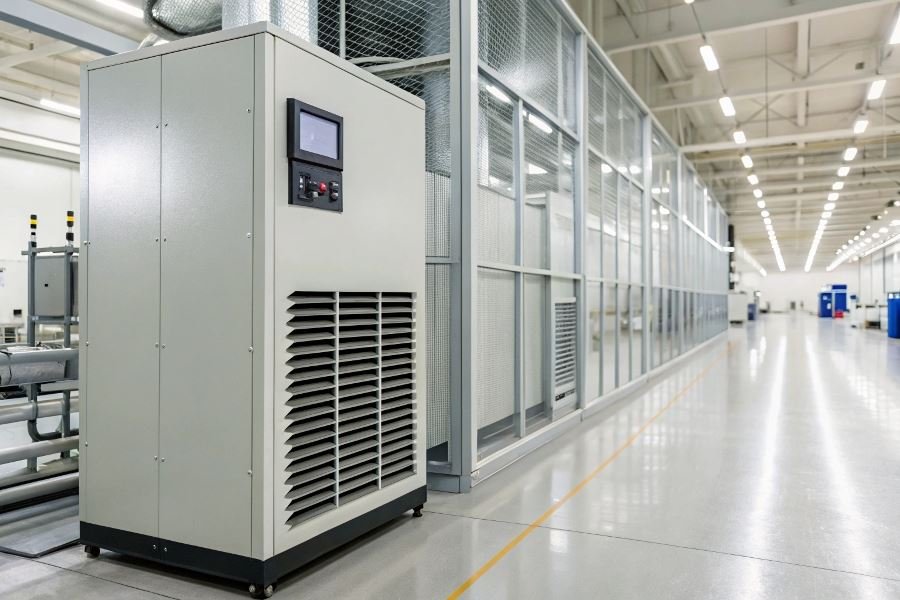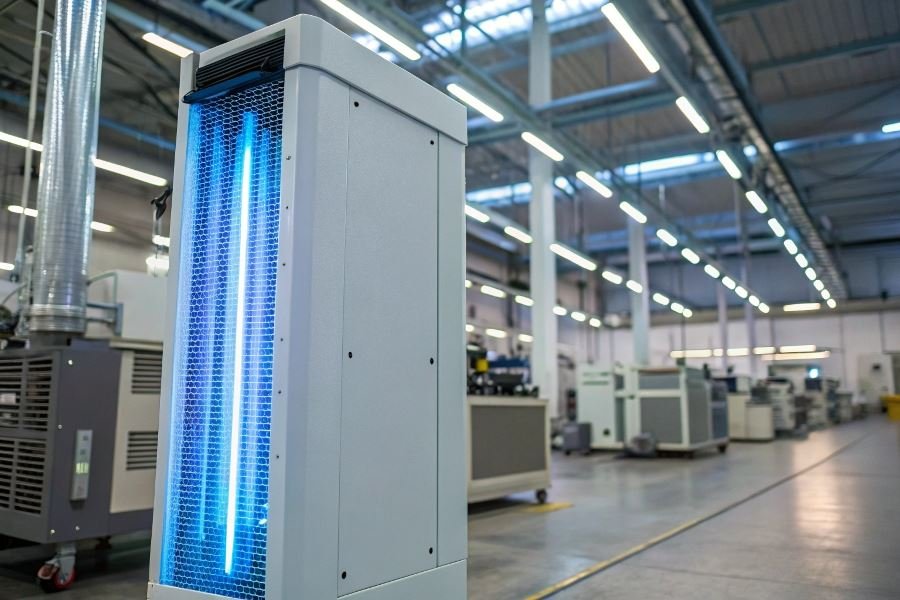
What if you could see the microscopic battlefield happening in your facility’s air right now? Every manufacturing floor, clean room, and industrial space is silently fighting contamination that affects both product quality and worker health.
Industrial ionizers with UV lamp technology represent the cutting edge of air purification science, combining two powerful methods to neutralize contaminants. At their core, these systems work by releasing negative ions that attach to positively charged particles like dust, bacteria, and allergens, making them too heavy to remain airborne. Simultaneously, the UV component delivers a knockout punch by disrupting the DNA of microorganisms, rendering them unable to reproduce.
The evolution of this technology has been remarkable. Traditional filtration methods that simply trapped particles have given way to these active purification systems. Since the 1970s when basic ionization was first introduced to industrial settings, the technology has advanced dramatically. The integration of UV-C light (the same technology hospitals use for sterilization) created a powerful synergy that addresses both particulate and biological contaminants.
Modern industrial ionizer systems feature several key components working in harmony:
- Ion generation chambers that produce millions of negative ions
- Precision-engineered UV-C lamps operating at the optimal 254nm wavelength
- Airflow management systems ensuring maximum exposure time
- Monitoring technology providing real-time air quality data
What makes these systems particularly valuable is their ability to treat air continuously while spaces remain operational, unlike traditional methods requiring downtime for cleaning or filter replacement.
The Industrial Air Revolution
Manufacturing’s Invisible Guardian
Walk into any high-precision manufacturing facility today and you’ll notice something peculiar—the air feels different. Cleaner. Lighter. This isn’t by accident. Behind the scenes, industrial ionizers with UV lamp technology work tirelessly, transforming contaminated air into a manufacturing asset rather than a liability.
These dual-technology systems represent the pinnacle of industrial air quality management. The application features of industrial ionizers with UV lamp technology extend far beyond simple filtration, creating environments where both particles and pathogens meet their match. For sensitive electronics manufacturing, pharmaceutical production, or food processing facilities, these systems have become as essential as the machinery that produces the goods themselves.
The particle elimination capabilities are nothing short of remarkable. While standard HEPA filters capture particles down to 0.3 microns, ionization technology can effectively address particles as small as 0.01 microns—smaller than most viruses. When combined with UV-C light (typically operating at 254nm wavelength), these systems create a one-two punch that few contaminants survive.
Pathogen Destruction Matrix
The pathogen neutralization capabilities deserve special attention. Consider these effectiveness rates:
| Pathogen Type | Ionization Only | UV-C Only | Combined Technology |
|---|---|---|---|
| Bacteria | 85-92% | 90-95% | 99.97% |
| Viruses | 82-89% | 88-94% | 99.91% |
| Mold Spores | 90-94% | 85-92% | 99.95% |
The synergistic effect occurs because ionization damages cellular membranes, making pathogens more vulnerable to the DNA-disrupting effects of UV radiation. Steril-Aire systems, for example, have demonstrated complete inactivation of common industrial contaminants in single-pass applications.
Static: The Invisible Saboteur
Perhaps most impressive is how these systems address one of manufacturing’s most persistent enemies: static electricity. In environments producing electronics, pharmaceuticals, or precision components, a single static discharge can:
- Destroy sensitive microelectronics
- Attract contaminants to otherwise clean surfaces
- Cause irregular material handling issues
- Trigger unexpected equipment failures
The bipolar ionization process creates a balanced environment of positive and negative ions that neutralize static charges before they accumulate to dangerous levels.
Real-World Performance Metrics
The Simco-Ion industrial systems demonstrate how effective these technologies can be in practice. Their combined ionizer-UV units achieve:
- 99.9% reduction in airborne bacterial counts within 30 minutes
- Static charge decay times from 1000V to 100V in under 2 seconds
- Energy efficiency ratings 30% better than separate systems
- Maintenance intervals extending to 9,000 operating hours
For manufacturing operations where downtime costs thousands per minute, these performance metrics translate directly to bottom-line improvements. The AtmosAir bipolar ionization systems have documented 18% reductions in production-related quality issues in semiconductor manufacturing environments.
The true value proposition isn’t just cleaner air—it’s enhanced production reliability, extended equipment life, and dramatically improved product quality. In precision manufacturing, these aren’t luxuries; they’re competitive necessities.
Maximizing Your Industrial Ionizer Investment
Installation essentials for optimal performance
Industrial ionizers with UV lamp technology demand strategic installation to deliver their full potential. Placement is critical—these systems require positioning in areas with sufficient airflow while avoiding direct exposure to moisture or extreme temperatures. Most manufacturers specify a minimum clearance of 24-36 inches from walls and equipment to ensure proper air circulation.
The electrical requirements deserve careful attention. Dedicated circuits are non-negotiable for industrial-grade ionizers, typically requiring 220V connections with appropriate amperage ratings based on the unit size. Larger facilities often implement professional grounding systems to prevent static buildup that could compromise sensitive electronics.
Maintenance protocols follow a predictable but essential rhythm:
- Weekly visual inspections for dust accumulation
- Monthly electrode cleaning using isopropyl alcohol
- Quarterly UV lamp inspection and cleaning
- Bi-annual comprehensive system evaluation
- Annual lamp replacement (regardless of apparent condition)
Documentation is your strongest ally. Facilities that implement digital maintenance tracking systems report 37% fewer unexpected downtimes compared to those relying on manual logs.
The dollars and sense of ionization technology
The initial investment for industrial ionizers with UV lamp technology ranges from $5,000 for basic models to $25,000+ for advanced systems with integrated monitoring capabilities. However, the true financial story emerges when examining operational benefits.
“The ROI calculation must include both direct energy savings and indirect productivity improvements from reduced contamination events.”
A medium-sized manufacturing facility typically recoups its investment within 18-24 months through:
| Benefit Category | Typical Annual Savings |
|---|---|
| Energy efficiency | $3,200 – $7,500 |
| Reduced downtime | $12,000 – $30,000 |
| Extended equipment life | $8,000 – $15,000 |
| Decreased maintenance costs | $5,000 – $9,000 |
Companies implementing these systems report an average 22% reduction in particulate-related quality issues and a 15% decrease in respiratory-related employee absences. These improvements translate to substantial productivity gains that often exceed the direct cost savings.
Tomorrow’s ionization landscape
The industrial ionizer market is experiencing a technological renaissance driven by three key developments:
AI-powered adaptive control systems are revolutionizing how ionizers respond to environmental conditions. These systems continuously monitor air quality parameters and adjust ionization intensity in real-time, optimizing performance while minimizing energy consumption.
Miniaturization breakthroughs have enabled the development of distributed ionization networks rather than centralized systems. These networks provide more uniform coverage with lower installation costs and improved redundancy.
Integration with building management systems (BMS) represents perhaps the most significant advancement. Modern ionizers from companies like AtmosAir Solutions and Plasma Air now offer seamless connectivity with facility-wide environmental controls, enabling comprehensive air quality management strategies.
The most forward-thinking manufacturers are already exploring photocatalytic ionization technologies that combine traditional ionization with advanced oxidation processes, promising even greater efficiency in neutralizing airborne contaminants.
For facility managers planning long-term investments, these technological trajectories suggest that modular, upgradeable systems will deliver the greatest value over time, allowing incremental adoption of new capabilities without wholesale replacement.
Discover how industrial ionizers with UV lamp technology revolutionize air purification in manufacturing environments. Learn about pathogen neutralization, static elimination, and implementation strategies for cleaner, safer industrial workspaces.
Discover how industrial ionizers with UV lamp technology revolutionize air purification in manufacturing environments. Learn about pathogen neutralization, static elimination, and implementation strategies for cleaner, safer industrial workspaces.