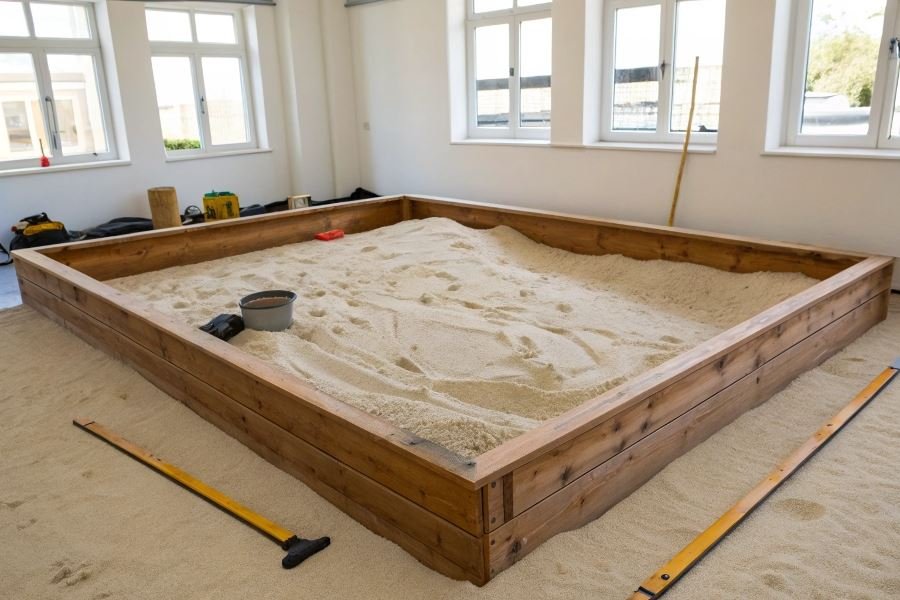
Ever watched a child’s imagination unfold in a sandbox that’s either cramped like a postage stamp or sprawling like a desert? The difference between magical play and frustrated abandonment often comes down to one critical factor: proper sizing.
Indoor sandboxes have revolutionized play by bringing the beach experience home, regardless of weather or season. But determining the optimal dimensions isn’t simply about squeezing the largest box possible into your available space. It’s about creating a harmonious balance between playability and practicality.
The golden ratio for sandbox sizing typically follows a 1:3 proportion—your sandbox should occupy no more than one-third of your available play area. This allows for comfortable movement around the sandbox and prevents the room from feeling overwhelmed by a single play element.
Beyond square footage: Critical sizing considerations
Room dimensions tell only part of the story. When planning your indoor sandbox, consider:
- Traffic patterns: Allow at least 24 inches of clearance around all sides
- Number of simultaneous users: Each child needs approximately 9 square feet of sandbox space
- Storage requirements: Sand toys need homes too!
- Growth potential: Children’s play patterns evolve rapidly
Standard sizes that work
| Room Size | Recommended Sandbox Dimensions | Best For |
|---|---|---|
| Small (8×10’) | 2×2’ or 2×3’ | Single child play |
| Medium (10×12’) | 3×3’ or 3×4’ | 1-2 children |
| Large (12×15’+) | 4×4’ or 4×6’ | Multiple children |
Remember: The perfect sandbox isn’t necessarily the largest one—it’s the one that creates the ideal play environment while respecting your home’s spatial harmony.
The Science of Sandbox Sizing: Maximizing Play in Limited Spaces
Indoor sandboxes have revolutionized sensory play, bringing the beach experience right into your living space. But determining the right dimensions isn’t guesswork—it’s a calculated decision that balances play value with practical space management. When planning your indoor sandbox setup, understanding optimal dimensions of a sand box depending on the area of the room becomes the critical factor that can make or break your investment.
The 30% Golden Ratio
The most successful indoor sandbox installations follow what experts call the “30% rule”—a principle that suggests your sandbox should occupy no more than 30% of your available floor space. This ratio ensures children have ample room to play while adults maintain comfortable navigation paths around the space.
Why 30% works:
- Preserves sufficient movement space for caregivers
- Prevents the room from feeling cramped or overwhelmed
- Maintains proper air circulation around the play area
- Allows for additional furniture or storage solutions
For example, in a standard 12’ × 12’ room (144 square feet), your sandbox should ideally measure no larger than 43 square feet—perhaps a 6’ × 7’ rectangle or a 7’ diameter circle.
Safety Clearance: The Non-Negotiable Buffer Zone
Beyond the 30% allocation, maintaining proper clearance around your sandbox isn’t just convenient—it’s essential for safety.
Minimum clearance requirements:
| Zone Type | Minimum Clearance | Ideal Clearance |
|---|---|---|
| Access Path | 24 inches | 36 inches |
| Play Zone | 30 inches | 48 inches |
| Emergency Exit Path | 36 inches | 48 inches |
These clearances ensure that:
- Children can safely enter and exit the sandbox
- Adults can reach any point of the sandbox for supervision
- The sandbox can be properly maintained and cleaned
- Emergency situations can be handled without obstruction
Proportional Scaling for Different Room Sizes
The relationship between room size and sandbox dimensions isn’t strictly linear—smaller spaces require more thoughtful proportioning.
For rooms under 100 square feet:
- Reduce the sandbox percentage to 20-25% of available space
- Consider rectangular shapes that can be positioned against walls
- Prioritize depth over width for maximum play value in minimal footprint
- Look for multi-functional designs with covers that convert to seating
A 9’ × 10’ room (90 square feet) might accommodate a 3’ × 5’ rectangular sandbox, occupying approximately 15 square feet or about 17% of the room.
For larger spaces (200+ square feet):
- The 30% rule can be more flexibly applied
- Consider central placement with 360° access
- Explore irregular shapes that create distinct play zones
- Incorporate built-in seating around perimeters
In a spacious 15’ × 20’ room (300 square feet), you could comfortably fit a 6’ × 10’ sandbox (60 square feet) while maintaining excellent circulation and functionality.
Remember that these calculations assume the sandbox is the primary feature of the room. If sharing space with other large furniture or play equipment, adjust your sandbox dimensions accordingly to maintain those critical clearance zones and prevent the room from feeling cluttered or hazardous.
Bringing Your Sandbox Vision to Life
Measuring for sandbox success
The journey from sandbox concept to reality begins with precise measurements. Grab a tape measure and map out potential locations in your room, leaving at least 24 inches of clearance on all sides for comfortable access. This buffer zone isn’t just convenient—it’s essential for preventing sand migration beyond the play area.
Pro tip: Use painter’s tape to outline your proposed sandbox footprint directly on the floor. Live with this visual marker for a few days to ensure it doesn’t disrupt natural traffic patterns or create awkward spaces.
For accurate dimensioning, consider the “rule of thirds”—your sandbox should ideally occupy no more than one-third of the available floor space in a dedicated playroom, or one-fifth in multi-purpose areas. This proportion maintains room functionality while providing adequate play space.
Tailoring dimensions to room purpose
Multi-purpose rooms demand different sandbox strategies than dedicated play spaces. In shared living areas, consider these dimensional approaches:
| Room Type | Recommended Sandbox Size | Key Consideration |
|---|---|---|
| Dedicated playroom | 4’ × 4’ to 6’ × 6’ | Can accommodate larger footprints |
| Family room | 3’ × 3’ to 4’ × 4’ | Must integrate with existing furniture |
| Bedroom | 2’ × 2’ to 3’ × 3’ | Compact design with lid for conversion |
| Sunroom | 3’ × 4’ to 4’ × 5’ | Natural light exposure factor |
For multi-functional spaces, prioritize sandboxes with built-in seating that doubles as containment walls. This design maximizes the play-to-footprint ratio while providing practical seating when the sandbox isn’t in use.
Convertibility becomes paramount in shared spaces. Consider models from KidKraft or Step2 that transform into seating or storage when playtime ends.
Future-proofing your sandbox investment
Children grow quickly, and their play patterns evolve even faster. A thoughtfully dimensioned sandbox accommodates this development:
For toddlers (1-3 years): A 3’ × 3’ sandbox provides ample space for individual exploration. This size allows for easy adult supervision while maintaining a manageable footprint.
For preschoolers (3-5 years): Expand to 4’ × 4’ to accommodate more complex building projects and collaborative play. This dimension supports 2-3 children playing simultaneously.
For elementary-aged children (6+): Consider 5’ × 5’ or larger to enable sophisticated sand engineering projects and group activities.
The most future-proof approach incorporates modular design. Start with a smaller footprint and add extension sections as children grow and interests develop. Some manufacturers offer expansion kits specifically for this purpose.
Adaptability factor: Select sandboxes with removable dividers that can section the space for different activities or age groups. This feature proves invaluable for families with children of varying ages.
Remember that the most successful sandbox implementation balances immediate needs with long-term utility. By carefully considering room dimensions, usage patterns, and growth trajectories, you’ll create a play space that evolves alongside your child while respecting your home’s spatial integrity.
Discover the perfect indoor sandbox dimensions for your space with our room-to-box ratio guide. Learn the 30% rule, minimum clearance requirements, and how to scale sandbox size proportionally to room area for safe, comfortable indoor play environments.
Discover the perfect indoor sandbox dimensions for your space with our room-to-box ratio guide. Learn the 30% rule, minimum clearance requirements, and how to scale sandbox size proportionally to room area for safe, comfortable indoor play environments.