
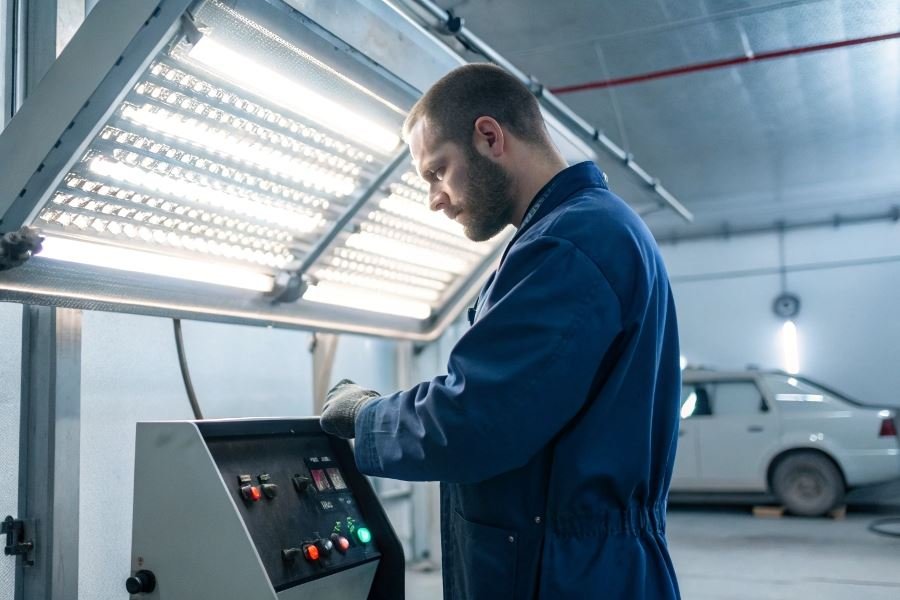
Ever watched paint dry? In auto repair, that’s not just an expression of boredom—it’s literally costing you money. Every minute a vehicle sits idle waiting for paint or clear coat to cure represents lost revenue and decreased throughput. This is where infrared drying technology enters the scene, transforming what was once a bottleneck into a competitive advantage.
Infrared dryers utilize electromagnetic radiation to generate heat that penetrates directly into the substrate rather than simply heating the surrounding air. Unlike conventional convection methods, infrared waves transfer energy directly to the object being dried, creating heat from within the coating itself. This fundamental difference is why infrared technology can reduce curing times by up to 70% compared to traditional methods.
The benefits extend far beyond just speed. Energy efficiency stands as a major advantage, with infrared systems typically consuming 30-50% less electricity than conventional dryers. The focused heating pattern also means more precise application, reducing the risk of defects like orange peel or uneven curing that plague traditional drying methods.
When evaluating infrared dryers for your auto service business, three critical factors demand attention:
- Coverage area and configuration – Does the unit match your typical repair size?
- Heat intensity and adjustability – Can you fine-tune settings for different materials?
-
Mobility and setup requirements – Will it integrate seamlessly into your existing workflow?
The right infrared system doesn’t just dry paint—it transforms your entire operation’s efficiency and quality standards.
Technical Specifications That Make or Break Your Auto Service Infrared Dryer
When selecting equipment for your auto body shop, the technical specifications of infrared dryers can dramatically impact your operation’s efficiency, quality, and bottom line. These powerful tools have revolutionized paint curing processes, but not all infrared dryers are created equal. Understanding what to pay attention to when buying an infrared dryer for an auto service requires diving into the critical specifications that separate professional-grade equipment from subpar alternatives.
Power Output and Heating Capacity
The backbone of any infrared dryer is its power output, typically measured in watts or kilowatts. Professional auto service operations generally require systems ranging from 3kW for spot repairs to 15kW for full-body applications.
Higher power doesn’t always mean better performance. What matters is the power-to-coverage ratio and how efficiently that power is converted to infrared energy. A well-designed 6kW system might outperform a poorly engineered 10kW unit.
For optimal curing results, look for:
- Power density of at least 600W per square foot for clear coat applications
- Consistent power distribution across the entire heating area
- Quick ramp-up times (under 60 seconds to reach operating temperature)
Coverage Area and Adjustability
The versatility of your infrared dryer hinges on its coverage capabilities and adjustability features.
Premium systems offer modular designs where heating panels can be positioned independently, allowing technicians to tackle anything from small dent repairs to full quarter panels. Height adjustability from 12-48 inches accommodates various vehicle shapes and provides flexibility when working on different components.
| Feature | Basic Models | Professional Models |
|---|---|---|
| Height Adjustment | Fixed or limited | Fully adjustable (12-48″) |
| Panel Movement | Single unit | Independent panel positioning |
| Coverage Area | 2-4 sq ft | Up to 36+ sq ft |
| Mobility | Wheeled base | Pneumatic lift systems |
Short-wave vs. Medium-wave Technology
The infrared spectrum used by your dryer fundamentally affects curing quality, speed, and energy efficiency.
Short-wave infrared (0.7-2.0 μm) penetrates deeper into paint layers, curing from the inside out. This technology heats the substrate directly rather than the surrounding air, resulting in:
- Faster curing times (typically 50-70% faster than conventional methods)
- Reduced risk of dust contamination
- Lower energy consumption
Medium-wave infrared (2.0-4.0 μm) provides more gentle, even heating that’s ideal for temperature-sensitive materials and larger surface areas. While slightly slower than short-wave, it offers:
- More uniform heat distribution
- Reduced risk of overheating sensitive components
- Better compatibility with water-based paints
Many top-tier systems from SprayBooth Technology and Infratech now offer dual-spectrum capabilities, combining both technologies for optimal results across different applications.
Temperature Control and Programming
The precision of temperature control separates professional equipment from entry-level options. Advanced infrared dryers feature:
- Digital temperature control with ±5°F accuracy
- Programmable curing cycles for different paint types
- Memory functions for storing custom programs
- Temperature sensors that automatically adjust output
- Integrated timers with auto-shutoff capabilities
These sophisticated controls prevent overheating while ensuring complete curing, eliminating guesswork and reducing the risk of costly rework.
Energy Efficiency and Operational Costs
While initial purchase price matters, the long-term operational costs often represent the true investment value. Energy-efficient infrared dryers can reduce electricity consumption by 40-60% compared to conventional heating methods.
Look for systems with:
- High conversion efficiency (70%+ of electricity converted to usable infrared energy)
- Zoned heating capabilities to activate only necessary panels
- Standby modes that reduce power consumption between jobs
- Quick heat-up times that minimize idle running
The most efficient models might command premium prices of $5,000-15,000 but can deliver ROI within 12-18 months through reduced energy costs and faster throughput.
Smart Selection: Practical Infrared Dryer Considerations
Space Requirements and Mobility Features
The footprint of your infrared dryer can make or break your workflow efficiency. Professional auto service shops often juggle limited space with multiple repair stations. Modern infrared dryers come in various configurations—from compact wall-mounted units to full-sized mobile systems on wheels.
A quality mobile unit should feature lockable casters, adjustable height mechanisms, and articulating arms that extend up to 6 feet. This flexibility allows technicians to position the dryer precisely where needed without rearranging the entire workspace.
Space-saving tip: Look for foldable models that can collapse when not in use, reducing their footprint by up to 70% during storage.
Durability and Build Quality
Professional-grade infrared dryers face harsh shop conditions daily. The difference between consumer and professional models becomes evident after just months of heavy use.
Key build quality indicators include:
- Aircraft-grade aluminum frames that resist warping under heat
- Powder-coated finishes that withstand chemical exposure
- Sealed control panels protected from dust and overspray
- High-temperature silicone wiring rated for continuous operation
- Reinforced joints and stress points
The most durable units typically feature modular construction, allowing for component replacement rather than complete system failure.
Warranty Coverage and Parts Availability
The warranty tells you how much a manufacturer trusts their own product. Industry leaders typically offer:
| Warranty Component | Standard Coverage | Premium Coverage |
|---|---|---|
| Heating Elements | 1-2 years | 3-5 years |
| Control Systems | 2 years | 5+ years |
| Frame/Structure | 5 years | Lifetime |
| Labor | 90 days | 1 year |
Beyond the warranty period, parts availability becomes crucial. Before purchasing, verify that replacement components—particularly specialized bulbs and control boards—can be sourced without excessive downtime or international shipping delays.
ROI Analysis and Productivity Improvements
Investing in quality infrared technology delivers measurable returns:
-
Energy efficiency: Infrared dryers consume 40-60% less electricity than conventional forced-air systems while achieving faster cure times.
-
Labor optimization: Reduced curing times (typically 7-15 minutes versus 30+ minutes for conventional methods) allow technicians to complete more jobs per day.
-
Quality improvements: Consistent heat distribution reduces the risk of paint defects, minimizing costly rework.
A mid-range professional infrared dryer priced at $3,500-5,000 typically pays for itself within 8-12 months through these efficiency gains.
Top 3 Recommended Infrared Dryer Brands
-
Infratech – Their Pro Series offers exceptional temperature consistency with digital controls accurate to ±2°F. Their modular design allows for easy component replacement, and their North American manufacturing ensures quick parts availability.
-
REVO – Pioneers in short-wave infrared technology, REVO systems provide the fastest cure times in the industry. Their Rapid curing technology reduces energy consumption by up to 80% compared to conventional methods.
-
SpeedDry – Offering the best balance of affordability and performance, SpeedDry’s Accelerator series features intuitive digital interfaces and programmable cure cycles that simplify operation for technicians of all experience levels.
When evaluating these brands, request on-site demonstrations to compare performance with your specific materials and conditions. The best system isn’t necessarily the most expensive—it’s the one that integrates seamlessly with your existing workflow while delivering consistent results.
Discover the key factors to consider when investing in an infrared dryer for your auto service. Our comprehensive guide covers essential technical specs, practical considerations, and top recommended brands for professional automotive refinishing.
Discover the key factors to consider when investing in an infrared dryer for your auto service. Our comprehensive guide covers essential technical specs, practical considerations, and top recommended brands for professional automotive refinishing.


