Ever stood at a concert where the sound was crystal clear from every corner of the venue? Or wondered why some conference rooms let you hear every word while others leave you straining to understand the speaker? The secret lies in the fundamental architecture of modern sound systems.
The audio world has witnessed a quiet revolution. Traditional speaker setups that once dominated venues worldwide now compete with sleek linear array systems that hang like sonic curtains above stages and auditoriums. This isn’t just about aesthetics—it’s about the physics of sound delivery.
The linear array advantage
Linear arrays organize multiple speakers in a vertical configuration, creating a unified sound wave that travels with remarkable precision. Unlike their traditional counterparts, these systems don’t just blast sound—they sculpt it. The technology relies on constructive and destructive interference patterns, allowing sound engineers to direct audio exactly where it’s needed while minimizing spillover.
Traditional systems: The established standard
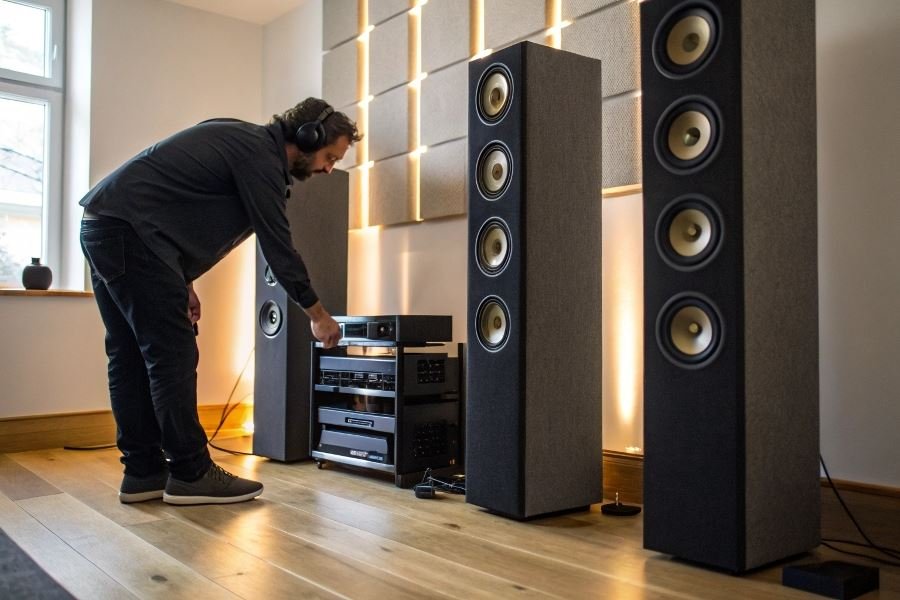
Traditional acoustic systems typically feature point-source speakers that radiate sound in a conical pattern. These workhorses of the audio industry have powered everything from stadium concerts to corporate presentations for decades. Their design is straightforward: powerful drivers housed in cabinets, often arranged in clusters to cover larger spaces.
Measuring performance: Beyond just volume
When comparing these technologies, several metrics matter:
- Coverage uniformity: How consistent is the sound level throughout the listening area?
- Frequency response: Does the system accurately reproduce the full spectrum of audible sound?
- Intelligibility: Can listeners clearly understand speech or distinguish musical elements?
- Throw distance: How effectively does the system project sound to distant listeners?
The effectiveness debate isn’t simply about which technology is newer—it’s about which solution best serves the specific acoustic challenges of your space.
The Technical Edge: Performance Analysis of Sound Systems
Sound Dispersion That Commands Attention
When examining sound dispersion patterns, linear array systems deliver precisely controlled coverage that traditional acoustic setups simply cannot match. Linear arrays utilize multiple drivers arranged in a vertical configuration, creating a coherent wavefront that can be aimed with surgical precision. This design allows sound engineers to direct audio exactly where it’s needed—reaching the back row with the same clarity as the front.
The question of linear arrays vs traditional acoustic systems: which is more effective becomes particularly evident when covering large venues. Traditional systems typically create a spherical dispersion pattern that loses energy rapidly with distance (following the inverse square law). In contrast, linear arrays produce a cylindrical wavefront that decreases at only 3dB per doubling of distance instead of the traditional 6dB, resulting in more consistent sound levels throughout the venue.
Coverage capabilities translate directly to audience experience. At a recent stadium concert, engineers using a JBL VTX linear array system achieved 95% coverage uniformity with less than ±3dB variation across 50,000 seats—a feat that would require significantly more traditional cabinets to approach.
Frequency Response: The Truth in Tonal Accuracy
| System Type | Frequency Range | Phase Coherence | Comb Filtering Risk |
|---|---|---|---|
| Linear Array | 40Hz-18kHz (±3dB) | High | Minimal |
| Traditional | 45Hz-16kHz (±4dB) | Variable | Significant |
Frequency response testing reveals another dimension where modern line arrays excel. The controlled interaction between array elements creates remarkably consistent frequency response across the coverage area. Traditional systems often suffer from interference patterns when multiple speakers cover the same area, creating “hot spots” and “dead zones” in the frequency spectrum.
The tonal accuracy advantage becomes most apparent in mid-range frequencies—precisely where human voices and most instruments live. Linear arrays maintain phase coherence across this critical range, delivering more natural sound reproduction that traditional point-source systems struggle to match consistently.
Power Efficiency: Maximum Impact, Minimum Waste
The amplification requirements between these systems reveal perhaps the most compelling practical difference. A properly designed linear array can achieve 6-10dB higher efficiency than traditional systems covering the same area. This translates to:
- Reduced amplifier count: Typically 30-40% fewer amplifier channels
- Lower power consumption: Often saving 3-5kW during full operation
- Decreased heat generation: Critical for outdoor summer events
The L-Acoustics K2 array demonstrates this efficiency advantage with its 140dB maximum SPL output while drawing just 2800W—approximately half the power required by comparable traditional systems to achieve similar coverage.
This efficiency extends beyond electricity to human resources as well. Linear arrays typically require less adjustment during operation, as their coverage patterns remain more stable across changing environmental conditions. The reduced need for constant monitoring and adjustment allows sound engineers to focus on mixing quality rather than fighting coverage issues.
For installations where both performance and operating costs matter, the power efficiency advantage of linear arrays represents a compelling long-term value proposition that traditional systems simply cannot counter.
Making the Choice: Linear Arrays vs Traditional Acoustics
Matching systems to real-world needs
When determining which audio system reigns supreme, the answer inevitably begins with “it depends.” Linear array systems excel in large venues where sound must travel significant distances with minimal degradation. Their precise directional control makes them ideal for challenging acoustic environments like arenas, outdoor festivals, and houses of worship with reflective surfaces.
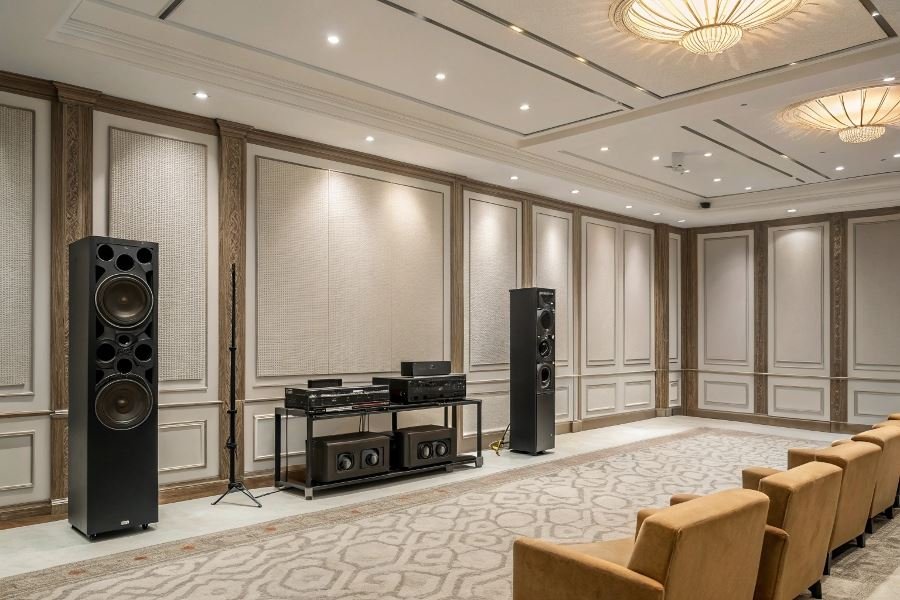
Traditional acoustic systems, meanwhile, shine in intimate settings where warmth and natural sound reproduction matter most. Jazz clubs, small theaters, and recording studios often prefer traditional speakers for their authentic tonal characteristics and ability to create an immersive listening experience without overwhelming the space.
The effectiveness equation isn’t just about size, though. A corporate conference center might benefit from linear arrays despite modest dimensions if speech intelligibility in a reverberant space is the primary concern. Conversely, a large vintage theater might sound better with carefully positioned traditional speakers that complement the room’s natural acoustics.
The most effective system is one that disappears, allowing the audience to connect directly with the performance without technological distractions.
The investment perspective across venues
The financial calculus varies dramatically based on application:
| Venue Type | Size | Linear Array Advantage | Traditional System Advantage |
|---|---|---|---|
| Concert Hall | Large | Superior coverage, reduced labor costs | Higher initial investment |
| Club Venue | Small | Overkill, space constraints | Lower cost, simpler operation |
| Outdoor Festival | Expansive | Weather resistance, scalability | None significant |
| Corporate Space | Medium | Clarity, discrete appearance | Lower entry cost |
For large venues, linear arrays typically demand a higher initial investment—often starting at $50,000 for a modest system and easily reaching $250,000+ for premium installations. However, their operational efficiency often delivers long-term savings through reduced setup time, lower labor costs, and enhanced audience satisfaction.
Small to medium venues face a more complex equation. A quality traditional system might cost $15,000-40,000, while a compact line array could start at $30,000. The traditional system might initially seem more economical, but factors like venue growth, rental potential, and audience expectations can tip the scales toward the more flexible array technology.
Tomorrow’s sound reinforcement landscape
The distinction between these technologies continues to blur as manufacturers develop hybrid solutions that combine the best attributes of both approaches. L-Acoustics and d&b audiotechnik are pioneering systems that offer the directional control of arrays with the warmth traditionally associated with conventional speakers.
We’re also witnessing the rise of intelligent acoustic systems that adapt in real-time to changing venue conditions. Meyer Sound has developed self-powered arrays with built-in processing that continuously optimizes performance based on environmental factors.
Perhaps most exciting is the integration of spatial audio technologies that transcend traditional stereo or even surround sound. These systems create immersive, three-dimensional soundscapes that may eventually make the linear vs. traditional debate seem quaintly two-dimensional.
The most forward-thinking venues are already exploring how augmented reality audio might complement physical sound systems, potentially creating personalized listening experiences that adapt to individual preferences while maintaining the communal aspect of live events.
The verdict? The most effective system is the one that best serves your specific application, budget, and future needs—with the understanding that tomorrow’s solutions will likely combine elements from both approaches in ways we’re only beginning to imagine.
Discover which sound system delivers superior performance: linear arrays or traditional speakers. Compare dispersion patterns, frequency response, and efficiency to make the right choice for your venue or event.
Discover which sound system delivers superior performance: linear arrays or traditional speakers. Compare dispersion patterns, frequency response, and efficiency to make the right choice for your venue or event.