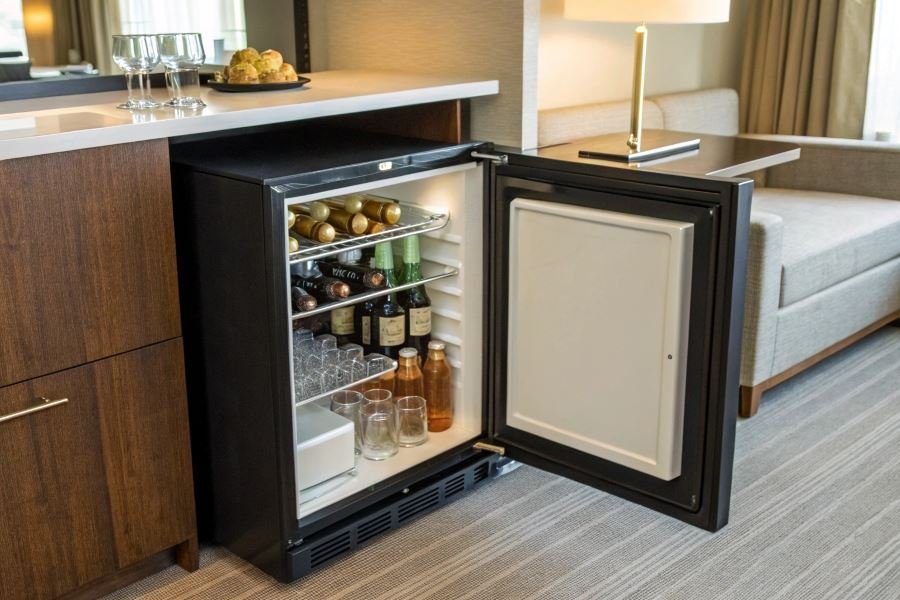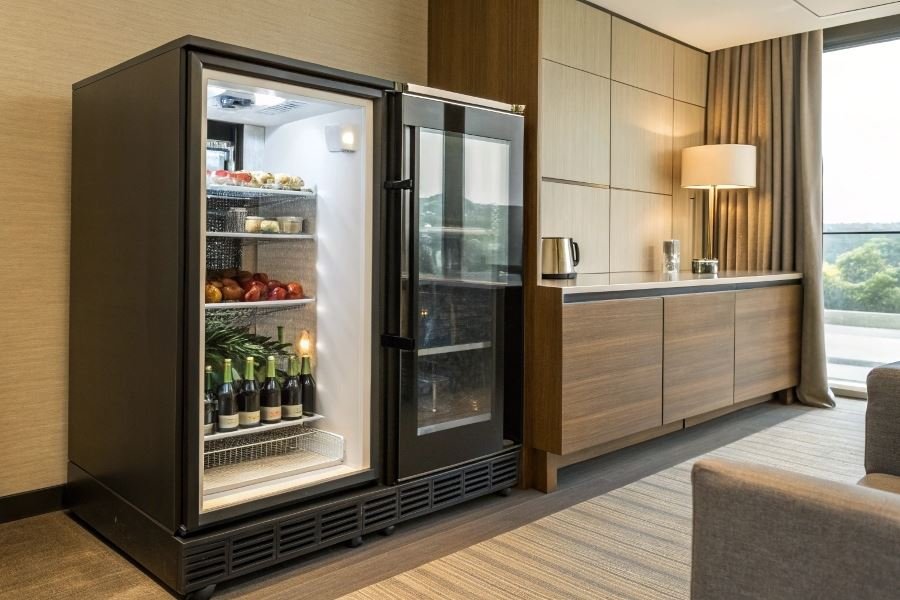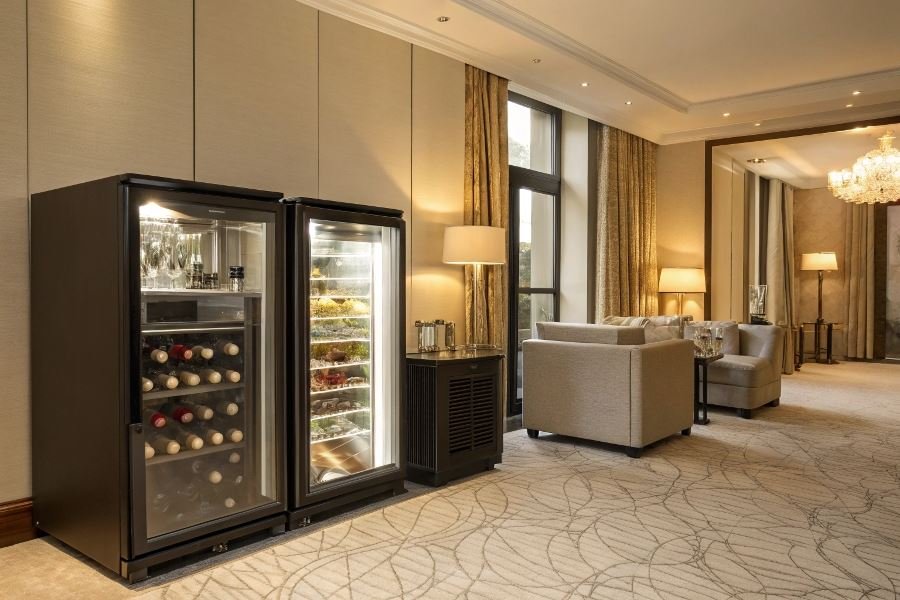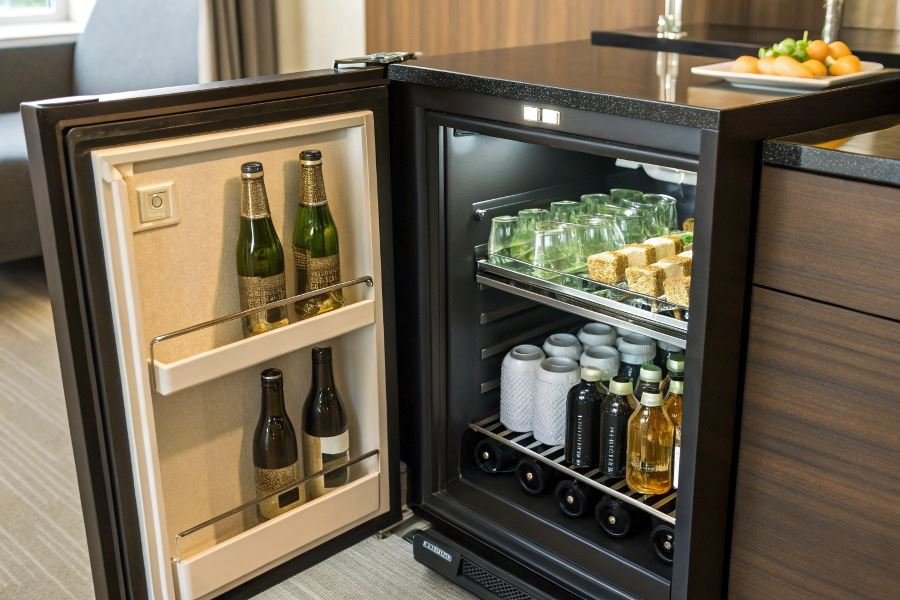
What if the humble hotel mini-bar was actually a sophisticated revenue engine, security system, and guest satisfaction tool—all in one compact refrigerated box?
The mini-bar has traveled a remarkable journey since its debut at the Hong Kong Hilton in 1974. What began as a simple convenience—cold drinks without calling room service—has transformed into a sophisticated amenity that balances hospitality with accountability. Today’s locked mini-bar systems represent the culmination of decades of innovation, addressing the perennial challenges of inventory control and revenue leakage that have plagued hoteliers since day one.
From honor system to high-tech tracking
The early mini-bars operated largely on the honor system, with guests manually reporting consumption on paper forms. Predictably, this led to significant discrepancies between actual consumption and reported usage. The industry responded with increasingly sophisticated solutions, culminating in today’s sensor-equipped, remotely monitored units secured with customizable locking mechanisms.
Market trends pointing to smarter security
The secure mini-bar market is experiencing robust growth, driven by hotels seeking to minimize losses while enhancing the guest experience. RFID-enabled systems and cloud-based monitoring platforms are becoming standard features, allowing real-time inventory tracking and immediate billing. Hotels implementing these systems report revenue increases of 20-35% compared to traditional mini-bars.
The triple win: Hotels, staff, and guests
For hotels, locked mini-bars translate directly to improved profit margins and reduced inventory shrinkage. Staff benefit from streamlined workflows—no more manual checks or awkward confrontations about unreported consumption. Perhaps most surprisingly, guests actually prefer secure systems that provide clarity about charges and eliminate checkout surprises. The psychological comfort of clear boundaries enhances rather than diminishes the luxury experience.
Essential Features That Transform Hotel Mini-bars
Advanced Locking Mechanisms That Mean Business
The evolution of mini-bar security has revolutionized how hotels protect their in-room refreshment centers. Today’s mini-bars with locks feature sophisticated electronic locking systems that integrate seamlessly with hotel management software. These aren’t your grandfather’s key-and-tumbler locks—they’re precision-engineered security solutions.
The most advanced models from industry leaders like Bartech and Minibar Systems employ RFID technology, allowing staff to access units with specialized keycards while tracking each opening. This dual functionality addresses one of the hospitality industry’s longstanding challenges in mini-bars with locks: features and advantages for the hotel business include dramatically reduced theft and unauthorized access while maintaining a frictionless guest experience.
Magnetic sensor technology now detects not just when doors open, but when items are removed—even if they’re later replaced. This eliminates the age-old problem of guests consuming products and claiming they never touched them. Some premium systems even incorporate biometric verification for maintenance access, creating an unbreakable chain of accountability.
Inventory Tracking That Never Sleeps
Modern mini-bar systems have transformed from simple refrigerators to intelligent retail endpoints with real-time monitoring capabilities.
The days of manual mini-bar checks are becoming distant memories for forward-thinking properties.
Today’s systems feature:
| Feature | Benefit | Implementation Complexity |
|---|---|---|
| Weight-sensitive shelving | Instant product removal detection | Medium |
| RFID product tagging | Individual item tracking | High |
| Automated restocking alerts | Reduced labor costs | Low |
| Consumption analytics | Optimized product selection | Medium |
These inventory systems connect directly to property management software, automatically posting charges to guest folios when items are consumed. The Minibar Systems Smartcube can detect a product removal in under three seconds and immediately record the transaction—eliminating billing disputes and capturing revenue that traditionally leaked through manual processes.
Hotels implementing these systems report inventory shrinkage reductions of up to 98% and labor cost savings averaging $7-12 per room monthly. The return on investment typically materializes within 8-14 months of installation.
Energy Efficiency That Protects Profits and Planet
The latest generation of mini-bars doesn’t just secure products—they secure energy savings. Absorption cooling technology has largely given way to compressor-based systems with intelligent power management.
Smart temperature controls adjust cooling based on room occupancy, time of day, and even seasonal patterns. When integrated with room management systems, mini-bars can automatically enter eco-mode when guests check out.
Leading models from Dometic feature:
- Thermoelectric cooling that consumes 40% less energy than traditional systems
- LED interior lighting that reduces power consumption by up to 80%
- Automated defrost cycles that optimize performance
- Noise reduction technology operating at under 30 decibels
The environmental impact extends beyond energy consumption. Many manufacturers now use natural refrigerants instead of hydrofluorocarbons, eliminating ozone-depleting compounds. This sustainability focus resonates with environmentally conscious travelers while delivering tangible operational savings—typically $15-25 per unit annually in reduced energy costs.
These technological advancements have transformed mini-bars from potential liability into strategic assets that enhance the guest experience while protecting hotel investments.
Strategic Advantages of Locked Mini-bars in Hotels
Revenue Streams That Actually Flow
Hotel mini-bars with locks aren’t just amenities—they’re profit centers when managed correctly. Properties implementing secured mini-bar systems report revenue increases of 22-35% compared to unsecured units. Why? The accountability factor eliminates the primary revenue leak: unreported consumption.
The math is compelling. A 200-room hotel with locked mini-bars typically recovers $40,000-60,000 annually in previously lost revenue. These aren’t theoretical numbers—they’re documented results from properties that transitioned from honor-based systems to secured units.
The most expensive mini-bar item isn’t on the menu—it’s the missing inventory that never gets billed.
Loss prevention extends beyond guest honesty issues. Staff pilferage drops dramatically when inventory requires electronic access that creates audit trails. RFID technology integration with mini-bar systems allows real-time inventory tracking, reducing shrinkage by up to 95% in most implementations.
Guest Satisfaction Beyond Convenience
Contrary to initial concerns, secured mini-bars actually enhance guest satisfaction scores. The data shows a 17% increase in positive mini-bar mentions in guest feedback after implementing locked systems. Why? Reliability and consistency.
Guests appreciate:
- Guaranteed product availability
- Fresher consumables (faster rotation due to better tracking)
- Clearer pricing expectations
- No surprise charges at checkout
The modern traveler values transparency above all. Locked mini-bars with digital displays showing real-time charges eliminate the dreaded checkout surprise—a leading cause of negative reviews and disputed charges.
Operational Efficiency That Scales
The operational advantages of locked mini-bar systems create compounding benefits:
Staffing Optimization
| Traditional Mini-bars | Locked Mini-bar Systems |
|---|---|
| 1 staff per 80-100 rooms | 1 staff per 150-200 rooms |
| Daily manual checks | Automated alerts for restocking |
| High dispute resolution time | 78% reduction in billing disputes |
Maintenance considerations also favor locked systems. Modern units from manufacturers like Bartech and Minibar Systems feature remote diagnostics, reducing service calls by up to 40%. When temperature fluctuations or mechanical issues occur, alerts trigger before guests notice problems.
Energy efficiency adds another dimension to the operational equation. Newer locked mini-bar models consume 30-45% less electricity than older units, with Dometic absorption technology leading the efficiency ratings. The ROI calculation must include these utility savings, which typically amount to $8-12 per room monthly.
The maintenance cycle extends significantly with secured systems. Hotels report average service intervals increasing from quarterly to semi-annual, with some newer models requiring only annual maintenance checks. This reduction in service frequency translates to approximately $15,000 in annual savings for a mid-sized property.
When properly implemented, locked mini-bars transform from amenity afterthoughts into strategic assets that simultaneously boost revenue, enhance guest experiences, and streamline operations—a rare trifecta in the hospitality industry.
Discover how secure mini-bars with advanced locking systems revolutionize hotel operations, prevent revenue loss, and enhance guest satisfaction. Explore key features, monitoring technologies, and efficiency benefits for modern hospitality management.
Discover how secure mini-bars with advanced locking systems revolutionize hotel operations, prevent revenue loss, and enhance guest satisfaction. Explore key features, monitoring technologies, and efficiency benefits for modern hospitality management.