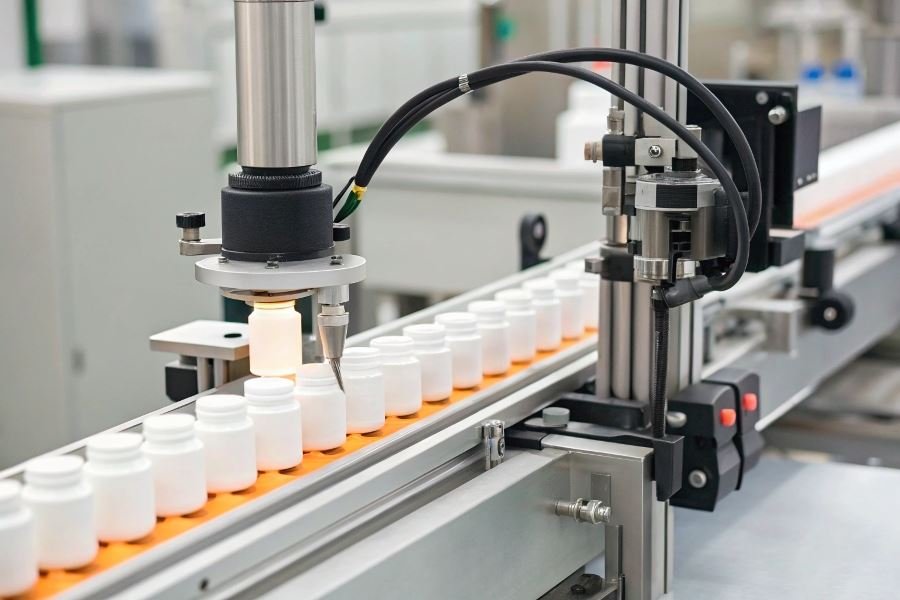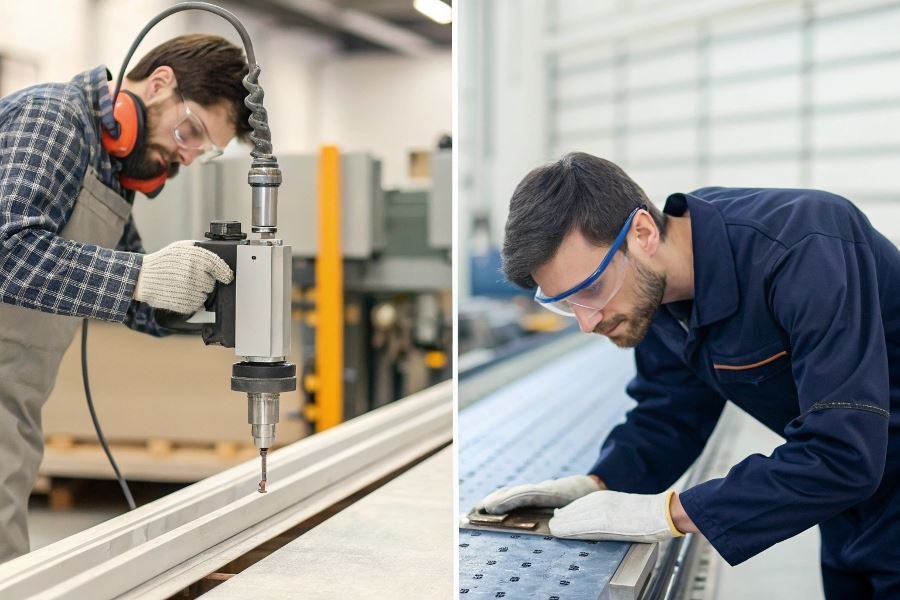
Ever watched a small batch producer meticulously apply each label by hand, while across town, a production line whirs with machines applying thousands of labels per hour? The contrast is striking—and your choice between these approaches could significantly impact your bottom line.
Labeling technology has transformed dramatically since the first paper gummed labels appeared in the 1800s. What began as purely manual processes evolved through semi-automatic solutions in the mid-20th century to today’s sophisticated automatic systems capable of applying labels at speeds exceeding 500 units per minute.
The decision between manual and automatic labeling isn’t just about speed—it’s about precision, consistency, labor costs, and production volume. Manual labelers offer flexibility and low initial investment, making them ideal for small businesses producing limited quantities or applying variable information. Meanwhile, automatic systems deliver unmatched efficiency for high-volume operations where consistency is paramount.
Evolution of labeling technology
The journey from hand-applied stickers to AI-powered labeling systems reflects broader manufacturing trends. Early mechanical labelers in the 1950s gave way to pneumatic systems in the 1970s, followed by computer-controlled equipment in the 1990s. Today’s systems integrate with inventory management software and can adjust to different container shapes automatically.
Assessing your labeling needs
To determine which solution fits your operation:
- Analyze your production volume: How many units require labeling daily?
- Consider product variability: Do you label different products requiring frequent changeovers?
- Evaluate labor availability: Is skilled labor accessible and affordable in your area?
- Calculate total ownership cost: Look beyond purchase price to maintenance and operational expenses
The most effective approach often evolves with your business. Many successful operations begin with manual systems and graduate to automatic solutions as volume demands increase—creating a strategic pathway for growth without overinvesting prematurely.
Manual vs Automatic Labelers: The Business Efficiency Showdown
Speed That Drives Production
When evaluating labeling solutions, throughput capacity stands as the most immediate differentiator between manual and automatic systems. Manual labelers typically process 500-1,000 items per day with a single operator, while entry-level automatic labelers easily handle 1,500-3,000 items per hour. High-end automatic systems from manufacturers like Quadrel or Weber Packaging can achieve rates exceeding 12,000 units hourly.
The decision between manual vs automatic labelers: which is more effective for your business often hinges on your production volume requirements. Companies processing fewer than 5,000 units weekly may find manual systems sufficient, while operations exceeding this threshold typically see dramatic efficiency improvements with automation.
Real-world impact: A mid-sized beverage producer switching from manual to automatic labeling increased daily output from 4,800 to 28,000 bottles while reducing labor requirements by 75%.
Precision Across Environments
| Aspect | Manual Labelers | Automatic Labelers |
|---|---|---|
| Placement accuracy | ±2-5mm | ±0.5-1mm |
| Consistency | Variable (operator dependent) | Highly consistent |
| Error rate | 2-5% | 0.1-0.5% |
| Environmental sensitivity | Moderate | Low (climate-controlled) |
Accuracy differences become particularly pronounced in regulated industries like pharmaceuticals and food production, where label placement precision directly impacts compliance. Manual systems rely heavily on operator skill and attention, creating variability that automatic systems eliminate through calibrated mechanical precision.
The consistency advantage of automatic labelers compounds with production volume—what begins as a minor quality improvement becomes a significant competitive advantage at scale.
Investment Economics
Initial investment presents the starkest contrast:
- Manual labelers: 300−2,500
- Semi-automatic systems: 3, 000−15,000
- Fully automatic systems: 20, 000−150,000+
However, operational costs tell a different story. Labor costs for manual labeling average $15-25 per hour per operator, while automatic systems typically require $2-5 per hour in operational costs (including maintenance, electricity, and occasional supervision).
The break-even point typically occurs between 10-24 months for businesses processing more than 10,000 units weekly. Companies using Herma labeling systems report ROI achievement in as little as 8 months when upgrading from manual processes.
Facility Integration Considerations
Manual labeling stations require approximately 15-25 square feet per workstation, while automatic systems demand 30-100 square feet depending on configuration and throughput capacity. Beyond raw space requirements, integration factors include:
- Power requirements: Manual systems need standard outlets; automatic systems often require 220V connections
- Compressed air: Many automatic systems require 80-100 PSI continuous supply
- Line integration: Automatic systems must physically connect with existing production lines
- Environmental controls: Precision labelers perform optimally in temperature-controlled environments
Product Adaptability Matrix
The flexibility to handle diverse product shapes and packaging types varies significantly:
- Manual systems: Highly adaptable with minimal changeover time (1-5 minutes)
- Semi-automatic: Moderate adaptability with 10-30 minute changeovers
- Fully automatic: Traditionally less flexible with 30-90 minute changeovers, though newer systems from Accutek feature rapid-change components reducing this to 15 minutes
For businesses with frequent product changes or small batch production, manual systems retain a flexibility advantage. However, modern automatic systems increasingly incorporate programmable settings that store parameters for different products, significantly reducing changeover complexity.
Making the Final Decision for Your Labeling Strategy
When manual labelers deliver exceptional ROI
Manual labelers shine in specific business environments where precision and adaptability trump speed. Small batch producers—particularly artisanal food companies, craft breweries, and boutique cosmetics manufacturers—often find manual labeling systems provide superior return on investment. With initial costs starting at just $150-300 for quality hand applicators versus $5,000+ for entry-level automatic systems, the math makes sense for operations labeling fewer than 500 units daily.
Flexibility remains the manual labeler’s superpower. When your product line includes irregular containers or requires frequent label design changes, manual systems eliminate the costly reconfiguration time automatic systems demand. A winery producing limited edition releases, for instance, can switch between differently shaped bottles without missing a beat—something that would require significant downtime with automatic equipment.
For businesses where labor costs remain reasonable and production volumes stay modest, the ROI calculation typically favors manual approaches. The break-even point? Most businesses find manual labeling remains cost-effective until production exceeds 1,000-1,500 units per day.
Business scenarios where automatic labelers excel
Automatic labeling systems demonstrate undeniable superiority in high-volume operations where consistency and throughput are paramount. Manufacturing facilities producing more than 2,000 identical units daily typically recoup their investment within 12-18 months through labor savings alone.
The efficiency gains are staggering. While a skilled operator with a manual labeler might apply 500-600 labels per hour, entry-level automatic systems consistently deliver 2,000-3,000 labels hourly. Advanced systems from manufacturers like Quadrel can reach speeds of 6,000+ units per hour with near-perfect placement accuracy.
Industries with strict regulatory compliance requirements—pharmaceuticals, chemicals, and food processing—benefit tremendously from the documentation capabilities built into modern automatic labelers. These systems can integrate with inventory management software, creating audit trails that manual processes simply cannot match.
Hybrid approaches that maximize efficiency
The most sophisticated operations often implement hybrid labeling strategies, leveraging the strengths of both approaches. A beverage company might deploy automatic labelers for their mainstream products while maintaining manual stations for seasonal or limited releases.
This balanced approach allows businesses to:
- Scale production efficiently during peak demand periods
- Maintain flexibility for specialty products
- Create redundancy that prevents costly downtime
- Optimize labor allocation based on current production needs
Smart implementation involves strategic workstation design. Positioning manual labeling stations alongside automatic systems allows workers to shift between approaches as needed, maximizing productivity across varying batch sizes.
Implementation strategies for optimal results
Transitioning between labeling systems requires thoughtful planning. Businesses achieving the smoothest implementations typically follow a phased approach:
- Conduct thorough production analysis to identify bottlenecks
- Run parallel systems during transition periods
- Invest in comprehensive operator training
- Establish clear quality control protocols
- Schedule regular maintenance and calibration
The technology integration aspect cannot be overlooked. Modern labeling systems from providers like Accuplace offer sophisticated software interfaces that connect with enterprise resource planning systems, enabling real-time production monitoring and predictive maintenance.
For businesses contemplating the transition, pilot programs prove invaluable. Starting with a single production line allows teams to refine processes before full-scale implementation, significantly reducing disruption and ensuring the chosen solution truly delivers the promised efficiency gains.
Discover which labeling solution maximizes efficiency for your operation. Compare speed, accuracy, and ROI between manual and automatic labelers to make an informed investment that aligns with your production volume and packaging requirements.
Discover which labeling solution maximizes efficiency for your operation. Compare speed, accuracy, and ROI between manual and automatic labelers to make an informed investment that aligns with your production volume and packaging requirements.