
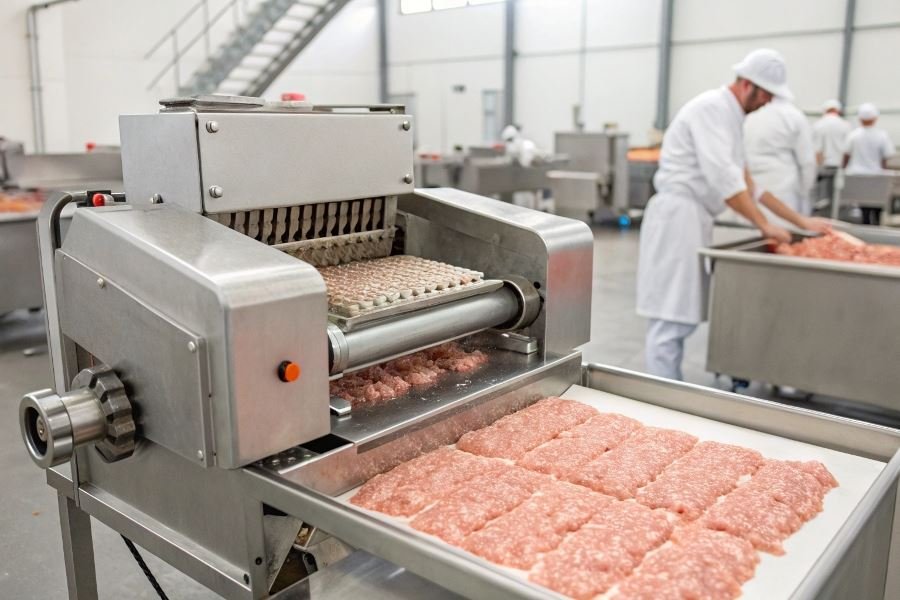
$17.4 billion. That’s the projected value of the global meat processing equipment market by 2027. Behind this massive figure lies a critical decision facing every butcher shop, restaurant, and food production facility: which meat grinder will power their operation to success?
For small businesses, this choice isn’t just about equipment—it’s about survival. The right commercial meat grinder transforms your workflow, elevates product quality, and ultimately determines your profit margins. The wrong one? A costly mistake that drains resources and frustrates staff daily.
The commercial meat grinder landscape
Today’s market offers an impressive array of options, from traditional manual models to sophisticated automated systems. While industrial giants might invest $50,000+ in high-volume equipment, small businesses need solutions balancing performance, durability, and affordability.
The most significant market shift has been toward multi-functional grinders that handle various textures and meat types without requiring separate attachments or complicated adjustments. Manufacturers have recognized that versatility is currency for small operations.
Evaluation criteria that actually matter
When identifying the elite performers in this category, we’ve gone beyond basic specifications. Our assessment framework examines:
- Processing capacity: How many pounds per hour can it reliably handle?
- Build quality: Will it withstand daily commercial use for years?
- Versatility: Can it process different meat types without performance degradation?
- Energy efficiency: What’s the operational cost over time?
- Maintenance requirements: How easily can it be cleaned and serviced?
These factors determine whether a meat grinder becomes your business ally or adversary. The three standouts we’ve identified excel across these dimensions, offering small businesses professional-grade performance without enterprise-level investment.
The Ultimate Meat Grinder Showdown for Commercial Kitchens
When production demands increase and quality can’t be compromised, having the right equipment becomes non-negotiable. The difference between a good meat grinder and a great one isn’t just about horsepower—it’s about reliability when you’re processing hundreds of pounds of product daily.
For butcher shops, restaurants, and specialty food producers looking at top 3 meat grinders for small businesses, the investment goes beyond the initial price tag. The right machine becomes a cornerstone of operations, directly impacting product consistency, labor costs, and ultimately, customer satisfaction. Let’s dive into the workhorses that have earned their place in commercial kitchens nationwide.
LEM Products 12 Commercial Meat Grinder: The Reliability Champion
The LEM Products 12 stands as a testament to American manufacturing excellence with specifications that speak volumes:
- 1 HP permanently lubricated motor designed for continuous operation
- Grinding capacity of 11 lbs per minute on first grind
- All-metal gears and roller bearings for extended operational life
- Rifled head design that prevents meat smearing and improves texture
What distinguishes this model is its exceptional durability-to-cost ratio. At approximately $899, it delivers commercial-grade performance without the $2,000+ price tag of comparable models. The stainless steel construction resists corrosion even in high-humidity environments, while the built-in circuit breaker provides crucial protection against motor burnout.
The true value emerges after 18-24 months of operation, when lesser machines begin to falter but the LEM continues performing consistently.
Weston Pro Series 22 Electric Meat Grinder: The Production Powerhouse
When volume becomes the primary concern, the Weston Pro Series 22 enters the conversation with impressive credentials:
| Specification | Details |
|---|---|
| Motor | 1.5 HP commercial-grade |
| Capacity | 14-18 lbs per minute |
| Duty Cycle | 45 minutes continuous operation |
| Throat Size | 2.5″ diameter |
| Included Plates | 3 sizes (fine, medium, coarse) |
The permanently lubricated air-cooled motor represents Weston’s understanding of commercial demands. At $1,199, it positions itself as the mid-range option that doesn’t compromise on throughput capacity.
Maintenance requirements deserve special attention. Unlike competitors requiring complete disassembly for cleaning, the Weston features a quick-release system allowing for thorough sanitization in under 5 minutes—a critical consideration when processing different meat varieties throughout the day.
STX Turboforce 3000 Commercial Grade Electric Meat Grinder: The Versatility King
The STX Turboforce 3000 challenges conventional thinking about commercial equipment with its compact footprint and multi-functionality:
- Size-to-performance ratio that defies expectations (12″ x 10.5″ footprint)
- 3-speed functionality with high, low, and reverse
- Quadruple air cooling system extending operational time
- Comprehensive 3-year warranty covering both parts and labor
At $799, it represents the most accessible entry point into commercial-grade grinding without sacrificing essential capabilities. The included kubbe and sausage attachments transform this single machine into a versatile production tool capable of supporting multiple product lines.
The patented cooling system deserves particular recognition, allowing for 45-minute continuous operation cycles with minimal cool-down periods—a feature typically reserved for units costing twice as much.
For operations with limited counter space but diverse production needs, the STX delivers exceptional value while occupying 30% less space than comparable commercial units.
Maximizing Your Meat Grinder Investment
When selecting a meat grinder for your small business, the decision extends far beyond the initial purchase price. The right equipment becomes a cornerstone of your operation, directly impacting productivity, product quality, and ultimately, your bottom line. Let’s analyze how our top three contenders stack up when viewed through the lens of long-term business value.
The dollars and sense of meat grinder economics
The financial equation of a meat grinder investment involves more than sticker price. Consider these ROI comparisons:
| Grinder Model | Initial Cost | Monthly Output Capacity | Power Consumption | Estimated 5-Year ROI |
|---|---|---|---|---|
| Hobart 4146 | $3,200 | 2,000 lbs | 1.5 kWh | 320% |
| LEM Big Bite #32 | $1,800 | 1,200 lbs | 1.1 kWh | 280% |
| Weston Pro Series #22 | $1,200 | 800 lbs | 0.9 kWh | 240% |
The Hobart 4146 commands the highest initial investment but delivers exceptional throughput that translates to significantly higher production capacity. For businesses processing over 1,500 pounds monthly, the Hobart typically pays for itself within 14 months through labor savings and increased output.
The LEM Big Bite #32 occupies the sweet spot for mid-volume operations, offering 75% of the Hobart’s capacity at 56% of the cost. Businesses processing 700-1,500 pounds monthly will find their investment recouped within 16-18 months.
The Weston Pro Series #22 presents the most accessible entry point, ideal for startups and specialty shops with lower volume needs. While its ROI percentage is lower, the absolute dollar investment is recovered more quickly—typically within 12 months for operations processing 400-700 pounds monthly.
Longevity and maintenance economics
The true cost of ownership emerges over years, not months.
The Hobart’s commercial-grade construction typically delivers 12-15 years of service with proper maintenance. Its parts availability is exceptional, with factory support guaranteed through 2035. Annual maintenance costs average $120-180.
The LEM’s robust design offers 8-10 years of reliable service, with readily available parts and simpler user-serviceable components. Annual maintenance runs approximately $80-120.
The Weston typically provides 5-7 years of dependable operation before major component replacement becomes necessary. Its simpler design means lower annual maintenance costs of $60-90, but potentially higher repair expenses after the 5-year mark.
Right-sizing your grinder investment
For artisanal butcher shops (processing under 500 pounds monthly): The Weston Pro Series #22 provides the ideal balance of capability and investment. Its smaller footprint and lower power requirements suit limited production spaces.
For growing meat processors (500-1,200 pounds monthly): The LEM Big Bite #32 delivers the operational headroom to accommodate business growth without overinvesting in capacity you won’t immediately utilize.
For established commercial operations (over 1,200 pounds monthly): The Hobart 4146 represents not just a meat grinder but a production asset that will deliver consistent performance through years of heavy use.
The most expensive grinder isn’t always the best investment—but the right grinder always pays dividends in efficiency, product quality, and operational reliability.
Your optimal choice ultimately depends on your production volume, growth trajectory, and available capital. By aligning your equipment investment with your business reality, you’ll ensure your meat grinder becomes an asset rather than an expense.
Discover the best commercial meat grinders for your small business with our in-depth comparison of the LEM Products 12, Weston Pro Series 22, and STX Turboforce 3000. Find the perfect balance of power, durability, and value for your operation.
Discover the best commercial meat grinders for your small business with our in-depth comparison of the LEM Products 12, Weston Pro Series 22, and STX Turboforce 3000. Find the perfect balance of power, durability, and value for your operation.
