
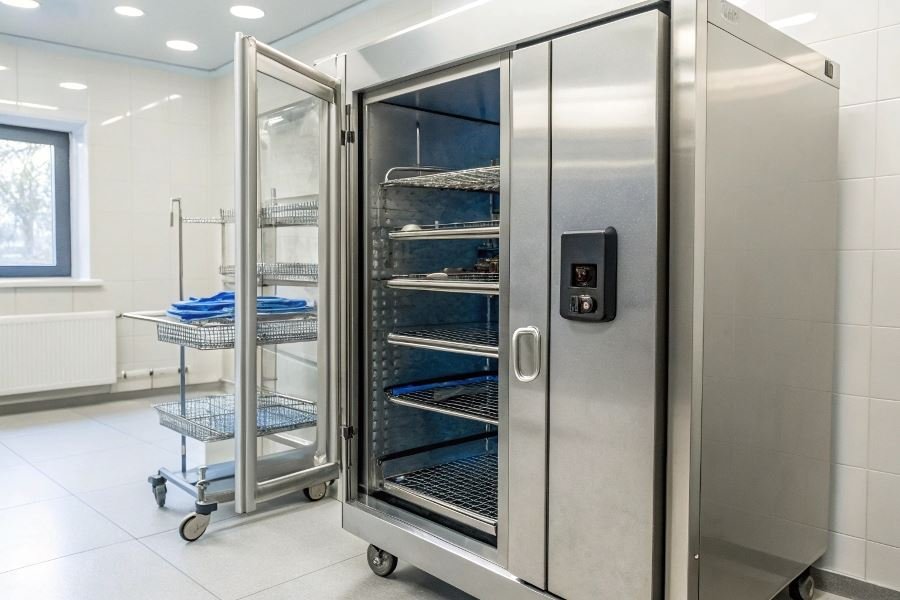
What if I told you that behind every successful surgical procedure lies a meticulously dried and disinfected instrument? The battle against healthcare-associated infections often hinges on equipment that rarely makes headlines but serves as the foundation of patient safety.
Medical drying cabinets with disinfection capabilities represent specialized equipment designed to thoroughly dry and sanitize medical instruments, endoscopes, respiratory equipment, and other critical healthcare tools. Unlike conventional drying methods, these cabinets create controlled environments where both moisture elimination and pathogen destruction occur simultaneously, ensuring instruments remain sterile until needed.
The science behind the safety
At their core, these systems combine precise temperature control, HEPA-filtered air circulation, and often UV-C light or ozone technology to achieve a dual purpose: removing all moisture that could harbor bacterial growth while eliminating existing microorganisms. The most advanced models maintain positive pressure environments that prevent external contaminants from entering during the drying cycle.
“Proper drying is not just about preventing rust—it’s about creating an environment where pathogens simply cannot survive.”
Why proper disinfection isn’t optional
The stakes in healthcare settings couldn’t be higher. The CDC estimates that approximately 1 in 31 hospital patients acquires at least one healthcare-associated infection daily. Many of these infections can be traced back to improperly processed equipment. Beyond patient outcomes, there’s also the financial reality: a single serious infection can cost a facility between $28,000 and $45,000 in additional care expenses.
Meeting rigorous standards
Medical drying cabinets must comply with stringent regulatory frameworks established by organizations like the FDA, CDC, and AAMI. These standards specify parameters for:
- Minimum temperature thresholds
- Air quality requirements
- Cycle documentation capabilities
- Material compatibility testing
- Validation protocols
The Joint Commission’s surveys specifically evaluate a facility’s adherence to these standards, making proper drying equipment not just good practice, but essential for accreditation.
Critical Applications of Medical Drying Cabinets
Healthcare facilities face a constant battle against pathogens. The frontline weapons in this fight include specialized equipment that maintains sterility and extends the lifespan of critical medical tools. Drying cabinets with disinfection capabilities represent a cornerstone technology in modern healthcare settings, offering multi-faceted solutions to infection control challenges.
These specialized cabinets have revolutionized how medical institutions approach instrument processing and storage. Drying cabinets with disinfection: application in medical institutions encompasses everything from surgical tools to laboratory equipment and personal protective gear. The integration of both drying and disinfection functions creates a comprehensive approach to maintaining sterile conditions while extending equipment lifespan.
Surgical Instrument Processing Excellence
Surgical instruments represent significant investments for medical facilities—both financially and in terms of patient outcomes. High-quality stainless steel instruments can cost hundreds or even thousands of dollars per piece, making proper maintenance essential.
Modern drying cabinets employ controlled airflow systems that remove moisture from instruments within minutes rather than hours. This rapid drying prevents corrosion and extends instrument life by up to 300%. Many advanced models incorporate:
- UV-C light disinfection (254nm wavelength)
- HEPA-filtered air circulation
- Positive pressure environments
- Digital monitoring systems
The Steelco DS800 series exemplifies this technology, offering validated drying cycles that reduce microbial contamination by 99.9999% while protecting delicate instrument surfaces.
Laboratory Equipment Protection Systems
Laboratory settings present unique challenges with specialized glassware, precision measurement tools, and sensitive analytical equipment.
Laboratory-specific drying cabinets maintain not just sterility but calibration accuracy for sensitive instruments.
These specialized cabinets feature:
| Feature | Benefit |
|---|---|
| Temperature-controlled drying | Prevents warping of precision components |
| Laminar airflow | Ensures even drying without cross-contamination |
| Adjustable shelving | Accommodates various equipment sizes |
| Antimicrobial interior surfaces | Prevents biofilm formation |
The Thermo Fisher Scientific Heratherm series provides customizable solutions for laboratories handling everything from basic glassware to advanced PCR equipment, with programmable cycles that adapt to specific equipment needs.
PPE Disinfection and Longevity
The global health challenges of recent years have highlighted the critical importance of personal protective equipment (PPE). Specialized drying cabinets now offer dedicated solutions for masks, face shields, and other protective gear.
Advanced PPE drying cabinets combine gentle heat (typically 50-60°C) with UV-C disinfection to achieve:
- Complete moisture removal from N95 respirators
- Destruction of viral and bacterial contaminants
- Preservation of filtration efficiency
- Extension of PPE lifespan by 5-10x normal usage
The Belimed PPE series can process up to 50 complete sets of protective equipment in under 45 minutes, making it ideal for high-volume facilities facing rapid turnover requirements.
“Proper drying and disinfection of PPE isn’t just about infection control—it’s about resource management and sustainability in healthcare settings.”
These specialized applications demonstrate why drying cabinets with integrated disinfection capabilities have become essential infrastructure in forward-thinking medical institutions focused on both patient safety and operational efficiency.
Transforming Healthcare Through Drying Cabinets
Healthcare facilities face a constant battle against pathogens. In this high-stakes environment, specialized equipment like drying cabinets with disinfection capabilities aren’t just convenient—they’re critical infrastructure that saves lives. These systems have revolutionized how medical institutions manage equipment, instruments, and supplies while maintaining rigorous infection control standards.
Patient safety through superior infection control
The primary benefit of modern drying cabinets with disinfection features is their remarkable impact on infection prevention. Studies conducted by the Centers for Disease Control and Prevention show that properly disinfected equipment can reduce healthcare-associated infections by up to 30%. These cabinets employ multiple disinfection technologies:
- UV-C light systems that destroy bacterial DNA
- Ozone generators that penetrate hard-to-reach surfaces
- HEPA filtration that removes airborne contaminants
- Heat disinfection that eliminates moisture-loving pathogens
A major teaching hospital in Boston implemented these systems in 2022 and documented a 27% reduction in surgical site infections within just eight months. The technology doesn’t just clean—it creates verifiable results that translate directly to better patient outcomes.
“The ROI isn’t just financial. When you prevent even one serious infection, you’ve potentially saved a life.” – Dr. Michael Osterholm, infectious disease specialist
Operational efficiency that transforms workflows
Beyond infection control, these systems deliver remarkable operational benefits:
Time savings: Staff spend 62% less time managing equipment drying and disinfection processes compared to manual methods.
Resource optimization: Modern cabinets reduce equipment damage from improper handling and extend the lifespan of sensitive instruments by up to 40%.
Space utilization: Compact designs with high-capacity interiors maximize limited hospital real estate.
The cost-effectiveness becomes clear when analyzing the complete picture:
| Factor | Traditional Methods | Drying Cabinets with Disinfection |
|---|---|---|
| Annual labor costs | $42,000 | $16,000 |
| Equipment replacement | $38,500 | $22,700 |
| Infection-related costs | $175,000+ | $122,500 |
| Energy consumption | High | Moderate |
| Total annual impact | Base reference | $94,300 savings |
These figures represent averages from a 200-bed hospital implementation. The American Hospital Association reports that facilities typically achieve complete ROI within 14-18 months of installation.
Integration strategies that maximize impact
Successful implementation requires thoughtful integration into existing workflows:
-
Strategic placement – Positioning units at point-of-use locations rather than centralized processing areas reduces transport time and contamination risks.
-
Standardized protocols – Developing clear SOPs for different equipment categories ensures consistent results and staff compliance.
-
Cycle customization – Programming specific disinfection cycles for different equipment types optimizes both effectiveness and throughput.
-
Staff training – Comprehensive education programs ensure proper usage and maintenance.
The most successful implementations pair technology with process improvement. Joint Commission surveys indicate that facilities using drying cabinets with disinfection as part of a comprehensive infection control strategy score 22% higher on compliance metrics.
When properly implemented, these systems don’t just add another step to existing processes—they fundamentally transform how medical institutions approach equipment management, creating safer environments for patients while delivering substantial operational benefits.
Discover how medical drying cabinets with advanced disinfection technology enhance infection control, extend equipment lifespan, and ensure regulatory compliance in healthcare settings. Essential solutions for modern medical facilities.
Discover how medical drying cabinets with advanced disinfection technology enhance infection control, extend equipment lifespan, and ensure regulatory compliance in healthcare settings. Essential solutions for modern medical facilities.