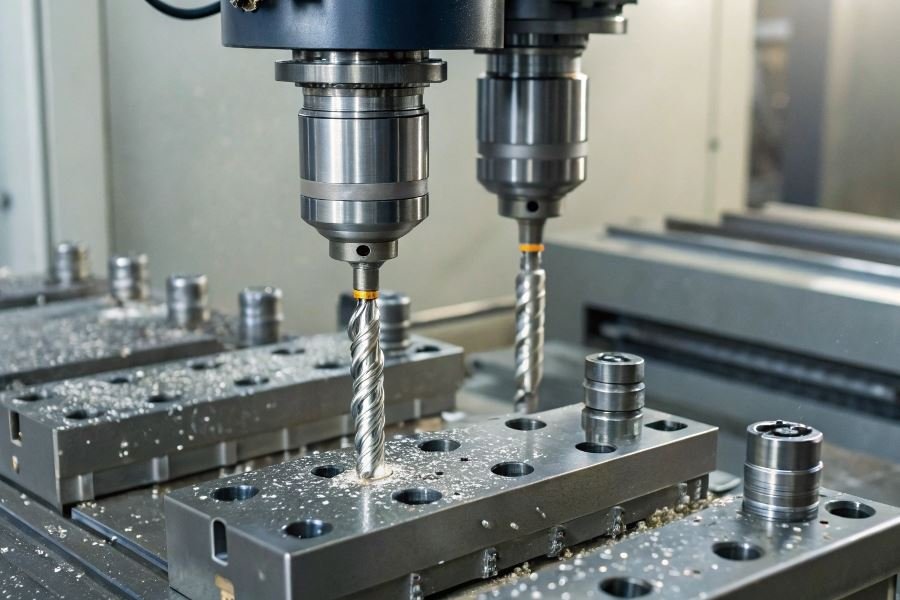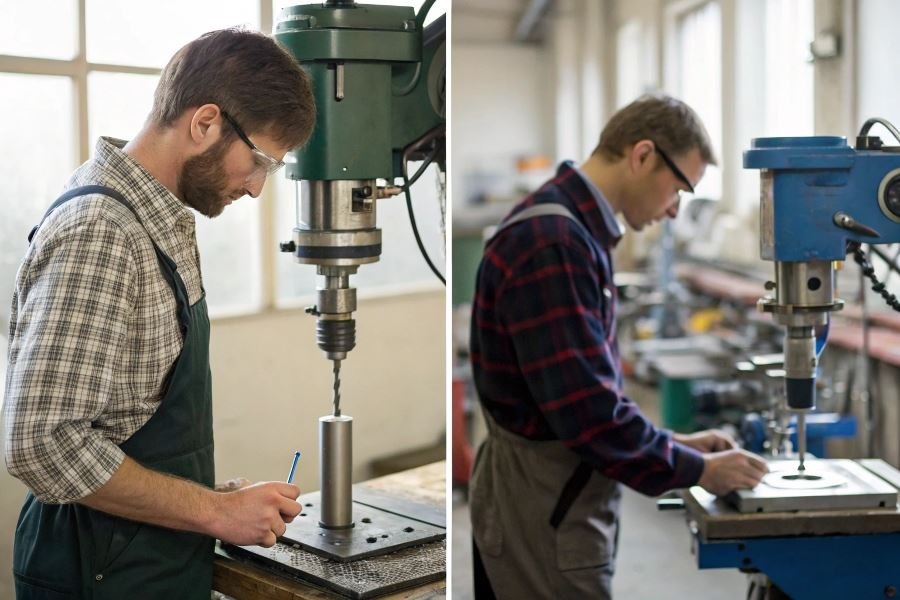
The difference between drilling a perfect hole and wasting a $5,000 piece of titanium often comes down to a single decision: automatic or manual?
When Boeing revolutionized aircraft manufacturing with the 777 in the early 1990s, they made a pivotal shift to automated drilling systems that reduced assembly time by 40% compared to previous models. This transformation represents the fundamental choice facing industries today: embrace automation or maintain manual control? The efficiency gap between these approaches has widened dramatically, with automatic drilling machines now capable of maintaining 0.0005-inch precision across thousands of operations without operator fatigue.
From hand cranks to digital precision
Drilling technology has undergone remarkable transformation since the first manual drills appeared in ancient Egypt around 3000 BCE. The industrial revolution brought mechanical advantages, but the true leap came with CNC (Computer Numerical Control) integration in the 1970s. Today’s automatic drilling systems incorporate multi-axis positioning, real-time feedback loops, and material-specific programming that would seem like science fiction to craftsmen of previous generations.
Measuring what matters: The efficiency equation
When comparing automatic and manual drilling, five critical metrics determine true efficiency:
- Throughput rate: Automatic systems typically process 3-5× more workpieces per hour
- Precision consistency: Manual drilling accuracy degrades over time due to operator fatigue
- Material waste: Automated systems reduce scrap rates by up to 30%
- Labor requirements: One operator can manage multiple automatic machines
- Energy consumption: Surprisingly, some advanced automatic systems use less power per operation than manual alternatives
Market dynamics: The shifting landscape
The drilling equipment market has reached $7.2 billion globally, with automatic systems gaining ground rapidly. While North American manufacturing still maintains a 40% manual drilling presence, Asian markets have pushed automation adoption to nearly 70% in new installations. The most significant trend is the emergence of hybrid systems that combine the flexibility of manual operation with the precision of automation—offering the best of both worlds for small to medium manufacturers.
The Productivity Showdown: Automatic vs Manual Drilling
When evaluating production systems, the choice between automatic drilling machines and manual operations represents one of the most consequential decisions manufacturers face. The efficiency gap between these approaches has widened dramatically as technology advances, transforming what was once a simple preference into a strategic business decision.
Speed and precision that defines success
Automatic drilling machines operate at speeds that manual operations simply cannot match. While a skilled operator might complete 5-10 holes per minute with a manual drill press, CNC automatic drilling systems routinely process 60-100 holes in the same timeframe. This 10x productivity multiplier fundamentally changes production economics. Automatic drilling machines vs. manual ones: which is more efficient becomes less a question and more a mathematical certainty when examining throughput alone.
The precision differential is equally striking. Haas Automation drilling centers consistently achieve positional accuracy within ±0.0002 inches, while manual operations typically deliver ±0.005 inches at best. This 25-fold improvement in precision translates directly to reduced scrap rates and higher-quality finished products.
The true cost equation
Labor requirements present perhaps the starkest contrast between these drilling methodologies:
| Factor | Manual Drilling | Automatic Drilling |
|---|---|---|
| Operators required | 1 per machine | 1 per 3-5 machines |
| Training time | 2-3 weeks | 4-6 weeks (programming) |
| Fatigue factor | High (limits shift productivity) | Minimal |
| Error rate | Increases with time | Consistent throughout production |
The initial investment disparity remains significant. A quality manual drill press from JET Tools might cost 2, 000−5,000, while entry-level CNC drilling systems from DMG MORI start around $75,000. However, the operational math changes dramatically when calculating cost-per-hole over time.
The five-year total cost of ownership often favors automatic systems for production volumes exceeding 10,000 units annually, with the breakeven point continuing to drop as technology costs decrease.
Industry-specific efficiency considerations
Different sectors experience varying returns on automation investment:
Aerospace manufacturing sees outsized benefits from automatic drilling, with complex components requiring thousands of precisely positioned holes. Boeing reports 80% reduction in drilling time for certain airframe components after automation implementation.
Small-batch custom fabrication presents a more nuanced picture. For runs under 50 units, manual drilling often remains economically viable, particularly when factoring in programming time.
Furniture manufacturing occupies a middle ground where hybrid approaches flourish. Herman Miller employs automatic drilling for standardized components while maintaining manual operations for custom elements.
The electronics industry demonstrates perhaps the most dramatic efficiency differential. Circuit board drilling requires hundreds of holes at microscopic diameters and spacings—a task virtually impossible without automation. Precision Drilling Systems automatic micro-drilling equipment can process 30,000 holes per hour with positional accuracy of ±0.0001 inches.
When evaluating these systems, manufacturers must consider not just the immediate production metrics but also adaptability to changing market demands. Automatic systems excel at consistent, high-volume production but require significant retooling for product changes. Manual operations offer flexibility for varied or evolving product lines, though at substantially lower throughput rates.
Making the Right Choice for Maximum Drilling Efficiency
The decision between automatic and manual drilling equipment represents a critical crossroads for operations of all sizes. Let’s cut through the complexity and establish a clear framework for making this choice with confidence.
Project Scale Drives Equipment Decisions
The scale of your operation fundamentally dictates your drilling equipment needs. Small workshops handling limited production runs often find manual drilling provides sufficient throughput without excessive capital investment. Conversely, manufacturing facilities processing hundreds or thousands of identical components benefit dramatically from automation’s consistency and speed.
Decision insight: When production volume exceeds 500 identical holes per week, automatic drilling typically becomes more economically viable than manual alternatives.
Mid-sized operations face the most nuanced decision. Consider the Bosch PBD 40 semi-automatic drill press as a transitional solution—offering precision positioning while requiring manual loading/unloading, it bridges the gap between fully manual and automatic systems.
ROI Calculations That Actually Matter
The investment calculation extends far beyond the initial purchase price. A comprehensive ROI analysis must include:
| Factor | Manual Drilling | Automatic Drilling |
|---|---|---|
| Initial equipment cost | 1, 500−5,000 | 15, 000−150,000+ |
| Labor hours per 1,000 holes | 40-60 hours | 5-10 hours |
| Error rate | 2-5% | 0.1-0.5% |
| Maintenance costs (annual) | 5-10% of purchase price | 8-15% of purchase price |
| Energy consumption | Lower | Higher |
The breakeven timeline varies dramatically based on labor costs in your region. At $25/hour labor rates, a $50,000 automatic drilling system typically reaches ROI within 18-24 months when replacing two manual stations operating at full capacity.
Material waste reduction often becomes the hidden ROI accelerator. Automatic systems from manufacturers like FANUC reduce scrap rates by up to 90% compared to manual operations, creating substantial savings on high-value materials.
Future Trends Reshaping Drilling Efficiency
The drilling landscape continues to evolve at breakneck speed. Three key developments demand attention:
-
AI-enhanced adaptive drilling systems now adjust feed rates and speeds in real-time based on material resistance, extending tool life by up to 40% while maintaining precision.
-
Hybrid manual-automatic solutions are gaining traction, offering programmable positioning with manual tool control—providing flexibility without the full automation price tag.
-
IoT-connected drilling platforms from companies like DMG MORI now deliver predictive maintenance alerts and performance analytics, reducing downtime by identifying potential failures before they occur.
The efficiency gap between automatic and manual drilling continues to widen, particularly as labor costs increase and automation technology becomes more accessible. For operations planning beyond a 3-5 year horizon, the scalability of automatic systems provides strategic advantages that manual systems simply cannot match.
The ultimate decision requires honest assessment of your operation’s volume, precision requirements, and growth trajectory. While automatic drilling represents a significant investment, its efficiency advantages compound over time—transforming what initially appears as an expense into a competitive advantage that pays dividends for years to come.
Discover which drilling technology delivers superior results in our comprehensive efficiency comparison of automatic vs. manual drilling machines. Learn key performance metrics, cost considerations, and how to choose the right equipment for your specific industrial applications.
Discover which drilling technology delivers superior results in our comprehensive efficiency comparison of automatic vs. manual drilling machines. Learn key performance metrics, cost considerations, and how to choose the right equipment for your specific industrial applications.