Ever wondered what’s really keeping your valuables safe? The humble lock—a device we interact with daily but rarely think about—has undergone a remarkable transformation from purely mechanical systems to sophisticated electronic solutions.
The journey from ancient wooden pins to today’s biometric scanners represents one of humanity’s longest-running security narratives. While mechanical locks have protected valuables since the Egyptians crafted wooden pin tumblers around 4000 BCE, electronic locks emerged only in the 1970s, revolutionizing how we think about access control. This technological leap didn’t just add convenience—it fundamentally changed our relationship with security.
Reliability has become the cornerstone of modern security systems as what’s being protected has grown increasingly valuable. A lock that fails at a critical moment isn’t just inconvenient; it can be catastrophic. The average American home now contains over $35,000 worth of possessions, making lock dependability more crucial than ever.
When evaluating lock reliability, three factors stand above all others:
- Resistance to physical attacks – How well does it withstand force?
- Environmental durability – Will it function in extreme temperatures or weather?
- Power independence – Can mechanical locks function without electricity, giving them an edge during outages?
The mechanical vs. electronic debate isn’t simply about tradition versus innovation—it’s about matching the right security solution to specific needs. While mechanical locks offer proven longevity, electronic systems provide advanced features like audit trails and remote access that were unimaginable just decades ago.
The Battle of the Locks: Reliability Under Scrutiny
When security matters, the choice between electronic and mechanical locks becomes more than a simple preference—it’s a strategic decision with long-term implications. The reliability factors that separate these two technologies reveal a complex landscape where neither option claims absolute superiority.
Let’s dive deep into what makes each locking system tick. Electronic or mechanical locks: a comparison of reliability requires examining multiple factors that affect performance in real-world conditions. Both systems have evolved significantly, with mechanical locks refining designs that have worked for centuries while electronic options leverage cutting-edge technology to offer convenience alongside security.
Built to Last: Durability Face-Off
Mechanical locks showcase impressive physical resilience. Constructed from hardened metals like brass and steel, quality mechanical locks from manufacturers like Medeco can withstand decades of use. Their simple internal mechanisms—pins, tumblers, and springs—have fewer potential failure points.
Electronic locks present a more complex durability profile. While premium models from Schlage incorporate reinforced strike plates and anti-drill protection, they contain sensitive circuitry vulnerable to environmental factors.
Physical tampering resistance comparison:
| Lock Type | Picking Resistance | Forced Entry Resistance | Weather Resistance |
|---|---|---|---|
| Mechanical | Moderate to High (depends on pin configuration) | High (solid construction) | Excellent (minimal sensitive components) |
| Electronic | Very High (no keyway to pick) | High (similar physical construction) | Moderate (electronics vulnerable to moisture) |
When the Lights Go Out: Reliability During System Failures
The Achilles’ heel of electronic security becomes apparent during power disruptions. Even the most sophisticated Yale electronic lock becomes a potential liability when batteries die or power systems fail.
Most electronic locks incorporate backup systems—emergency keys, external battery connections, or power reserves—but these introduce additional complexity and potential failure points.
Mechanical locks shine in this category with their complete independence from external power sources. They function identically in blackouts, brownouts, or electromagnetic pulse scenarios—a reliability factor that security professionals consistently highlight.
The Maintenance Equation: Long-Term Performance
The maintenance requirements between these systems differ dramatically:
Mechanical locks require:
- Occasional lubrication (typically every 1-2 years)
- Minimal cleaning to prevent dust accumulation
- Replacement of worn components after extensive use (often 10+ years)
Electronic locks demand:
- Regular battery replacement (typically every 6-12 months)
- Software updates to patch security vulnerabilities
- Circuit board and sensor maintenance
- Protection from moisture and temperature extremes
Long-term performance data suggests quality mechanical locks from Baldwin can maintain reliable operation for 25+ years with minimal maintenance. Electronic counterparts from companies like August typically show higher failure rates after 5-7 years as electronic components degrade.
Industry insight: The total cost of ownership for electronic locks typically exceeds mechanical options by 30-40% when factoring in maintenance, battery replacement, and shorter replacement cycles.
The reliability equation isn’t one-dimensional. Electronic locks offer unmatched access control, audit trails, and remote management capabilities that mechanical systems simply cannot match. However, when evaluating pure reliability—the consistent performance of the core locking function regardless of conditions—mechanical systems maintain a significant advantage in durability, power independence, and maintenance simplicity.
Making the Right Choice: Lock Systems for Every Need
Where Mechanical Locks Truly Excel
Mechanical locks have stood the test of time for good reason. These traditional systems shine in environments where reliability under extreme conditions is non-negotiable. Remote cabins, outdoor gates, and facilities in harsh climates benefit from mechanical locks’ ability to function without power sources or network connectivity.
Small businesses with limited security budgets find mechanical locks from brands like Schlage and Medeco offer exceptional value. A high-quality deadbolt can provide decades of service with minimal maintenance—just occasional lubrication and cleaning.
Heritage properties deserve special consideration. Historic buildings often benefit from mechanical locks that maintain architectural integrity while providing security. The Baldwin Reserve series, for instance, offers period-appropriate aesthetics without compromising on modern security features.
Mechanical systems also excel in high-traffic areas where simplicity equals efficiency:
| Environment | Why Mechanical Works Best |
|---|---|
| School classrooms | No battery failures during critical moments |
| Rental properties | Lower replacement costs, fewer tenant complaints |
| Emergency exits | Reliable operation without power dependency |
| Remote locations | Function without electricity or network coverage |
The absence of electronics means fewer points of failure—a crucial advantage when security cannot be compromised.
When Electronic Locks Make Perfect Sense
Electronic lock systems transform security management in dynamic environments. Office buildings with multiple departments benefit tremendously from systems like HID Global access control, where permissions can be updated instantly across hundreds of doors.
Hotels represent the perfect electronic lock application. Staff can issue temporary credentials without physical key exchanges, while maintaining detailed access logs. The SALTO hotel system can manage thousands of rooms with minimal administrative overhead.
Access tracking capabilities create accountability. Electronic systems excel in:
| Setting | Electronic Advantage |
|---|---|
| Research laboratories | Detailed logs of who accessed sensitive areas |
| Data centers | Customizable access levels for different security zones |
| Multi-tenant buildings | Time-restricted access for maintenance personnel |
| Healthcare facilities | Emergency lockdown capabilities |
Electronic locks from Schlage Encode or August have revolutionized short-term rentals, allowing property managers to grant temporary access codes without physical key handoffs.
The flexibility to revoke access instantly provides security peace of mind that mechanical systems simply cannot match.
Hybrid Solutions: The Best of Both Worlds
Smart security doesn’t always mean choosing sides. Hybrid approaches combine mechanical reliability with electronic convenience in applications where neither alone suffices.
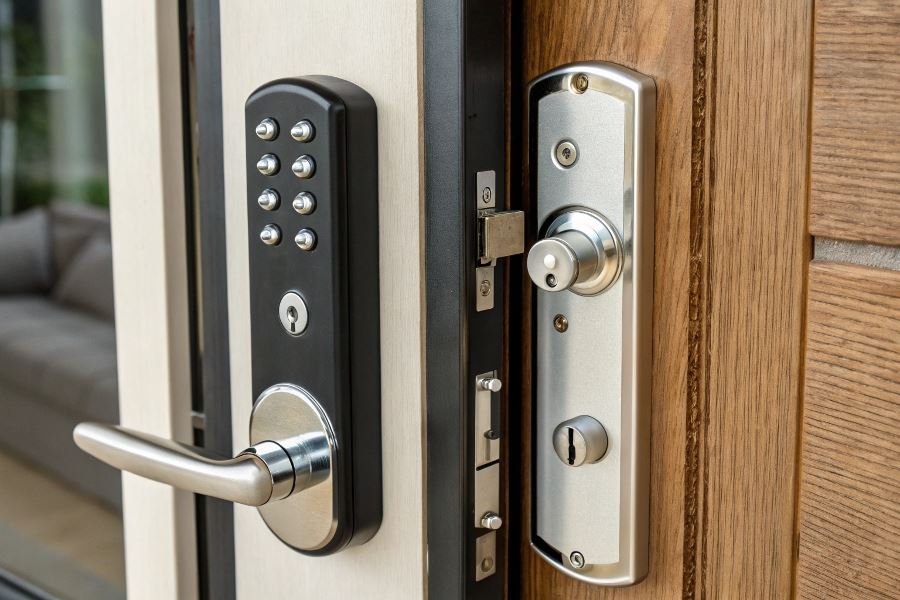
The Yale Assure lock series exemplifies this balance—offering keypad and app access while maintaining traditional key override capability for emergencies. This redundancy ensures access even during power outages or connectivity issues.
Commercial applications benefit tremendously from layered approaches. A manufacturing facility might use electronic access for main entrances with detailed logging, while securing equipment rooms with high-security mechanical locks from Abloy.
Hybrid solutions particularly shine in:
| Application | Hybrid Advantage |
|---|---|
| Home security | Electronic convenience with mechanical backup |
| Server rooms | Dual authentication requirements |
| Pharmaceutical storage | Electronic logs with mechanical tamper resistance |
| Executive offices | Convenience without sacrificing security |
The Kwikset Halo series demonstrates how modern systems can integrate with home automation while maintaining mechanical reliability when technology fails.
The most robust security strategy acknowledges that different access points have different requirements—and designs protection accordingly.
Discover which lock system offers superior protection for your property. Our in-depth comparison examines durability, power dependency, and maintenance needs of electronic vs mechanical locks to help you make the most reliable security choice.
Discover which lock system offers superior protection for your property. Our in-depth comparison examines durability, power dependency, and maintenance needs of electronic vs mechanical locks to help you make the most reliable security choice.