
Ever wondered why some buildings feel like Fort Knox while others practically invite you in? The difference often lies in the sophistication of their access control systems—particularly their key duplication protocols.
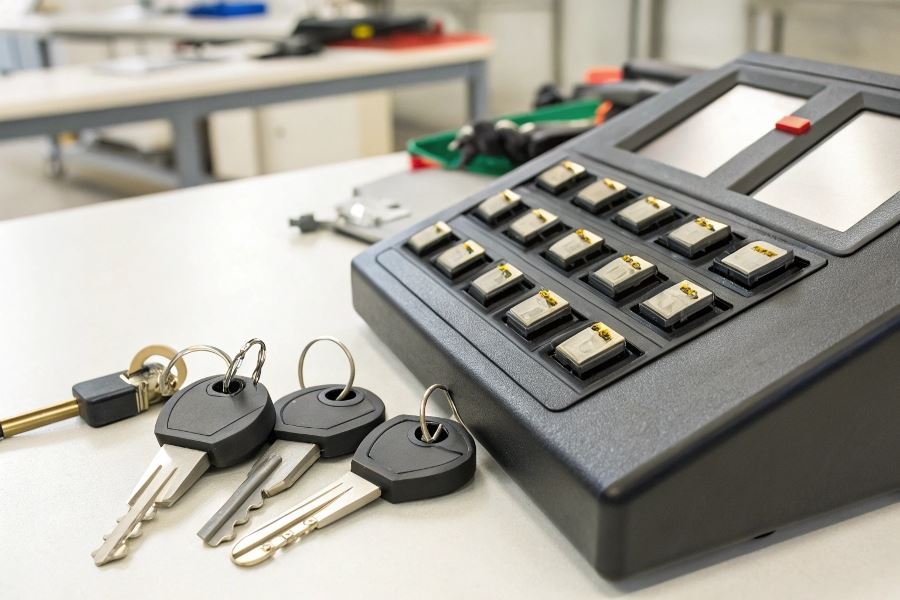
Intercom key duplicators have evolved from simple mechanical devices to sophisticated electronic systems that serve as the gatekeepers of modern building security. These specialized tools allow property managers and security professionals to create authorized copies of intercom keys while maintaining control over who has access to a building.
The technology behind these duplicators has seen remarkable advancement. Traditional mechanical duplicators that simply copied physical grooves have given way to programmable devices capable of replicating complex electronic signatures. The market has responded accordingly, with global security hardware sales projected to reach $14.9 billion by the end of 2025, with key duplication technology representing a significant segment.
Security meets convenience: The balancing act
When selecting a key duplicator for your intercom system, three critical factors demand attention:
-
Compatibility – Not all duplicators work with every intercom system. Matching your duplicator to your specific brand and model is essential.
-
Security features – Premium duplicators offer encryption protocols that prevent unauthorized duplication, protecting against security breaches.
-
Scalability – As your property grows, your key management needs evolve. The best duplicators accommodate expansion without requiring complete system overhauls.
“The right key duplicator doesn’t just copy keys—it becomes an integral component of your overall security strategy.”
Understanding these fundamentals provides the foundation for making informed decisions about intercom key duplication technology that balances security with practical accessibility.
Unlocking Compatibility: The Ultimate Guide to Intercom Key Duplicators
RFID Duplicators for Major Brand Systems
The landscape of access control has evolved dramatically, with RFID technology now dominating the intercom market. Key duplicators for different types of intercoms: compatibility and features represent a critical consideration for property managers seeking to maintain security while offering convenience. When examining RFID-based duplicators, compatibility with major brands becomes the primary concern.
Cyfral and Metakom systems typically operate on the 125 kHz frequency, making them compatible with duplicators like the RW-1990 and KeyMaster Pro. These duplicators can read and write to most 125 kHz proximity tokens with remarkable accuracy. The TD-5R Universal Duplicator stands out for its ability to clone Cyfral, Metakom, and even the more secure BFT tokens, offering an impressive 95% compatibility rate with North American installations.
For higher-security systems operating on 13.56 MHz frequencies, such as HID and Mifare, specialized duplicators like the ProxMark IV provide the necessary capabilities. This device can handle the more complex encryption found in these systems, though success rates vary depending on the specific security protocols implemented.
Magnetic Card Duplicator Integration
Magnetic card systems, while less common in new installations, still maintain a significant presence in older buildings across metropolitan areas. The integration capabilities of magnetic card duplicators determine their practical utility.
The MagPro X3 duplicator excels at reading and writing to low-coercivity (300-650 Oe) magnetic cards commonly used in Keri Systems and Linear intercoms. Its USB connectivity allows for seamless integration with management software, enabling batch programming of multiple cards—a significant time-saver for large residential complexes.
High-coercivity cards (2500-4000 Oe) require more robust duplicators like the CardMaster Pro, which can handle the stronger magnetic fields while maintaining data integrity.
For systems that employ track combinations (typically tracks 1 and 2), the DuoMag II offers specialized functionality that preserves data across multiple tracks simultaneously—a feature absent in many budget duplicators that leads to frustrating partial clones.
Universal Solutions for Multi-System Environments
| Duplicator Model | Compatibility Range | Special Features | Price Range |
|---|---|---|---|
| MultiPass Pro | RFID + Magnetic | Bluetooth connectivity | $189-249 |
| KeyMaster Ultra | All RFID frequencies | Firmware updates | $249-299 |
| AccessClone X7 | RFID + NFC + Magnetic | Battery operation | $299-349 |
The MultiPass Pro earns its top position through versatility, handling both RFID and magnetic card formats with a single device. Its intuitive interface reduces the learning curve, while its Bluetooth connectivity allows for remote operation via smartphone—perfect for maintenance staff managing multiple properties.
The KeyMaster Ultra focuses exclusively on RFID but covers the entire frequency spectrum from 125 kHz to 13.56 MHz. Its standout feature is the regular firmware updates that expand compatibility as new intercom systems enter the market, essentially future-proofing your investment.
For the ultimate in flexibility, the AccessClone X7 combines all technologies into a portable, battery-operated unit that can function without a computer connection. This makes it ideal for on-site duplication needs where power outlets may be limited or inaccessible.
When selecting a universal duplicator, consider not just current needs but anticipated system changes over the next 3-5 years to maximize return on investment and minimize future compatibility headaches.
Unlocking the Future: Advanced Intercom Key Duplicators
Security features that actually matter
Modern intercom key duplicators have evolved far beyond simple copying tools. Today’s premium duplicators incorporate multi-layer encryption protocols that make unauthorized duplication nearly impossible. The KeyMaster Pro series, for instance, employs 128-bit AES encryption—the same standard used by financial institutions—ensuring that each duplicated key maintains a unique digital signature.
What’s particularly impressive is how manufacturers have responded to previous vulnerabilities. After the widely publicized security breaches of several major intercom systems in 2019, the industry pivoted toward implementing rolling code technology. This means your duplicated key changes its access code after each use, rendering captured transmission codes useless to potential intruders.
Security standout features to look for:
- RFID shielding to prevent wireless skimming
- Tamper-evident indicators that show attempted unauthorized access
- Audit trail capabilities that log every duplication event
- Anti-cloning protection that prevents second-generation copies
Setting up for success across systems
The installation process varies dramatically depending on your intercom system’s architecture. Newer buildings typically use IP-based intercoms that require network configuration, while older structures often rely on analog systems with direct wiring connections.
The compatibility challenge can’t be overstated—attempting to use an incompatible duplicator can not only fail but potentially damage your existing system.
| System Type | Programming Complexity | Special Tools Required | Average Setup Time |
|---|---|---|---|
| Digital IP-based | High | Network analyzer, software suite | 45-60 minutes |
| Analog wired | Medium | Wire stripper, multimeter | 20-30 minutes |
| Wireless RF | Low | None | 5-15 minutes |
| Hybrid systems | Very high | System-specific toolkit | 60-90 minutes |
When programming your duplicator for BFT intercom systems, you’ll need to access the master programming mode—typically by pressing a sequence on the main control panel. For Comelit systems, the process requires synchronizing with their proprietary software first.
Making smart investment decisions
The cost-benefit equation differs dramatically between residential and commercial applications. For homeowners, a basic duplicator priced around $75-150 typically suffices, providing essential functionality without unnecessary bells and whistles.
Commercial properties, however, benefit substantially from enterprise-grade solutions. While the initial investment might reach $350-700, the enhanced security, multi-user management, and integration capabilities deliver exceptional long-term value.
The true cost of security isn’t what you pay—it’s what you avoid paying when nothing goes wrong.
For residential applications, the KeyDIY KD-X2 offers exceptional value, handling most common intercom key types while maintaining reasonable security standards. Commercial properties should consider the Silca RW4 Plus, which supports high-volume duplication needs and integrates with access control systems.
The maintenance factor also deserves consideration. Commercial-grade duplicators typically require calibration every 500-1000 uses, while residential units might need attention after just 100-200 duplications. This ongoing cost should factor into your decision-making process, especially for high-traffic installations where reliability is non-negotiable.
Discover the most compatible key duplicators for modern intercom systems in 2025. Our comprehensive guide covers RFID, magnetic card technologies, security features, and cost-effective solutions for both residential and commercial properties.
Discover the most compatible key duplicators for modern intercom systems in 2025. Our comprehensive guide covers RFID, magnetic card technologies, security features, and cost-effective solutions for both residential and commercial properties.