What if your point-of-sale system could grow alongside your business—without requiring a complete overhaul every time you expand? This isn’t just a dream scenario; it’s the reality that modular cash register systems are bringing to retail environments across America.
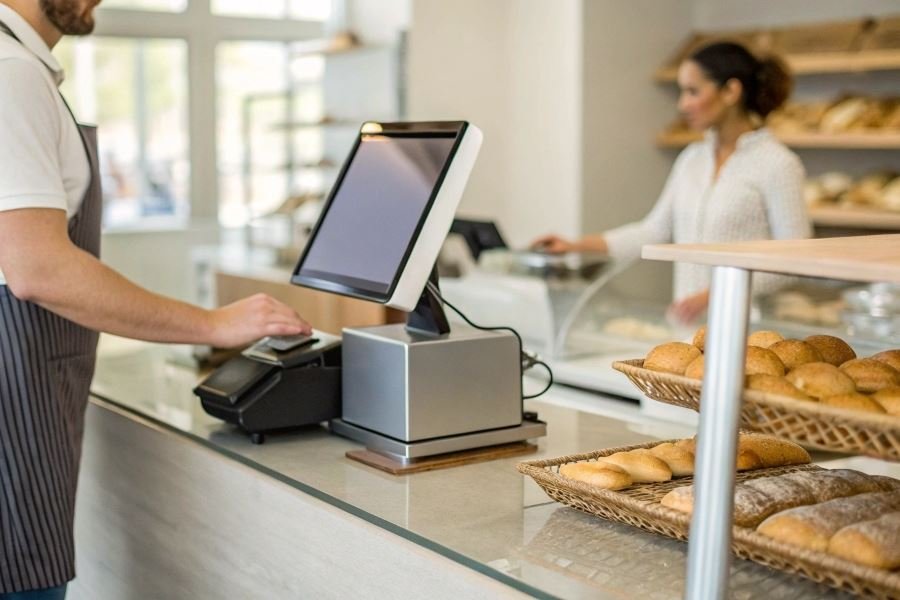
Modular cash registers represent a fundamental shift in how businesses approach their point-of-sale infrastructure. At their core, these systems consist of interchangeable hardware components—touchscreens, barcode scanners, customer displays, card readers—all connected to versatile software platforms that can be customized to specific business needs. Unlike traditional all-in-one registers, these systems allow merchants to add, remove, or upgrade individual components without replacing the entire system.
The evolution of this technology has been remarkable. From the mechanical cash registers invented by James Ritty in 1879 to today’s cloud-connected modular systems, we’ve witnessed a transformation that parallels the changing demands of retail itself. The current market landscape features solutions ranging from enterprise-level systems by NCR and Toshiba to nimble offerings from Square and Clover that have democratized sophisticated POS capabilities.
The scalability advantage
What makes modular systems truly revolutionary is their inherent scalability. When your business grows from one location to three, or when you add a new product line requiring specialized inventory tracking, modular systems expand with you. This adaptability translates directly to cost savings—businesses report up to 40% reduction in technology upgrade costs when using modular systems versus traditional POS solutions.
The beauty of modularity lies in its future-proofing potential. As payment technologies evolve (remember when contactless payments seemed futuristic?), businesses can simply add new components rather than replacing entire systems—making technological adaptation an evolution rather than a revolution.
Strategic Implementation for Business Growth
Modular cash registers represent a fundamental shift in how businesses approach point-of-sale technology. Unlike traditional fixed systems, these adaptable platforms allow businesses to expand functionality precisely when and how they need it. The flexibility inherent in modular systems creates a foundation for sustainable growth without requiring complete system overhauls when business needs evolve.
The concept of modular cash registers: opportunities for expansion extends far beyond simple transaction processing. These systems function as technological ecosystems that can be customized, upgraded, and integrated with existing business infrastructure. This adaptability makes them particularly valuable for businesses experiencing growth or seasonal fluctuations in demand.
Tailored Solutions Across Business Types
Specialty retailers benefit tremendously from modular systems that address their unique requirements. A jewelry store might implement specialized inventory modules that track individual pieces by serial number, while a bookstore could integrate publisher databases and reading recommendation engines. Clothing retailers often add RFID modules to streamline inventory management and reduce shrinkage.
Restaurants and food service operations leverage different module combinations:
| Module Type | Restaurant Application | Benefit |
|---|---|---|
| Kitchen Display | Order routing to prep stations | 32% reduction in order errors |
| Table Management | Digital floor plans with status indicators | 24% faster table turnover |
| Ingredient Tracking | Real-time inventory of food components | 18% less food waste |
Service businesses like salons, repair shops, and professional offices implement appointment scheduling modules, service history tracking, and customer relationship management tools that transform basic cash registers into comprehensive business management systems.
Seamless Integration Capabilities
The true power of modular systems emerges through integration with existing business infrastructure. Modern modular POS systems connect with:
- Accounting software like QuickBooks and Xero, eliminating manual data entry
- Inventory management platforms that provide real-time stock levels
- Customer relationship management (CRM) systems for personalized marketing
- E-commerce platforms enabling unified omnichannel experiences
These integrations create data ecosystems where information flows automatically between systems, reducing errors and providing comprehensive business intelligence.
Cost-Benefit Analysis: Modular vs. Traditional
Traditional POS systems typically require substantial upfront investment (3, 000−20,000 per terminal) with limited expansion options. When business needs change, these systems often require complete replacement.
Modular systems present a different financial model:
Initial investment: Often 15-30% lower than traditional systems
Expansion costs: Incremental module additions (200−1,500 per module)
Lifecycle value: 40% higher over a 5-year period due to adaptability
The real ROI advantage comes from avoiding system obsolescence. Modular systems evolve with your business rather than requiring replacement.
Businesses report average productivity improvements of 22% after implementing modular systems with customized workflows. The ability to add specialized functionality precisely when needed creates a competitive advantage that traditional systems simply cannot match.
For growing businesses, the strategic implementation of modular cash registers provides both immediate operational benefits and long-term expansion opportunities that align perfectly with evolving business models and customer expectations.
Future-Proofing Your Business with Modular Cash Registers
Technological adaptability in a changing market
The beauty of modular cash register systems lies in their inherent flexibility. Unlike traditional monolithic POS systems that require complete replacement when outdated, modular systems allow businesses to upgrade specific components as needed. This “building block” approach means you can start with a basic configuration and expand as your business grows.
Hardware upgrade pathways have become increasingly streamlined since the introduction of standardized connection protocols in 2020. Modern modular systems from providers like Square and Clover offer plug-and-play compatibility with peripherals ranging from customer-facing displays to inventory scanners and biometric authentication devices.
The most valuable aspect of modular cash registers isn’t what they can do today, but what they’ll be capable of tomorrow.
A prime example is the evolution of payment acceptance. Businesses that invested in modular systems in 2021 could easily add contactless payment modules without replacing their entire setup. Those same businesses can now integrate cryptocurrency payment options or biometric verification simply by adding new modules rather than investing in entirely new systems.
Scaling across multiple locations
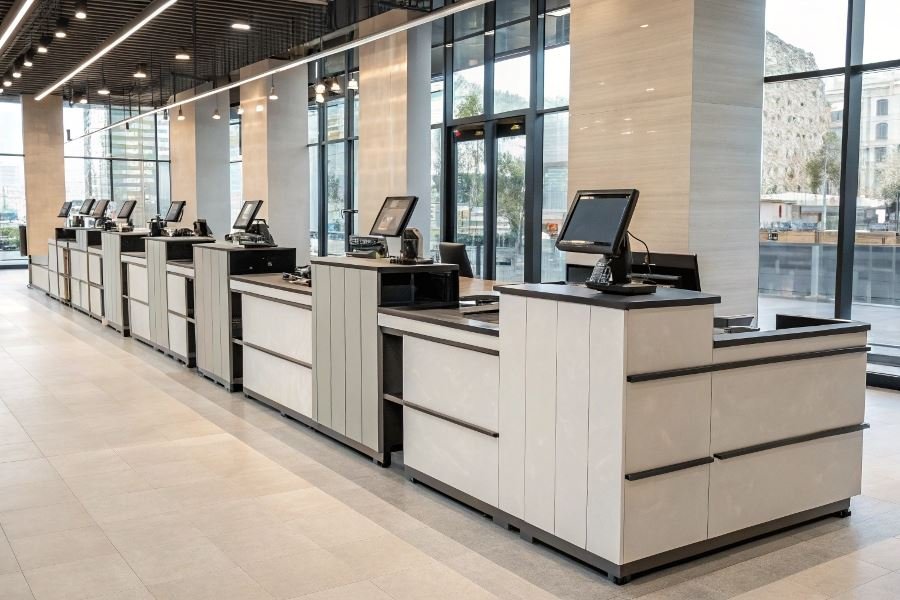
For businesses with growth ambitions, modular cash registers offer unparalleled scaling capabilities. Multi-location operations benefit from centralized management systems that can be gradually expanded without disrupting existing workflows.
The franchise-friendly architecture of modern modular systems allows for:
| Feature | Benefit |
|---|---|
| Centralized inventory management | Real-time stock visibility across all locations |
| Unified customer databases | Consistent customer experience regardless of location |
| Standardized reporting | Comparable performance metrics between branches |
| Customizable permissions | Location-specific access controls |
Toast has pioneered location-scaling features that allow businesses to replicate successful POS configurations across new locations with minimal configuration time. This standardization ensures consistent customer experiences while allowing for location-specific customizations where needed.
Investment considerations and growth potential
The initial investment in modular cash register systems typically exceeds that of traditional all-in-one solutions by 15-30%. However, the long-term ROI potential tells a different story.
Businesses implementing modular systems report:
- Reduced upgrade costs of 40-60% compared to full system replacements
- Extended system lifespan averaging 7-9 years versus 3-5 years for traditional systems
- Decreased downtime during upgrades (hours instead of days)
- Improved staff adaptability due to familiar interface continuity
The financial calculus becomes even more favorable when considering the opportunity cost of system limitations. A restaurant unable to quickly add QR code ordering capabilities during the pandemic faced significant competitive disadvantages compared to those with modular systems that could rapidly adapt.
Lightspeed users report an average ROI achievement within 14 months of implementation, primarily through labor efficiency gains and increased transaction volume capacity.
For growing businesses, the ability to incrementally scale technology investments in precise alignment with business needs represents perhaps the most significant advantage. Rather than over-investing in capabilities you might need someday, modular systems allow you to allocate capital exactly where and when it delivers maximum value.
This approach transforms your POS system from a depreciating asset into a strategic growth platform that evolves in lockstep with your business ambitions.
Discover how modular POS systems create flexible expansion opportunities for your retail business. Learn about customization options, integration capabilities, and strategic implementation approaches that drive scalability and long-term growth.
Discover how modular POS systems create flexible expansion opportunities for your retail business. Learn about customization options, integration capabilities, and strategic implementation approaches that drive scalability and long-term growth.