Ever tried to diagnose a fault in a component smaller than a grain of rice? That’s the daily reality for engineers working with Surface Mount Devices (SMDs). As these microscopic marvels continue shrinking while powering everything from smartphones to medical implants, having the right diagnostic tools isn’t just convenient—it’s essential.
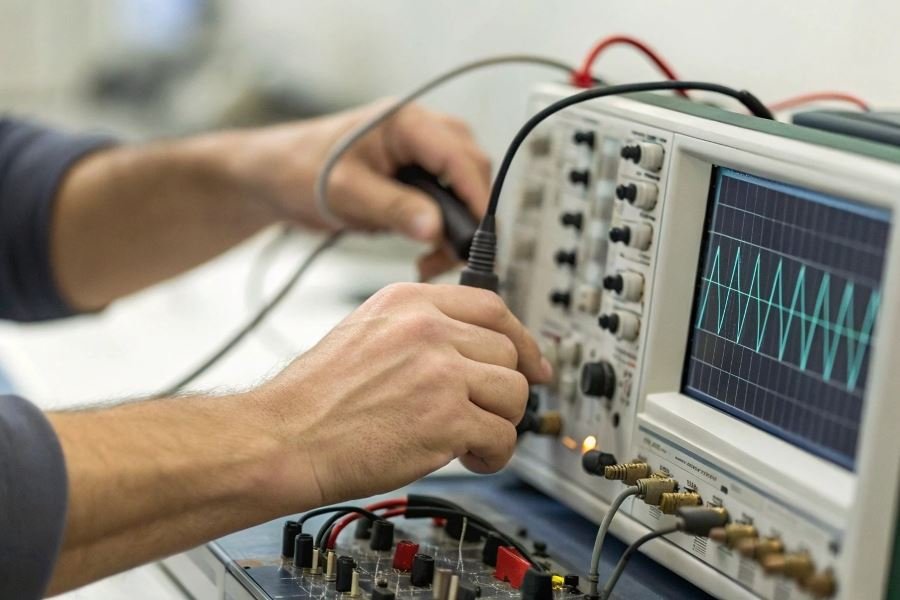
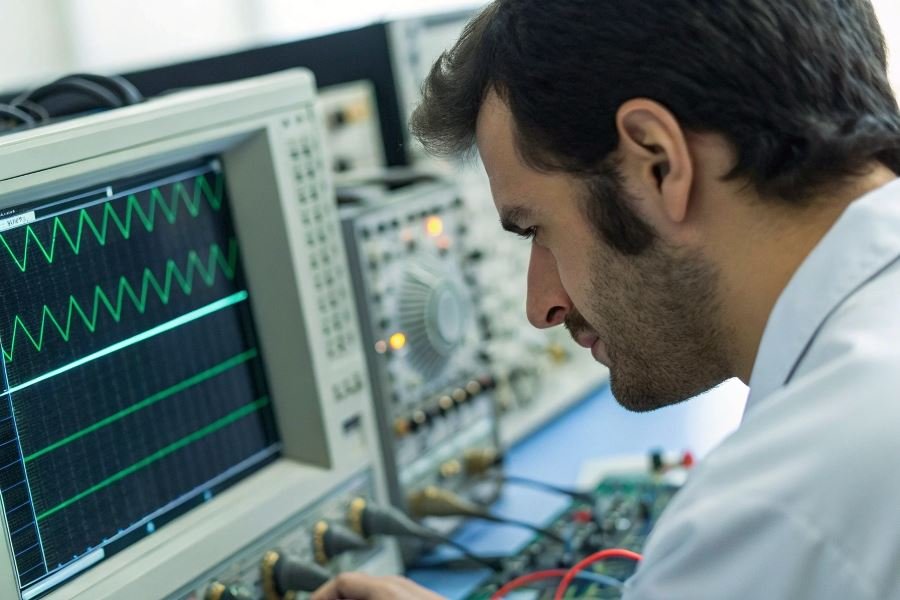
An oscilloscope for SMD work is like having superhuman vision. These sophisticated instruments capture, display, and analyze electrical signals flowing through these tiny components, revealing invisible problems that would otherwise remain mysteries. When troubleshooting modern electronics, oscilloscopes transform abstract electrical behavior into visual waveforms that tell the complete story of what’s happening in your circuit.
The SMD challenge
Surface-mount technology has revolutionized electronics manufacturing since its widespread adoption in the 1980s, but it presents unique diagnostic challenges. Components measuring just 0.4mm × 0.2mm (01005 package) demand precision that human hands and eyes simply cannot provide unaided. The right oscilloscope bridges this gap, offering:
- Unprecedented visibility into high-speed signals
- Real-time analysis of component behavior under actual operating conditions
- Fault isolation capabilities that can save hours of frustrating guesswork
The difference between standard oscilloscopes and those optimized for SMD work is like comparing a household magnifying glass to a surgical microscope. With features like higher bandwidth, faster sampling rates, and specialized probes designed for tiny contact points, SMD-focused oscilloscopes transform impossible diagnostic tasks into manageable ones.
Technical Specifications That Make or Break Your SMD Oscilloscope
When diving into the intricate world of surface mount devices, your oscilloscope becomes your most trusted ally—but only if it has the right specifications. The difference between capturing accurate signals and missing critical anomalies often comes down to technical details that many engineers overlook.
Selecting oscilloscopes for SMD components requires careful attention to several key parameters that directly impact measurement accuracy and reliability. The miniaturization of modern electronics has pushed signal frequencies higher while voltages have dropped lower, creating unique measurement challenges that demand specialized equipment capabilities.
Bandwidth: The Foundation of Signal Integrity
Bandwidth determines what you can see—and what remains invisible. When working with SMD components, the general rule is to select an oscilloscope with bandwidth at least five times higher than the fastest signal you’ll measure.
For modern SMD work, consider these bandwidth requirements:
| Application | Minimum Recommended Bandwidth |
|---|---|
| Basic digital circuits | 100 MHz |
| High-speed digital | 500 MHz – 1 GHz |
| RF applications | 2+ GHz |
| DDR memory testing | 4+ GHz |
Remember that inadequate bandwidth doesn’t just reduce amplitude—it distorts rise times and can completely mask glitches in high-frequency signals. The Keysight InfiniiVision series offers bandwidth options up to 6 GHz specifically designed for high-speed digital applications.
Sample Rate: Capturing Every Transient
Sample rate directly affects your ability to reconstruct waveforms accurately. For SMD work, particularly with high-speed digital signals, the Nyquist theorem is just the starting point—practical applications require 5-10 samples per cycle.
A 1 GHz signal requires a minimum sample rate of 10 GSa/s to capture subtle anomalies that might indicate design flaws or component failures.
Modern oscilloscopes like the Tektronix MSO Series offer sample rates up to 25 GSa/s, providing the temporal resolution needed for the most demanding SMD applications.
Probe Selection: The Critical Interface
Probe selection can make or break your measurements when working with tiny SMD components. Three factors deserve special attention:
- Impedance matching – High-frequency measurements demand probes with controlled impedance to prevent signal reflections
- Loading effects – Miniature SMD circuits can be easily affected by probe capacitance
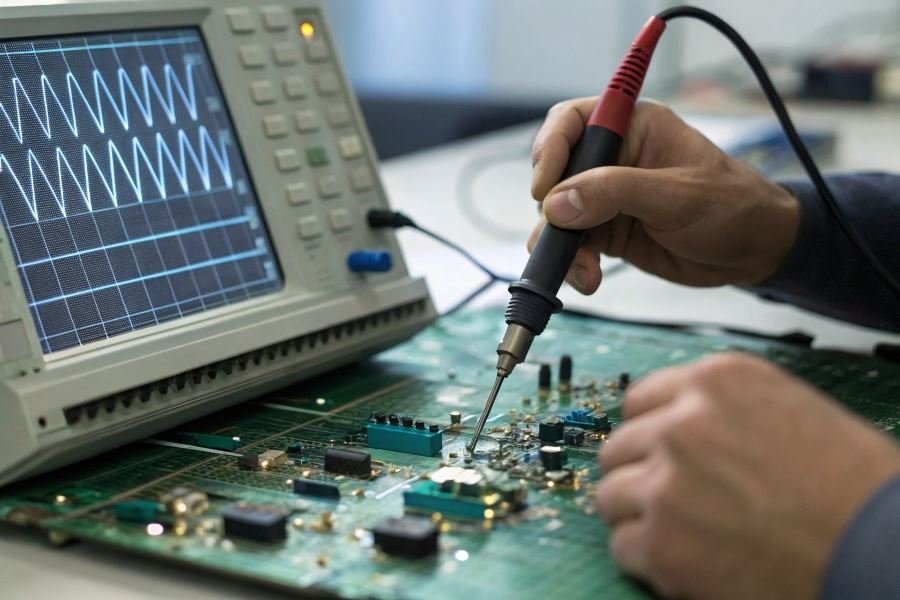
- Physical access – Fine-pitch components require specialized probe tips
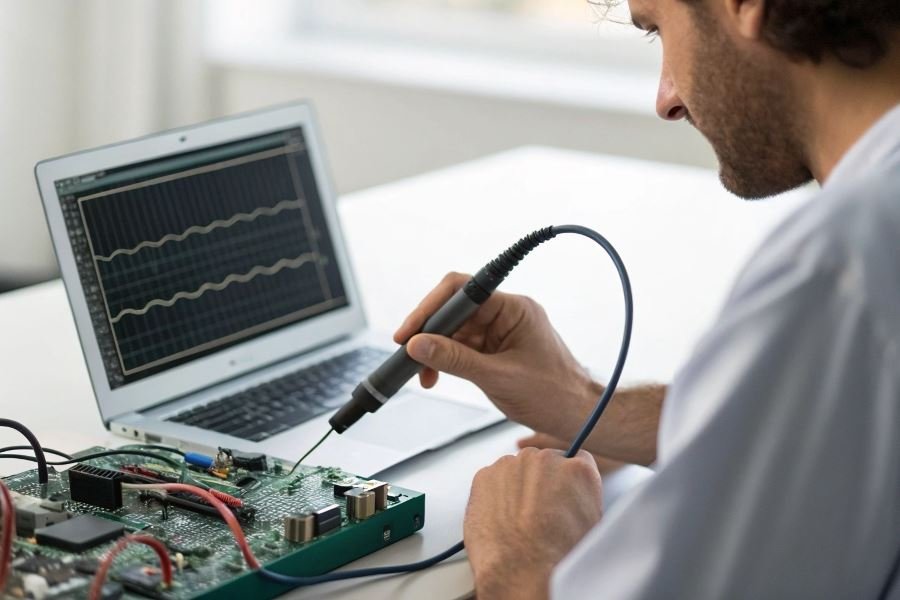
For precision SMD work, active probes with low capacitance (typically <1pF) are essential. The Rohde & Schwarz RT-ZZ80 offers 8 GHz bandwidth with specialized tips for SMD access.
Resolution and Sensitivity: Seeing the Smallest Signals
As SMD components operate at increasingly lower voltages, vertical resolution becomes paramount. Traditional 8-bit oscilloscopes often lack the sensitivity needed for modern low-voltage designs.
12-bit resolution provides 16 times more vertical detail than 8-bit systems, allowing you to visualize subtle signal variations that would otherwise be lost in quantization noise.
For power-sensitive SMD applications, look for oscilloscopes with:
- High vertical sensitivity (≤1mV/div)
- Low noise floor
- High-resolution acquisition modes
The Siglent SDS2000X Plus series offers 12-bit resolution with sensitivity down to 500μV/div, making it ideal for analyzing small-signal behavior in power-efficient SMD designs.
Unlocking the Power of Advanced Oscilloscope Features
When you’re hunched over a workbench squinting at SMD components smaller than a grain of rice, your oscilloscope transforms from mere test equipment into your most trusted ally. The difference between diagnosing a complex timing issue in minutes versus hours often comes down to the advanced features packed into modern digital oscilloscopes.
Digital filtering that reveals hidden signals
Digital signal processing capabilities have revolutionized oscilloscope technology. Today’s premium instruments offer real-time filtering that can extract critical signals from noisy environments—essential when working with sensitive SMD components.
Bandwidth filters allow you to eliminate high-frequency noise while preserving the signal characteristics you’re investigating. When troubleshooting a 24MHz microcontroller circuit with SMD components, applying a 30MHz low-pass filter can dramatically improve signal clarity without affecting the fundamental waveform.
The most powerful scopes now include customizable FIR filters that can be tailored to specific frequency responses, giving you unprecedented control over signal visualization.
Automated measurements that save precious time
Modern oscilloscopes have evolved far beyond basic voltage and time measurements. Advanced models from Keysight and Tektronix offer specialized measurement suites specifically designed for SMD component analysis:
- Automatic rise/fall time calculations
- Pulse width and duty cycle measurements
- Phase relationships between multiple signals
- Power analysis for voltage regulators
- Eye diagram analysis for high-speed digital signals
These automated functions eliminate tedious manual calculations and reduce human error. When characterizing an SMD switching regulator, automated power analysis can instantly provide efficiency metrics, switching losses, and safe operating area violations.
Connectivity that extends your workflow
| Connectivity Option | Typical Use Case | Benefit for SMD Work |
|---|---|---|
| USB | Direct PC connection | Quick data transfer for analysis |
| Ethernet | Remote operation | Monitor tests from clean room |
| Wi-Fi | Wireless integration | Reduced cable clutter at bench |
| Cloud storage | Data archiving | Compare measurements over time |
The ability to export waveform data in various formats (.csv, .mat, .wfm) enables deeper analysis in specialized software environments like MATLAB or custom Python scripts. This becomes invaluable when characterizing the frequency response of SMD filters or analyzing complex digital bus transactions.
Software tools that amplify your capabilities
The software ecosystem surrounding your oscilloscope can dramatically extend its capabilities for SMD work:
Protocol decoders transform cryptic digital signals into human-readable information. When debugging an I²C communication issue with an SMD accelerometer, seeing decoded address and data values in real-time can instantly pinpoint configuration errors.
Mask testing allows you to define acceptable signal parameters and automatically flag violations—perfect for production testing of SMD assemblies where consistency is critical.
Advanced triggering systems with zone touch capabilities let you isolate specific signal anomalies by simply drawing boxes on the screen where you want the scope to trigger. This is game-changing when hunting for intermittent glitches in high-speed SMD circuits.
The most sophisticated analysis packages now include jitter decomposition tools that can separate random and deterministic jitter components—essential when working with high-speed SMD components where timing margins are measured in picoseconds.
By leveraging these advanced features, you’ll transform your oscilloscope from a simple measurement tool into a comprehensive SMD debugging platform that reveals insights impossible to obtain through basic voltage measurements alone.
Discover how to select the perfect oscilloscope for SMD component testing with our comprehensive guide. Learn about essential bandwidth specs, probe types, and advanced features that ensure accurate signal capture for surface-mount device troubleshooting.
Discover how to select the perfect oscilloscope for SMD component testing with our comprehensive guide. Learn about essential bandwidth specs, probe types, and advanced features that ensure accurate signal capture for surface-mount device troubleshooting.