
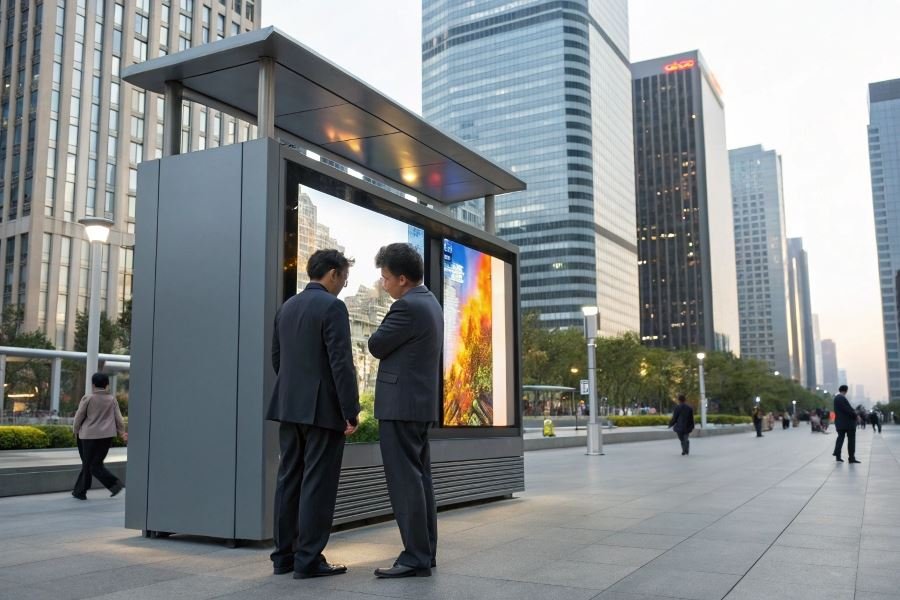
Ever noticed how a single vibrant billboard can make you remember a brand for days? That’s no accident—it’s the calculated impact of strategic outdoor advertising.
Outdoor advertising remains a cornerstone of effective marketing strategies, delivering unparalleled visibility in an increasingly fragmented media landscape. Unlike digital ads that can be blocked or scrolled past, physical displays command attention in the real world where your customers live and travel daily.
The marketing muscle of outdoor displays
When selecting outdoor advertising displays, understanding the diverse options available is crucial for maximizing your investment. The marketplace offers an impressive array of formats:
- Digital billboards: Delivering dynamic content with scheduling flexibility
- Traditional billboards: Providing 24/7 visibility at lower cost points
- Transit displays: Capturing mobile audiences on buses, trains, and taxis
- Street furniture: Engaging pedestrians through bus shelters and kiosks
Each format delivers unique advantages depending on your marketing objectives. Digital displays, while requiring higher initial investment, offer remarkable flexibility for updating content and targeting specific dayparts.
Smart investment considerations
Before committing resources to outdoor advertising displays, several critical factors demand attention:
“The three most important factors in outdoor advertising success: location, visibility, and message clarity.” – Outdoor Advertising Association
Location analysis should examine traffic patterns, visibility angles, and demographic exposure. Weather resistance becomes particularly crucial in regions experiencing extreme conditions, potentially affecting both maintenance costs and display longevity.
Remember that effective outdoor advertising isn’t just about being seen—it’s about being remembered in the moments that matter to your business growth.
Technical Essentials That Make or Break Outdoor Displays
When selecting outdoor advertising displays, the technical specifications aren’t just footnotes—they’re the foundation of your investment’s success. The difference between a display that commands attention for years and one that fades into obscurity often comes down to three critical factors: resolution quality, environmental resilience, and operational efficiency.
Resolution that commands attention
The resolution requirements for outdoor displays follow a simple but crucial principle: the further away your audience, the larger your pixels can be without sacrificing image quality. Features of choosing outdoor advertising displays must include careful consideration of pixel pitch—the distance between LED clusters that determines how sharp your content appears.
For highway billboards viewed from 150+ feet away, a pixel pitch of 16-20mm delivers sufficient clarity while keeping costs manageable. Street-level advertising viewed from 30-80 feet requires sharper resolution with 8-10mm pixel pitch. For premium urban locations where pedestrians might view content from just 10-25 feet away, nothing less than 4-6mm pixel pitch will maintain the professional image your brand deserves.
Brightness matters equally. Outdoor displays require minimum brightness levels of 5,000-7,500 nits to remain visible in direct sunlight, compared to indoor displays that typically operate at 300-500 nits. This substantial difference explains why consumer televisions fail spectacularly when repurposed for outdoor advertising.
Built to withstand nature’s fury
Outdoor displays face relentless environmental challenges that would destroy standard electronic equipment within days. Quality outdoor displays feature:
- IP65-IP68 ratings certifying protection against dust and water intrusion
- Operating temperature ranges of -40°F to 140°F (-40°C to 60°C)
- Corrosion-resistant materials for coastal or industrial environments
- Anti-UV coatings that prevent screen yellowing and degradation
The Samsung OH Series exemplifies this durability with its IP56-rated enclosure and built-in temperature management system that automatically adjusts brightness based on ambient conditions—extending component life while maintaining visibility.
The operational equation: power and maintenance
The true cost of outdoor display ownership extends far beyond purchase price. Modern LED displays consume between 200-600 watts per square meter, depending on brightness settings and content displayed. This translates to annual power costs between 350−1,000 per square meter at average commercial electricity rates.
| Display Type | Avg. Power Consumption | Annual Power Cost (10hrs/day) | Typical Maintenance Interval |
|---|---|---|---|
| Standard LED | 400W/m² | $730/m² | 6-12 months |
| Premium LED | 300W/m² | $550/m² | 12-24 months |
| LCD (with enclosure) | 500W/m² | $915/m² | 3-6 months |
Maintenance requirements vary dramatically based on quality. Budget displays often require quarterly service visits, while premium systems from manufacturers like Daktronics may operate reliably for 18-24 months between scheduled maintenance.
Remote monitoring capabilities have revolutionized maintenance efficiency. Systems that provide real-time performance data and allow remote diagnostics can reduce service costs by 30-40% while minimizing downtime—a critical consideration when your advertising display represents your brand 24/7.
The most successful outdoor advertising displays balance these technical considerations against budget constraints, creating systems that deliver years of reliable performance in challenging environments while maintaining the visual impact that drives advertising results.
Strategic Placement and ROI: The Science Behind Outdoor Display Success
Location Analysis: Finding Your Digital Sweet Spot
Location isn’t just important—it’s everything. The most stunning outdoor advertising display becomes invisible when placed in the wrong spot. Professional location analysis begins with traffic volume measurement, but digs much deeper into quality metrics.
High-traffic areas like Times Square command premium prices ($10,000-30,000 per day) because they deliver approximately 330,000 pedestrians daily. But raw numbers don’t tell the whole story. Dwell time dramatically impacts engagement rates—locations where people wait (transit stops, elevators) consistently outperform hurried environments by up to 37%.
Traffic pattern assessment requires understanding both macro and micro movements:
- Macro patterns: Seasonal tourism flows, commuter rhythms, event-driven surges
- Micro patterns: Sidewalk bottlenecks, natural pause points, line-of-sight obstacles
Leading brands use sophisticated heat-mapping technology from companies like Quividi to analyze pedestrian flow before committing to premium display locations. This technology can identify optimal viewing angles and predict attention patterns with remarkable accuracy.
The difference between a good location and a great one isn’t just about more eyes—it’s about the right eyes at the right moment.
Content Optimization That Demands Attention
Even perfectly placed displays fail without content optimized for the environment. Outdoor advertising requires a fundamentally different approach than other media channels.
The 3-second rule dominates outdoor display content strategy. Your message must be processed almost instantly or it’s lost forever. This demands ruthless editing:
| Content Element | Indoor Display | Outdoor Display |
|---|---|---|
| Word Count | 15-25 words | 7 words maximum |
| Visual Elements | 2-3 images | 1 dominant image |
| Call to Action | Multiple options | Single clear CTA |
Color contrast ratios become critical in outdoor environments. The International Sign Association recommends minimum contrast ratios of 7:1 for optimal visibility across varying light conditions. Dark text on light backgrounds consistently outperforms the reverse in daylight settings.
Dynamic content adaptation represents the cutting edge of outdoor display optimization. Systems from BroadSign allow content to automatically adjust based on:
- Time of day (breakfast promotions in morning, dinner specials at night)
- Weather conditions (umbrella ads during rain)
- Local events (sports team victories, concert crowds)
Measuring Effectiveness Beyond Impressions
The metrics that matter for outdoor advertising have evolved dramatically. Traditional OTS (Opportunity To See) calculations are being replaced by sophisticated attribution models that connect outdoor exposure to measurable business outcomes.
Modern ROI calculation incorporates:
- Impression quality scoring – Not all impressions are equal; factors like viewing angle, obstruction percentage, and attention probability create weighted values
- Cross-channel attribution – Tracking how outdoor displays drive online searches, website visits, and in-store traffic
- Conversion lift analysis – Comparing sales in markets with and without display presence
Nielsen now offers outdoor-specific attribution modeling that can demonstrate average ROI increases of 16% when displays are properly integrated into multi-channel campaigns.
The most sophisticated brands are implementing real-time effectiveness measurement using mobile device tracking (with appropriate privacy controls) to create closed-loop reporting systems that continuously optimize placement and content.
Discover the essential features for selecting high-performance outdoor advertising displays that maximize visibility and ROI. Learn about resolution requirements, weather durability, strategic placement, and content optimization for impactful marketing campaigns.
Discover the essential features for selecting high-performance outdoor advertising displays that maximize visibility and ROI. Learn about resolution requirements, weather durability, strategic placement, and content optimization for impactful marketing campaigns.


