Ever noticed how the same song can sound utterly transformative when played through a properly configured sound system? That spine-tingling clarity when every instrument finds its perfect place in the soundstage isn’t magic—it’s meticulous engineering.
Sound reproduction is fundamentally about translating electrical signals into precise mechanical movements that create pressure waves—what we perceive as music. The journey from recording to your ears involves countless critical handoffs, each potentially enhancing or degrading the original performance. A truly exceptional system doesn’t just play music; it resurrects it.
The building blocks of sonic excellence
At minimum, a high-quality sound system requires four essential components working in harmony:
- Source components: Whether digital streaming devices, turntables, or CD players—these determine your audio foundation
- Amplification: The powerhouse that takes weak electrical signals and strengthens them to drive your speakers
- Speakers: The final translators converting electrical energy into sound waves
- Room acoustics: Often overlooked yet arguably most crucial—how sound interacts with your space
The relationship between these elements is symbiotic. Even $50,000 speakers will disappoint when paired with inadequate amplification or placed in acoustically problematic environments.
Beyond equipment: The setup advantage
Equipment quality matters, but proper setup often delivers more dramatic improvements than upgrading components. Precise speaker positioning alone can transform a muddy, indistinct soundstage into a three-dimensional audio experience where instruments occupy distinct spaces. The difference between casual listening and truly immersive audio often comes down to thoughtful placement, calibration, and room treatment—techniques that cost far less than premium hardware upgrades.
The Architecture of Sound: Mastering Your Audio Environment
The Strategic Triangle of Speaker Placement
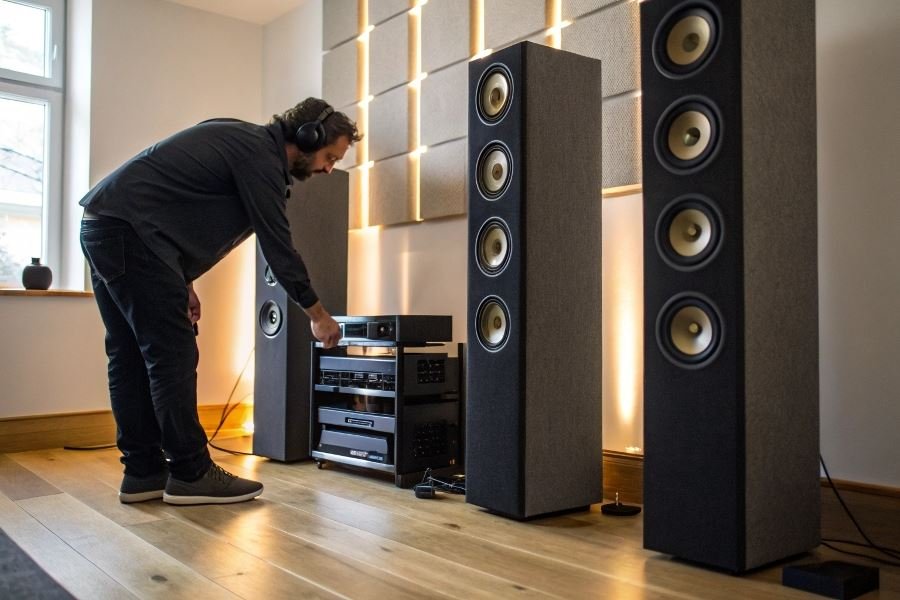
The difference between mediocre and magnificent sound often comes down to three feet in any direction. Speaker positioning follows the “rule of thirds” – a principle borrowed from photography that creates natural balance in your listening space. Place your main speakers at two points of an equilateral triangle, with your listening position at the third point. This creates what audio engineers call the “sweet spot,” where soundstages develop proper width and depth.
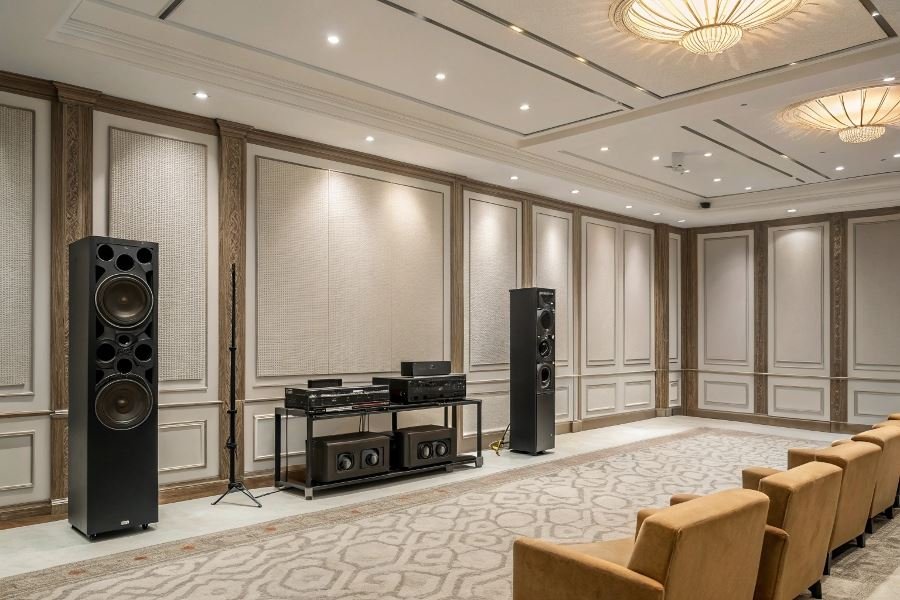
Setting up a sound system for optimal sound quality requires understanding that speakers should typically be positioned at ear level when seated. For floor-standing models like the KEF Reference 5, maintain at least 2-3 feet of clearance from walls to prevent bass buildup. Bookshelf speakers benefit from proper stands that place tweeters at ear height – the Monolith by Monoprice stands provide excellent vibration isolation while positioning speakers at the ideal 38-42 inches from the floor.
Toe-in angle matters tremendously. Start with speakers facing straight forward, then gradually angle them inward until the soundstage snaps into focus. Most systems find their sweet spot between 15-30 degrees of toe-in, but trust your ears over any formula.
Taming Your Room’s Acoustic Personality
Your walls, floor, and ceiling are active participants in your listening experience – sometimes helpful collaborators, sometimes saboteurs.
Hard, reflective surfaces create sound-muddying echoes that destroy clarity. Strategic acoustic treatment doesn’t require converting your living room into a recording studio. Start with these essentials:
- Bass traps in room corners where low frequencies accumulate
- Absorption panels at first reflection points (use the mirror trick: where you see speakers from your listening position)
- Diffusion panels on the wall behind your listening position
| Treatment Type | Optimal Placement | Primary Benefit |
|---|---|---|
| Bass Traps | Room corners | Controls low-frequency buildup |
| Absorption Panels | Side walls at first reflection points | Reduces harsh reflections |
| Diffusion Panels | Rear wall behind listening position | Creates spaciousness without deadening |
Companies like GIK Acoustics offer room analysis services to identify exactly where treatment will yield the greatest improvements. Even modest treatment – covering just 15-20% of wall surfaces – dramatically improves imaging and tonal balance.
The Hidden Power of Proper Connections
Cables aren’t merely conduits – they’re the nervous system of your audio setup. While the “cables make no difference” debate rages on, professional installers recognize that proper cable management affects both sound quality and system longevity.
Keep power and signal cables separated. When cables must cross, do so at 90-degree angles to minimize interference. For speaker cables, maintain identical lengths for left and right channels to preserve timing accuracy. The Audioquest Type 4 offers excellent performance without breaking the bank.
Digital connections benefit from quality cables with proper shielding. The difference between a basic HDMI cable and one with proper bandwidth certification becomes apparent when passing high-resolution audio formats like Dolby Atmos or DTS:X.
Connection quality matters as much as cable quality. Clean all connectors with dedicated contact cleaner like Deoxit annually. Ensure speaker binding posts are finger-tight – overtightening can damage connectors, while loose connections introduce resistance that alters frequency response.
By addressing these three foundational elements – speaker placement, room acoustics, and connection quality – you’ll extract performance from your system that most listeners never experience, regardless of budget.
Fine-Tuning Your Sound System: The Art of Audio Perfection
The difference between a good sound system and an exceptional one isn’t just about expensive equipment—it’s about meticulous calibration, thoughtful room management, and consistent maintenance. Let’s dive into the techniques that transform ordinary listening experiences into extraordinary sonic journeys.
Calibration: The Science Behind Perfect Sound
Proper calibration is where science meets art in audio. Start with a quality sound pressure level (SPL) meter—either a dedicated device like the UMIK-1 or an app like REW (Room EQ Wizard) paired with a calibrated microphone.
The calibration process follows a methodical sequence:
- Level matching – Ensure all speakers produce identical volume levels from your listening position
- Distance calibration – Adjust for varying distances between speakers and your ears
- Crossover settings – Determine the optimal frequency handoff between speakers and subwoofers
- EQ adjustments – Fine-tune frequency response to compensate for room anomalies
The goal isn’t to create a technically perfect system but rather one that delivers emotionally impactful sound tailored to your specific environment.
For multi-channel systems, consider investing in an automated calibration system like Audyssey or Dirac Live. These technologies use sophisticated algorithms to analyze your room’s acoustic properties and make precise adjustments.
Managing Room Acoustics: The Invisible Component
Your room is effectively another component in your sound system—perhaps the most influential one.
First reflection points require immediate attention. These are the spots where sound waves bounce off walls before reaching your ears, creating phase issues and muddying clarity. Identify them using the “mirror technique”:
| Reflection Point Location | Treatment Option | Approximate Cost |
|---|---|---|
| Side walls | 2″ acoustic panels | $100-300 |
| Ceiling | Diffuser panels | $150-400 |
| Rear wall | Bass traps | $200-500 |
Room resonance—where certain frequencies get amplified by your room’s dimensions—can be tamed with strategically placed bass traps in corners and along wall/ceiling junctions.
Remember that acoustic treatment isn’t about eliminating reflections entirely but creating a balanced sound field with controlled decay times across all frequencies.
For those seeking precision, room measurement software like REW can identify problematic frequencies and guide targeted acoustic treatments rather than applying generic solutions.
Maintenance: Preserving Audio Excellence
Even perfectly calibrated systems degrade without proper maintenance. Implement these practices to preserve sound quality:
Regular equipment inspection should include checking for:
- Loose connections that introduce noise or signal loss
- Dust accumulation on drivers and electronics
- Cable integrity, especially at connection points
- Speaker positioning drift (surprisingly common)
Component care extends equipment life and performance:
- Clean speaker drivers with soft brushes, never compressed air
- Use contact cleaner on connections annually
- Keep electronics ventilated to prevent thermal degradation
- Recalibrate your system after any room changes or equipment moves
Digital maintenance matters too—update firmware on processors, streamers, and digital components to benefit from performance improvements and bug fixes.
The most overlooked maintenance aspect? Your ears. Regular listening to reference recordings you know intimately helps identify subtle system changes before they become problems.
By approaching calibration scientifically, treating your room as a crucial component, and implementing consistent maintenance practices, your sound system will deliver exceptional performance for years to come—transforming ordinary listening into extraordinary experiences.
Discover expert techniques for positioning speakers, treating room acoustics, and calibrating your audio system to achieve audiophile-quality sound reproduction in your home listening environment.
Discover expert techniques for positioning speakers, treating room acoustics, and calibrating your audio system to achieve audiophile-quality sound reproduction in your home listening environment.