
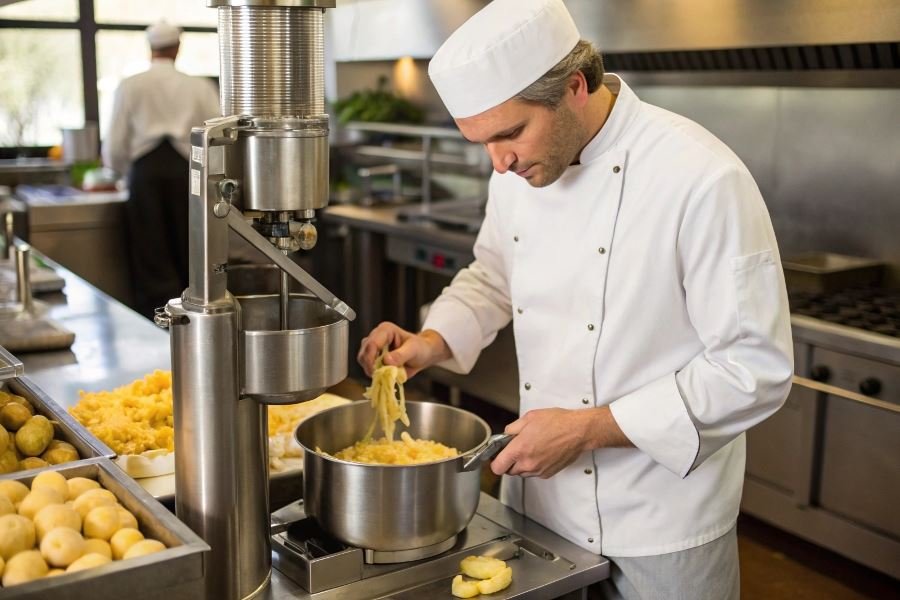
Ever watched your kitchen staff spend hours scrubbing potatoes when they could be creating culinary masterpieces? Those precious minutes add up—and directly impact your bottom line.
Behind every perfectly executed french fry and creamy mashed potato dish lies an unsung hero: the potato cleaning machine. Restaurants serving just 100 potato-based dishes daily can save approximately 15 labor hours weekly with the right equipment—transforming potato preparation from a dreaded chore into a seamless process.
The workflow revolution
Potato cleaning machines fundamentally reshape kitchen operations. Rather than dedicating valuable counter space and staff time to manual scrubbing, these specialized machines handle the dirty work. The result? A continuous flow from storage to preparation that eliminates bottlenecks during peak service times.
“The potato cleaning machine was the single best investment we made last year. It freed up my sous chef for more creative work and paid for itself within months.” — Executive Chef, James Peterson
Beyond clean potatoes: The ripple effect
The benefits extend far beyond spotless spuds:
- Labor optimization: Redirect skilled staff to tasks that directly enhance customer experience
- Consistency: Achieve uniform cleaning results regardless of who operates the equipment
- Food safety: Reduce cross-contamination risks through dedicated processing
- Water conservation: Modern machines use up to 70% less water than manual washing methods
Selecting the right potato cleaning machine isn’t merely a purchasing decision—it’s a strategic investment in operational excellence that touches every aspect of your kitchen workflow.
Essential Factors for Potato Cleaning Machine Selection
When equipping a commercial kitchen, the humble potato cleaning machine can make or break your operational efficiency. These workhorses transform a labor-intensive task into a streamlined process, but choosing the right one requires careful consideration of several critical factors.
Processing capacity stands as the cornerstone of effective equipment selection. Determining how to choose a potato cleaning machine for a restaurant begins with an honest assessment of your daily potato requirements. A neighborhood bistro serving 50-100 meals daily might function perfectly with a compact unit processing 200-300 pounds per hour, while a high-volume steakhouse needs industrial-grade equipment handling 1,000+ pounds hourly. Underestimating capacity creates bottlenecks; overestimating wastes capital and valuable kitchen real estate.
Throughput requirements by restaurant size
The relationship between restaurant size and machine capacity follows a predictable pattern:
| Restaurant Type | Daily Meals | Recommended Capacity | Example Models |
|---|---|---|---|
| Small Café | 50-100 | 200-300 lbs/hr | Hobart LXe |
| Mid-size Restaurant | 100-250 | 400-600 lbs/hr | Sammic PPC-12+ |
| Large Restaurant | 250-500 | 700-1000 lbs/hr | Fimar PPF/25 |
| Industrial Kitchen | 500+ | 1000+ lbs/hr | Nilma Peeler P25 |
The ideal machine grows with your business, offering 20-30% more capacity than your current needs to accommodate growth without immediate replacement.
Space constraints and installation realities
Kitchen real estate remains among the most valuable assets in the restaurant industry. Modern potato cleaning machines come in various configurations:
Countertop models occupy minimal space (typically 2-3 square feet) but offer limited capacity. These units work well in tight kitchens where floor space is at a premium.
Floor models deliver industrial-grade performance but require dedicated space, often 4-6 square feet plus clearance for maintenance access. Consider not just the machine’s footprint but also:
- Proximity to water supply and drainage
- Electrical requirements (standard 110V vs. 220V connections)
- Ventilation needs for steam and moisture management
- Service access for maintenance and cleaning
Installation costs can add 15-25% to your initial investment if plumbing modifications or electrical upgrades are necessary.
Water efficiency features worth the investment
Water consumption varies dramatically between basic and advanced models. Entry-level machines might use 5-7 gallons per minute continuously, while water-efficient designs incorporate:
- Recirculation systems that filter and reuse water during operation
- Timed spray cycles that optimize water usage without sacrificing cleaning quality
- Pressure-optimized nozzles that maximize cleaning power while minimizing volume
The Metcalfe EPW series, for example, reduces water consumption by up to 40% compared to conventional models through its innovative recirculation technology.
When evaluating efficiency, consider both immediate utility costs and long-term environmental impact. A machine that saves 1,000 gallons weekly represents not just reduced water bills but also alignment with growing consumer expectations for sustainable restaurant operations.
The most effective potato cleaning machines balance throughput requirements, spatial constraints, and resource efficiency – creating a seamless operation that transforms this fundamental kitchen task from bottleneck to benchmark.
Making the Smart Investment: Your Potato Cleaning Machine Decision
The true cost beyond the price tag
When finalizing your potato cleaning machine purchase, looking beyond the sticker price reveals the complete financial picture. The total cost of ownership (TCO) encompasses three critical elements that impact your bottom line.
First, the initial investment varies dramatically—from $1,500 for basic tabletop models to $25,000+ for industrial-grade automated systems. But purchase price is merely the beginning of your relationship with this equipment.
Operational costs create the most significant long-term impact. Energy-efficient models from manufacturers like Hobart might cost 15-20% more upfront but consume 30-40% less electricity over their lifespan. Water usage varies tremendously—some advanced systems recirculate water, reducing consumption by up to 70% compared to conventional models.
Maintenance expenses form the third critical component. Brushless motors typically require service every 3,000 hours versus 1,500 hours for traditional designs. Stainless steel components might cost more initially but resist corrosion and extend machine life by 5-7 years compared to aluminum alternatives.
The smartest operators calculate five-year TCO rather than focusing solely on acquisition cost.
Support infrastructure matters
The warranty package serves as your safety net during the critical early period. Industry standards typically offer 12-24 months of coverage, but premium manufacturers like Sammic extend protection to 36 months on certain components.
Service support availability can make or break your operation during peak hours. Before purchasing, investigate:
- Average technician response time in your area
- Availability of certified technicians (not just general repair services)
- Emergency service options during weekends and holidays
Parts availability becomes increasingly important as machines age. Established manufacturers maintain replacement part inventories for 7-10 years after model discontinuation, while lesser-known brands might support products for just 2-3 years.
Finding your perfect match
Different restaurant operations demand tailored solutions. This decision matrix helps identify optimal configurations:
| Restaurant Type | Daily Volume | Recommended Configuration | Key Features |
|---|---|---|---|
| Fast-casual | 100-300 lbs | Mid-range continuous flow | 300-500 lb/hr capacity, moderate water usage |
| Fine dining | 50-150 lbs | Compact batch processor | Gentler handling, lower noise, higher precision |
| High-volume QSR | 500+ lbs | Industrial automated system | 1000+ lb/hr capacity, integrated sorting |
| Food truck/Small kitchen | Under 50 lbs | Tabletop manual/semi-auto | Space-efficient, lower water requirements |
For establishments processing under 100 pounds daily, the Waring WFP16S offers excellent value with its 3-year warranty and compact footprint. Mid-volume operations benefit from Metcalfe’s continuous flow systems, which balance throughput with reasonable maintenance requirements.
High-volume operations should consider fully automated systems from TOMRA or Key Technology, which integrate optical sorting to remove defective potatoes before cleaning—reducing waste by up to 15%.
The ideal potato cleaning machine aligns with your specific operational needs while offering the optimal balance between upfront investment and long-term operational efficiency. By thoroughly evaluating TCO, support infrastructure, and your restaurant’s unique requirements, you’ll secure equipment that delivers clean potatoes and clean profits for years to come.
Discover how to select the perfect potato cleaning machine for your restaurant with our comprehensive buyer's guide. Learn about capacity requirements, space considerations, efficiency features, and cost factors to optimize your kitchen operations.
Discover how to select the perfect potato cleaning machine for your restaurant with our comprehensive buyer's guide. Learn about capacity requirements, space considerations, efficiency features, and cost factors to optimize your kitchen operations.