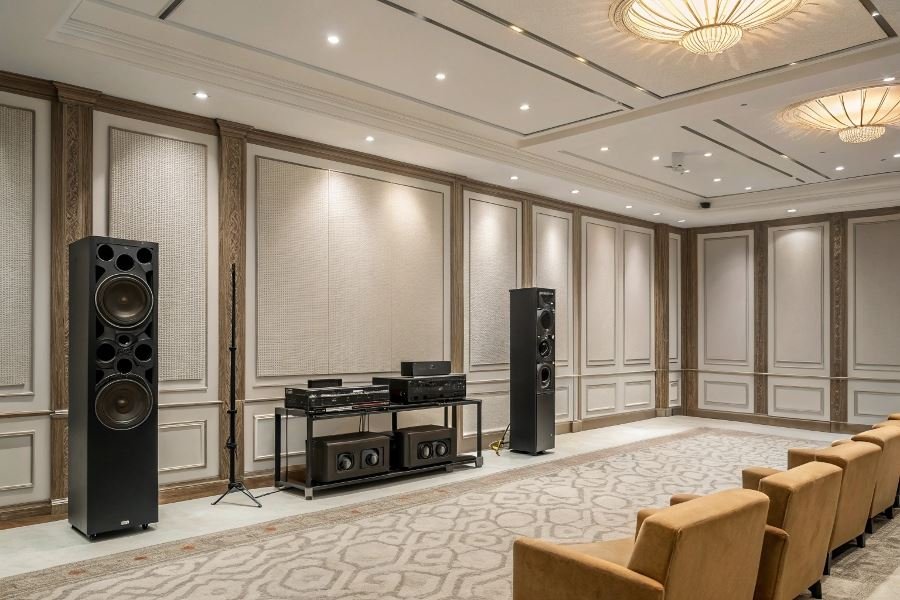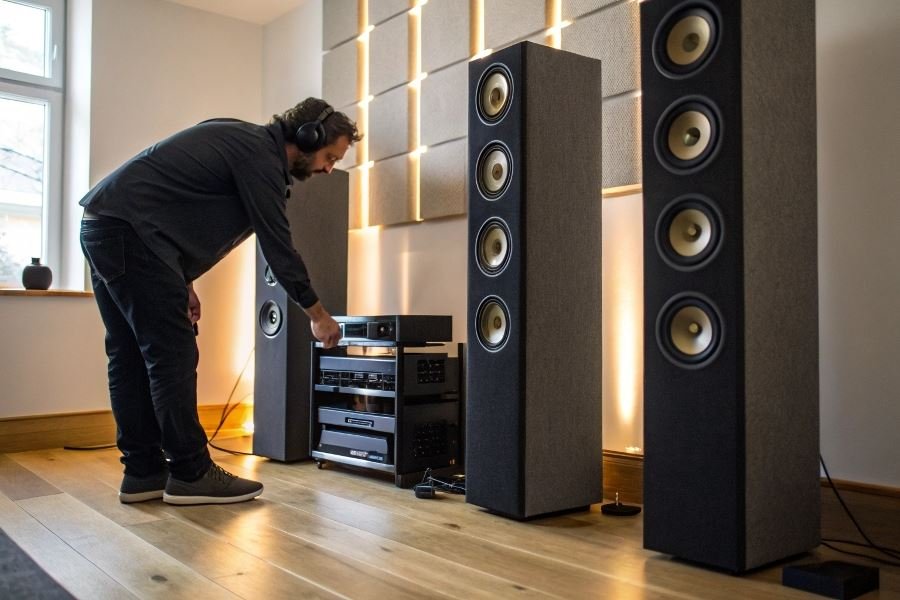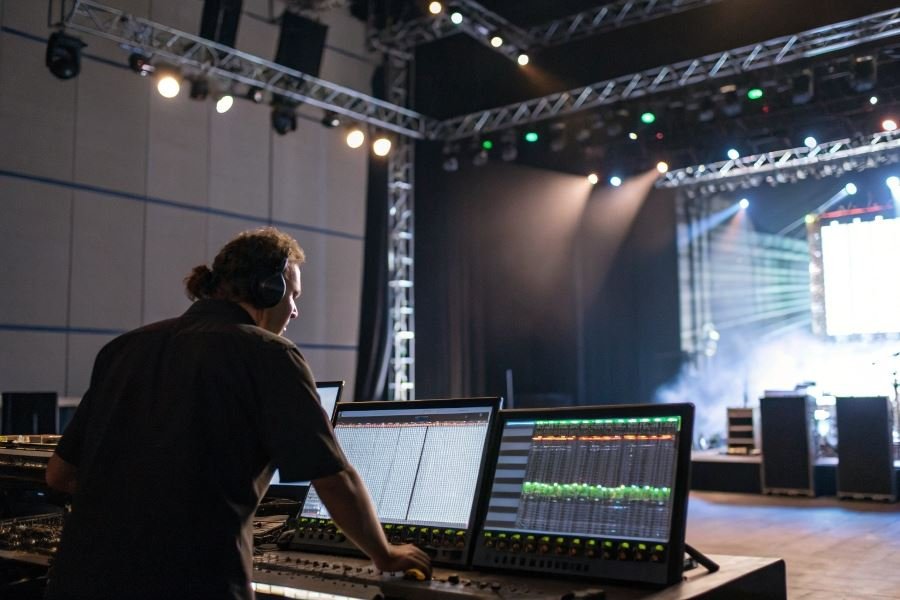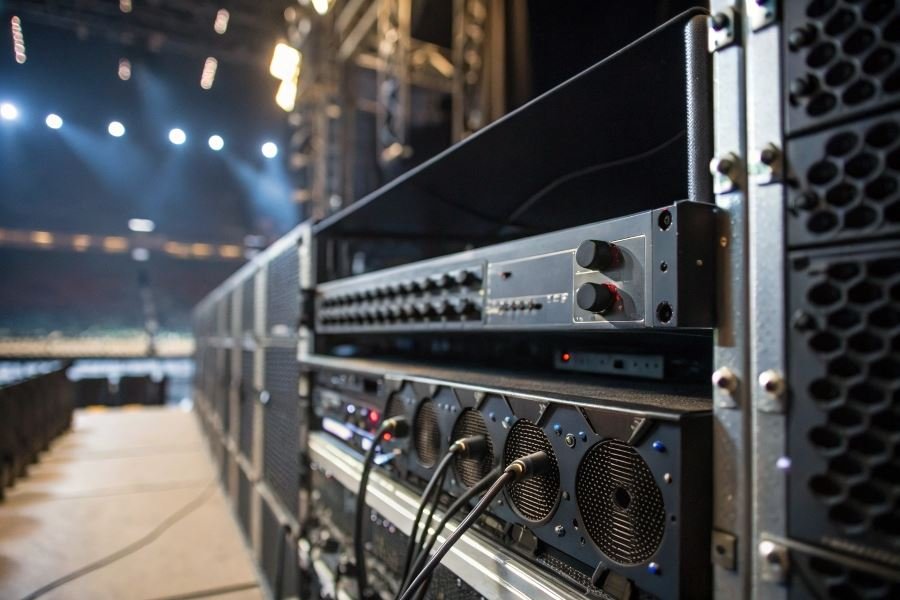
Ever stood at a concert where the bass hit you in the chest like a gentle earthquake? That’s not just good speakers—it’s exceptional amplification at work. Power amplifiers are the unsung heroes behind every memorable live performance, transforming weak electrical signals into the commanding sound waves that fill venues from intimate clubs to massive stadiums.
When selecting power amplifiers for concert equipment, you’re essentially choosing the engine that drives your entire sound system. The right amplifier doesn’t just make things louder—it preserves the integrity of each note, maintains clarity during dynamic passages, and delivers consistent performance even when pushed to its limits.
Three critical specifications that separate exceptional amplifiers from mediocre ones:
- Power rating – Measured in watts per channel, this determines how much acoustic energy your system can produce
- Damping factor – Controls speaker movement precision, especially crucial for tight, accurate bass response
- Signal-to-noise ratio – Ensures the music, not electrical interference, is what your audience hears
“An underpowered amplifier working too hard will distort long before a properly sized one reaches its limits.”
The relationship between amplifiers and speakers is particularly delicate. Matching impedance values isn’t just technical jargon—it’s the difference between equipment that performs flawlessly for years and components that fail catastrophically mid-performance. Modern Class-D amplifiers offer remarkable efficiency, generating less heat while delivering more power from lighter packages than their predecessors could have imagined.
Technical Essentials for Concert Power Amplifiers
When setting up a concert sound system, the power amplifier serves as the beating heart that transforms your audio signal into the thunderous sound that moves audiences. Selecting the right amplifier requires understanding several critical technical factors that directly impact performance. Let’s dive into what truly matters when evaluating power amplifiers for professional audio applications.
Power Output and Speaker Matching
The relationship between your amplifier’s power output and your speakers is perhaps the most fundamental consideration when building a concert sound system. How to choose a power amplifier for concert equipment often begins with a simple rule: your amplifier should deliver approximately twice the continuous power handling capacity of your speakers.
For example, if your speakers are rated at 500 watts continuous program, aim for an amplifier that delivers around 1000 watts into the speaker’s impedance. This “headroom” ensures clean reproduction of dynamic peaks without clipping—that nasty distortion that occurs when an amplifier runs out of power.
Real-world application: A Crown XLi 3500 delivering 1350 watts per channel at 4 ohms would pair nicely with speakers rated for 650-700 watts continuous handling.
Remember that underpowering can be more dangerous than overpowering—an underpowered amp pushed to clipping can send damaging DC current to your speakers.
| Speaker Power Rating | Recommended Amplifier Power | Headroom Factor |
|---|---|---|
| 300W @ 8Ω | 450-600W @ 8Ω | 1.5-2x |
| 500W @ 4Ω | 750-1000W @ 4Ω | 1.5-2x |
| 1000W @ 2Ω | 1500-2000W @ 2Ω | 1.5-2x |
Impedance Compatibility and Load Stability
Amplifiers must maintain stability across varying impedance loads—a critical factor often overlooked by novices. Professional concert amplifiers should handle loads down to 2 ohms, sometimes even 1 ohm for specialized models.
Impedance matching isn’t just about compatibility—it’s about maximizing power transfer and ensuring system reliability under demanding conditions.
When evaluating amplifiers, look for:
- Minimum stable impedance ratings – Can it handle 2-ohm loads without overheating?
- Bridged mode stability – Some amplifiers become unstable when bridged into lower impedances
- Power ratings across different impedances – How does output change from 8Ω to 4Ω to 2Ω?
The QSC PLD4.5 exemplifies excellent load stability, maintaining performance even when driving multiple speakers with varying impedances.
Distortion Specifications and Sound Quality
While power ratings grab headlines, distortion specifications reveal an amplifier’s true character. Total Harmonic Distortion (THD) measures how faithfully an amplifier reproduces the input signal, with lower percentages indicating cleaner sound.
For concert applications, look for:
- THD below 0.1% at full rated power
- Intermodulation distortion (IMD) specifications
- Signal-to-noise ratio (SNR) of at least 100dB
- Damping factor above 200 (higher is better for tight bass response)
The Lab.gruppen FP 10000Q delivers exceptional performance with THD+N of less than 0.05% across its entire operating range—a benchmark for pristine audio reproduction.
Beyond specifications, consider the amplifier’s topology (Class A/B, Class D, etc.) and how it aligns with your sonic preferences and practical needs like heat generation and power efficiency.
Remember that the best amplifier isn’t necessarily the most powerful—it’s the one that delivers clean, reliable power that complements your specific speaker system and venue requirements.
Practical Power: Selecting the Right Amplifier for Concert Sound
When it comes to concert sound, the power amplifier is your sonic engine—the component that transforms modest electrical signals into the thunderous waves that move audiences. Selecting the right amplifier isn’t just about maximum volume; it’s about creating an experience that resonates perfectly with both the venue and the performance.
Sizing up your space
The relationship between venue size and amplifier requirements follows a simple but critical principle: larger spaces demand more power. A small club venue might be perfectly served by amplifiers delivering 500-1000 watts per channel, while arena-sized productions often require systems pushing 10,000+ watts.
The acoustic environment plays an equally crucial role. Hard surfaces create reflections that can either enhance or destroy your sound. Consider these venue-specific requirements:
| Venue Type | Recommended Power | Key Acoustic Considerations |
|---|---|---|
| Small Club (200 people) | 500-1000W per channel | Absorption materials for intimate sound |
| Theater (500-1000 people) | 1000-2500W per channel | Balanced reflection/absorption ratio |
| Outdoor Festival | 5000W+ per channel | No natural boundaries; requires significant headroom |
| Arena (10,000+ people) | 10,000W+ per system | Complex reflection patterns; delay towers often needed |
Remember that power ratings tell only part of the story. An amplifier’s ability to deliver clean power at peak demands—its headroom—often matters more than raw wattage. The Crown I-Tech 12000HD delivers exceptional headroom that makes its 4000W per channel rating feel significantly more powerful in real-world applications.
Built to survive the road
Concert amplifiers live brutal lives—constantly loaded, unloaded, transported, and pushed to their limits. Durability isn’t optional; it’s essential.
Protection circuits represent your first line of defense against catastrophic failure. Look for:
- Thermal protection that prevents overheating
- Short circuit protection that safeguards against speaker failures
- Clip limiters that prevent distortion from damaging speakers
- DC protection that guards against harmful direct current reaching speakers
The QSC PLD Series exemplifies robust protection with its GuardRail technology, which maintains sonic integrity while preventing system damage.
Physical construction matters tremendously. Rack-mountable designs with reinforced chassis, quality connectors, and efficient cooling systems will survive years of touring. The Lab.gruppen FP Series amplifiers feature military-grade build quality with patented cooling systems that have made them road standards for decades.
Investment versus expenditure
Quality amplifiers represent significant investments, but calculating their true cost requires looking beyond the price tag.
Energy efficiency directly impacts operating costs. Class-D amplifiers like the Powersoft X Series convert up to 95% of power to sound (compared to 60% for older designs), dramatically reducing electricity consumption during extended operations.
Versatility creates value through adaptability. Modern amplifiers with DSP (Digital Signal Processing) capabilities, like the d&b audiotechnik D Series, can replace multiple components, providing crossover, EQ, and limiting functions that would otherwise require separate equipment.
The most expensive amplifier isn’t always the best choice. Mid-tier options from established manufacturers often deliver 90% of flagship performance at 60% of the cost. The Yamaha PX Series exemplifies this value proposition, offering professional-grade reliability without premium pricing.
When calculating long-term value, factor in:
- Expected lifespan (typically 7-10 years for quality amplifiers)
- Resale value (established brands maintain value better)
- Repair costs and availability of parts
- Compatibility with future system expansions
The right power amplifier balances immediate budget constraints against long-term operational needs, creating a foundation for sonic excellence that will serve your productions for years to come.
Discover how to select the perfect power amplifier for concert sound systems. Learn about crucial technical specifications, power-to-speaker matching, venue acoustics considerations, and reliability features that ensure optimal performance for professional audio setups.
Discover how to select the perfect power amplifier for concert sound systems. Learn about crucial technical specifications, power-to-speaker matching, venue acoustics considerations, and reliability features that ensure optimal performance for professional audio setups.