Ever wonder why some manufacturing plants run like clockwork while others constantly battle downtime? The difference often lies in the details—specifically, how accurately they measure what powers their operations.
Voltage measurement isn’t just a technical necessity; it’s the heartbeat of industrial efficiency. When selecting voltmeters for industrial environments, decision-makers face choices that directly impact productivity, equipment lifespan, and worker safety. The right instrument doesn’t just measure—it protects your entire operation.
The foundation of industrial reliability
Accurate voltage readings prevent catastrophic equipment failures. Consider this: a mere 3% voltage deviation can reduce motor efficiency by up to 10% and slash equipment lifespan by years. In high-precision manufacturing, even minor fluctuations can compromise product quality and trigger costly production halts.
Safety and efficiency: Two sides of the same coin
Modern industrial voltmeters come in several configurations, each designed for specific applications:
- Benchtop models offer laboratory-grade precision for calibration work
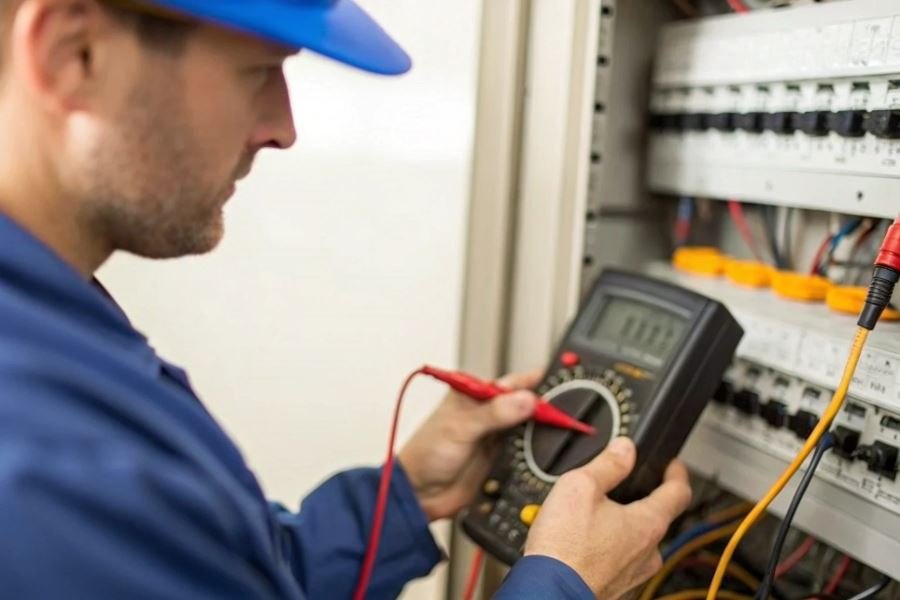
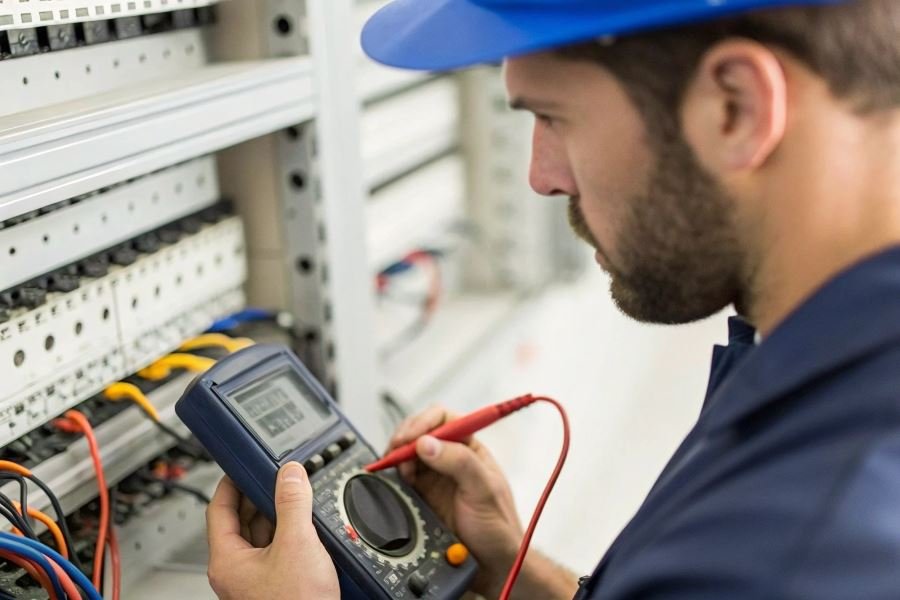
- Handheld digital multimeters provide flexibility for maintenance teams
- Panel-mounted systems deliver continuous monitoring for critical processes
- Data-logging voltmeters track patterns over time, revealing potential issues before they escalate
The distinction between consumer-grade and industrial-grade instruments isn’t merely about durability—it’s about reliability under extreme conditions. Industrial environments demand instruments that maintain accuracy despite electromagnetic interference, temperature fluctuations, and physical vibration.
Choosing wisely means understanding not just what you’re measuring, but where, when, and why those measurements matter.
Technical Specifications That Make or Break Industrial Voltmeters
When evaluating criteria for selecting a voltmeter for industrial enterprises, technical specifications become the foundation of your decision-making process. The right voltmeter doesn’t just measure voltage—it becomes your frontline defense against electrical failures, safety hazards, and production downtime. Let’s dive into the technical requirements that separate adequate instruments from exceptional ones.
Measurement Range and Accuracy: The Non-Negotiables
Industrial environments demand voltmeters with expansive measurement capabilities. Unlike residential settings where voltage typically stays within predictable parameters, manufacturing facilities must monitor everything from microvolts in sensitive control circuits to kilovolts in power distribution systems.
High-end industrial voltmeters offer measurement ranges from 0.1mV to 1000V DC and AC, with automatic range switching. The accuracy rating—typically expressed as a percentage of reading plus a fixed value—should be at least ±0.5% for general applications, while precision manufacturing may require ±0.1% or better.
Consider these typical accuracy requirements by industry:
- Semiconductor manufacturing: ±0.05% or better
- Automotive production: ±0.2% to ±0.5%
- Food processing: ±1% (often sufficient)
- Power generation: ±0.1% to ±0.3%
The difference between a voltmeter with 0.5% and 0.1% accuracy might seem minimal on paper, but represents thousands of dollars in product quality over time.
Resolution, Sensitivity and Input Impedance: The Technical Trifecta
Resolution determines the smallest voltage change your instrument can detect—critical when monitoring sensitive industrial processes. Modern digital voltmeters offer resolutions from 3½ digits (2,000 counts) to 6½ digits (2,000,000 counts).
| Resolution | Smallest Detectable Change | Typical Applications |
|---|---|---|
| 3½ digits | 0.5mV on 1V range | Basic troubleshooting |
| 4½ digits | 0.05mV on 1V range | General industrial use |
| 5½ digits | 0.005mV on 1V range | Precision manufacturing |
| 6½ digits | 0.0005mV on 1V range | Calibration, R&D |
Sensitivity works hand-in-hand with resolution, determining how well the voltmeter responds to small signal changes. For monitoring control systems or sensor outputs, look for sensitivities in the microvolt range.
Input impedance—perhaps the most overlooked specification—should exceed 10 MΩ for most applications. High impedance ensures your voltmeter doesn’t load the circuit being measured, which would result in false readings. Critical control circuits may require voltmeters with input impedances of 1 GΩ or higher.
Environmental Durability: Surviving Industrial Realities
The harshest critic of your voltmeter won’t be your procurement team—it will be your factory floor. Environmental specifications determine whether your instrument thrives or fails in real-world conditions.
Temperature tolerance should match your facility’s extremes. Standard industrial voltmeters operate from 0°C to 50°C, but specialized models can handle -20°C to 70°C. Temperature coefficient ratings (typically <0.01%/°C) tell you how much measurement accuracy drifts with temperature changes.
Moisture and dust resistance is quantified by IP (Ingress Protection) ratings. For most industrial environments, look for at least IP54 protection, while washdown areas require IP65 or better. The Fluke 87V industrial multimeter, for example, offers IP67 protection, allowing temporary immersion.
Vibration tolerance becomes critical near heavy machinery. Quality voltmeters specify their vibration resistance in G-forces across frequency ranges. Look for models tested to at least 3G, with premium options surviving 10G or more.
Remember that environmental durability affects not just functionality but also calibration stability. A voltmeter that requires recalibration after minor temperature fluctuations will cost you far more in downtime than investing in a properly specified instrument from the start.
Maximizing Your Industrial Voltmeter Investment
When selecting voltmeters for industrial applications, the decision extends far beyond the initial purchase. Smart facility managers and electrical engineers understand that implementation and ongoing maintenance represent the true value equation in industrial measurement equipment.
The real cost behind the price tag
The sticker price of an industrial voltmeter tells only a fraction of the story. A comprehensive Total Cost of Ownership (TCO) analysis reveals that initial investment typically represents just 20-30% of lifetime costs. Premium models from manufacturers like Fluke or Keysight might command $1,500-3,000 upfront, but their extended calibration intervals and robust construction dramatically reduce long-term expenses.
Consider this breakdown of a typical industrial voltmeter’s 10-year lifecycle:
| Cost Component | Percentage of TCO | Notes |
|---|---|---|
| Initial purchase | 25% | Higher for precision models |
| Calibration services | 35% | Varies by required accuracy |
| Maintenance/repairs | 15% | Quality units require fewer repairs |
| Training | 10% | Often overlooked but critical |
| Downtime costs | 15% | Reliability directly impacts production |
Budget-friendly options often become budget-draining liabilities when factoring in more frequent calibrations, shorter lifespans, and increased downtime. A $700 economy voltmeter requiring bi-annual calibration at $250 per service quickly surpasses the TCO of a $2,000 premium unit with annual calibration needs.
Calibration cadence and maintenance rhythms
Industrial voltmeters demand disciplined maintenance to deliver reliable measurements. Calibration requirements vary dramatically based on:
- Measurement accuracy requirements
- Environmental conditions (temperature fluctuations, humidity, vibration)
- Frequency of use
- Regulatory compliance needs
Most industrial facilities establish calibration intervals between 6-12 months, though high-precision applications may require quarterly verification. The National Institute of Standards and Technology recommends documenting drift patterns to potentially extend intervals for stable instruments.
Maintenance extends beyond calibration. Proper care includes:
- Regular inspection of test leads and connections
- Firmware updates to address bugs and security vulnerabilities
- Battery replacement for portable units
- Sensor cleaning and verification
- Documentation of performance history
Seamless system integration capabilities
Modern industrial environments demand interconnected measurement systems. Today’s leading voltmeters offer integration pathways that transform isolated measurements into networked intelligence.
When evaluating integration capabilities, assess:
- Communication protocols: Ethernet/IP, Modbus TCP, PROFINET, and OPC UA compatibility ensures your voltmeter speaks the same language as your control systems.
- Data logging capacity: Internal memory ranging from 10,000 to 1,000,000+ measurement points prevents data loss during network interruptions.
- Software compatibility: Look for instruments supporting open APIs or dedicated integration with platforms like Wonderware or Ignition SCADA.
The most valuable voltmeters transition from simple measurement tools to critical nodes in your condition monitoring network. This integration enables predictive maintenance, automated reporting, and real-time alerts when measurements drift beyond acceptable parameters.
The true value of an industrial voltmeter emerges when its measurements drive decisions, not just populate spreadsheets.
By carefully weighing these implementation and maintenance factors, you’ll select a voltmeter that delivers consistent value throughout its operational life.
Discover essential criteria for selecting industrial voltmeters that ensure accuracy, safety, and efficiency. Learn about measurement ranges, environmental durability factors, and integration capabilities for optimal performance in industrial settings.
Discover essential criteria for selecting industrial voltmeters that ensure accuracy, safety, and efficiency. Learn about measurement ranges, environmental durability factors, and integration capabilities for optimal performance in industrial settings.