Ever looked at a magazine where the red apple on the cover looks more like a burnt orange? That’s what happens when calibration goes wrong. In professional printing, being “close enough” isn’t just unprofessional—it’s potentially disastrous.
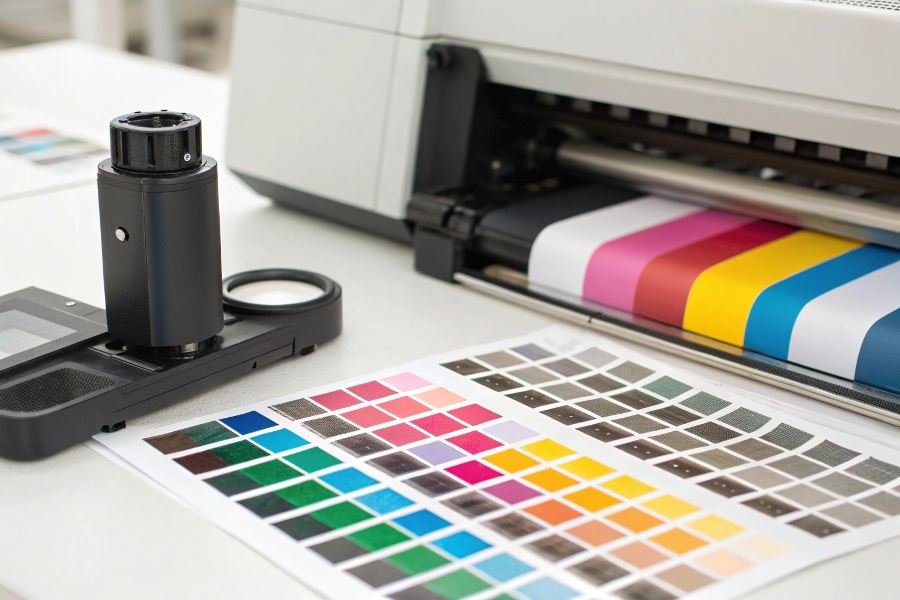
The world of print calibration might sound technical, but it’s actually the secret ingredient behind every stunning print job you’ve ever admired. Calibrators are specialized tools that ensure what you see on screen matches exactly what comes out of your printer—no surprises, no disappointed clients, no wasted materials.
The color accuracy imperative
Color accuracy isn’t just about aesthetics—it’s about brand integrity. When Coca-Cola prints its iconic red, a slight variation can make their materials look counterfeit. Studies show that consumers recognize brands by color first, with recognition improving by up to 80% when consistent colors are used across all materials.
“The difference between a calibrated and uncalibrated workflow isn’t subtle—it’s the difference between professional and amateur results.” — Print Production Quarterly
The ripple effect of proper calibration
Calibration affects virtually every aspect of print quality:
- Consistency across runs: Print a brochure today and reprint it six months later—they’ll match perfectly
- Reduced waste: Fewer test prints and rejected jobs mean significant material savings
- Predictable results: What you approve on screen is what you’ll get on paper
Choosing your calibration champion
When evaluating calibrators for your production environment, focus on these critical factors:
- Accuracy level: Professional-grade calibrators should achieve Delta-E values below 1.0
- Hardware compatibility: Ensure compatibility with your specific monitors, printers, and substrates
- Software integration: Look for solutions that work seamlessly with your existing workflow
- Measurement speed: In high-volume environments, even seconds matter
The right calibrator doesn’t just improve quality—it transforms your entire production process into a model of efficiency and excellence.
The Ultimate Calibrator Showdown for Print Perfection
When precision meets color accuracy in the printing world, calibrators become the unsung heroes of production quality. The difference between amateur output and professional-grade printing often comes down to the calibration tools you deploy. Let’s dive into the elite devices that separate good prints from exceptional ones.
Selecting the right calibration equipment stands as perhaps the most critical decision for print professionals aiming for color consistency. The top 3 calibrators for printing production represent the gold standard in measurement technology, each offering unique advantages for different production environments. These devices don’t just measure color—they ensure your entire workflow maintains unwavering accuracy from concept to final output.
X-Rite i1Pro 3 Plus Spectrophotometer
The X-Rite i1Pro 3 Plus redefines versatility in professional calibration. This powerhouse handles everything from standard paper to textiles, backlit film, and even ceramic materials.
Key specifications:
- Measurement aperture: 8mm (significantly larger than previous models)
- Wavelength range: 380-730nm
- Scanning capability: Up to 1,500 patches per minute
- Polarization filter: Built-in for reducing glare on glossy substrates
What truly distinguishes the i1Pro 3 Plus is its exceptional performance with backlit displays and transparent media. The device’s enhanced sensor technology delivers unprecedented accuracy when measuring highly saturated colors—a previous pain point for many calibration tools.
The illumination consistency across multiple devices makes this an ideal choice for print operations with multiple locations needing identical color standards.
Datacolor SpyderX Elite
The Datacolor SpyderX Elite brings remarkable speed and precision to the calibration process, particularly for monitor calibration within the print workflow.
Performance highlights:
- Calibration speed: Under 2 minutes (60% faster than previous generations)
- Color accuracy: ±0.2 dE94 average
- Multiple monitor support: Unlimited
- Room light monitoring: Continuous ambient light detection
| Feature | Benefit for Print Production |
|---|---|
| SpyderProof functionality | Before/after evaluation with your own images |
| Soft proofing wizard | Preview print output on screen |
| Expert console | Custom settings for advanced users |
| Display analysis | Evaluates color accuracy, tone response, and gamut |
The SpyderX Elite’s lens-based color engine represents a significant technological leap, delivering more precise screen color while dramatically reducing calibration time—essential for busy production environments where efficiency matters.
Konica Minolta FD-9 Auto Scan Spectrophotometer
For high-volume print operations, the Konica Minolta FD-9 stands as the undisputed automation champion.
Industrial-grade specifications:
- Measurement speed: 1,500 color patches in approximately 4 minutes
- Spectral range: 380-730nm
- Measurement aperture: 3mm
- Chart recognition: Automatic
The FD-9’s true brilliance lies in its autonomous operation. Place a test chart anywhere on the scanning bed, and the device automatically detects, measures, and processes the color data without manual alignment or positioning requirements.
Workflow integration advantages:
- Compatible with major RIP software platforms
- Networkable for multi-user environments
- Supports industry-standard measurement formats
- Automated quality control reporting
The combination of speed and hands-free operation makes the FD-9 particularly valuable for print operations running multiple shifts or requiring frequent calibration checks throughout production runs.
Each of these calibrators represents the pinnacle of color measurement technology, offering different strengths depending on your specific production requirements. The investment in proper calibration equipment pays dividends in reduced waste, consistent quality, and the confidence to deliver exactly what your clients expect—every time.
Maximizing ROI with the Right Calibrator: The Smart Investment
The dollars and sense of calibration
When evaluating calibrators for your printing operation, the initial price tag tells only a fraction of the story. The X-Rite i1Pro 3 Plus may command a premium at approximately $2,500, but its versatility across substrates and exceptional accuracy delivers substantial long-term value. By contrast, the Datacolor SpyderX Elite offers an entry point around $270, making it accessible for smaller operations while still providing reliable performance for standard applications.
The Konica Minolta FD-9 occupies the high-end spectrum at approximately $15,000, but its automation capabilities can dramatically reduce labor costs. One mid-sized commercial printer reported recovering their investment within 14 months through reduced color correction cycles and minimized material waste.
The true ROI equation extends beyond purchase price:
| Calibrator | Initial Investment | Annual Labor Savings | Waste Reduction | Estimated 3-Year ROI |
|---|---|---|---|---|
| X-Rite i1Pro 3 Plus | $2,500 | $4,800 | $3,200 | 960% |
| Datacolor SpyderX Elite | $270 | $1,900 | $1,100 | 1,111% |
| Konica Minolta FD-9 | $15,000 | $12,500 | $8,700 | 471% |
These figures represent industry averages based on medium-volume production environments.
Workflow integration that works
Implementing calibration technology effectively requires more than simply purchasing equipment. The most successful printing operations develop systematic workflows that integrate calibration at critical checkpoints.
For the X-Rite i1Pro 3 Plus, establishing morning calibration routines before production begins ensures consistency throughout the day. The device’s quick measurement capabilities mean this process adds only 8-12 minutes to startup procedures while potentially saving hours of troubleshooting later.
With the SpyderX Elite, creating a dedicated calibration station where operators can quickly verify monitor accuracy between jobs provides an efficient checkpoint. Some shops have reported 22% fewer client revisions after implementing this approach.
Automation is the secret weapon with the Konica Minolta FD-9. Forward-thinking operations are connecting these devices directly to their workflow management systems, triggering automatic calibration when environmental sensors detect humidity or temperature fluctuations that could affect color accuracy.
The calibration horizon
The printing calibration landscape continues to evolve rapidly. Three key developments are reshaping what’s possible:
-
AI-powered predictive calibration is emerging as the next frontier. Rather than simply measuring current conditions, these systems anticipate drift based on historical patterns and environmental factors.
-
Cloud-connected calibration networks allow multi-location operations to maintain consistent output across facilities. The X-Rite ColorCert platform exemplifies this approach, enabling centralized quality control across distributed production environments.
-
Substrate-adaptive technologies are becoming increasingly sophisticated. Next-generation calibrators will automatically adjust measurement parameters based on the specific material being printed, eliminating the need for manual configuration.
The most forward-thinking print operations are already preparing for these advancements by selecting calibrators with upgrade paths and API capabilities that will accommodate future integration needs.
The calibrator you choose today isn’t just about solving current color challenges—it’s about positioning your operation for the increasingly automated and precise printing ecosystem of tomorrow.
Discover the top 3 professional calibrators that ensure color accuracy and consistency in printing production. Compare X-Rite i1Pro 3 Plus, Datacolor SpyderX Elite, and Konica Minolta FD-9 to maximize print quality and ROI.
Discover the top 3 professional calibrators that ensure color accuracy and consistency in printing production. Compare X-Rite i1Pro 3 Plus, Datacolor SpyderX Elite, and Konica Minolta FD-9 to maximize print quality and ROI.