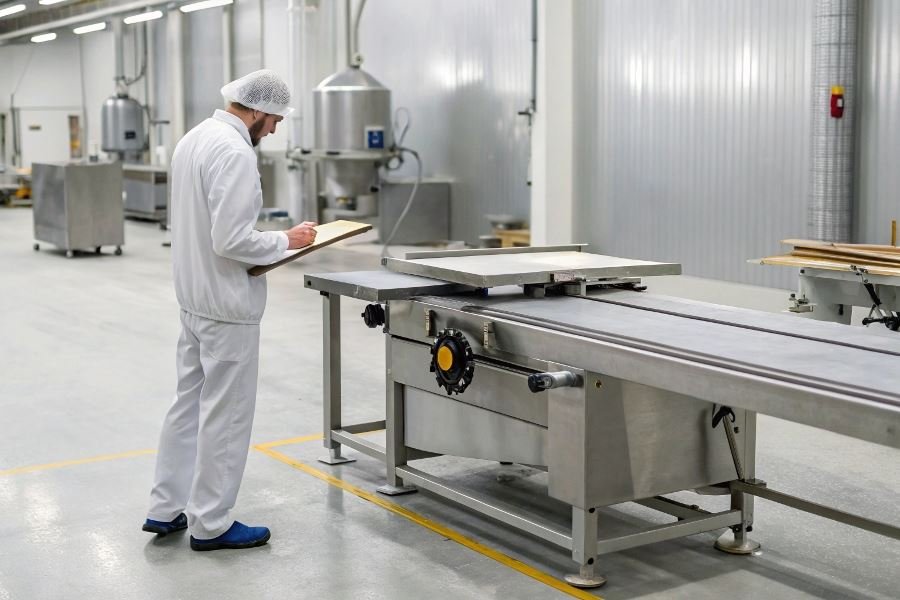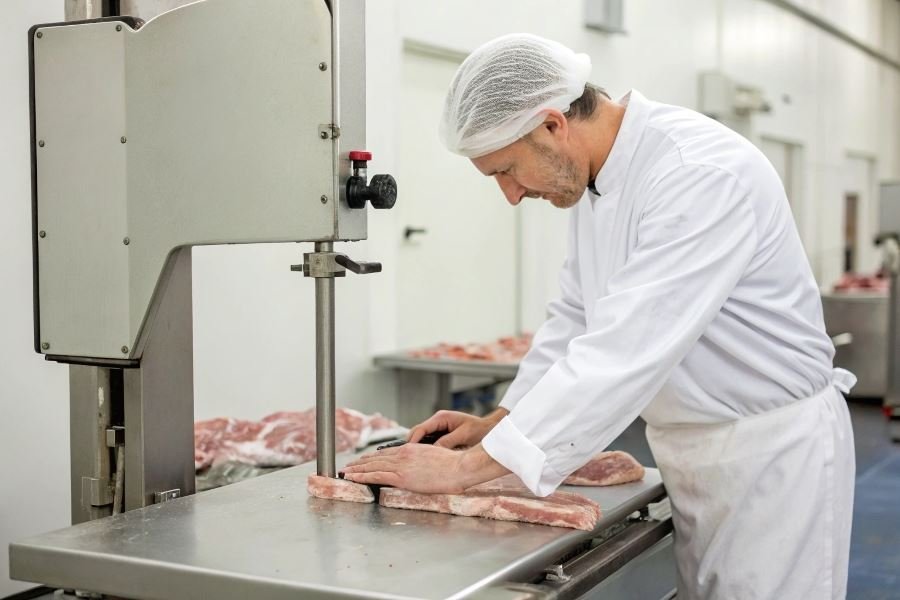
Ever sliced through a rock-solid frozen turkey with a regular knife? It’s like trying to cut diamonds with plastic scissors. The right saw for frozen products isn’t just a luxury—it’s the difference between precision processing and a frustrating, potentially dangerous experience.
When processing frozen foods at commercial scale, specialized equipment becomes non-negotiable. The dense, crystalline structure of frozen products demands tools specifically engineered to handle temperatures well below freezing without compromising food safety or blade integrity.
The frozen food cutting arsenal
The market offers several distinct categories of frozen product saws, each with unique advantages:
- Band saws: Workhorses of the industry, featuring continuous blade loops ideal for high-volume processing
- Circular saws: Precision cutters that excel at uniform slicing with minimal product waste
- Reciprocating saws: Versatile options for irregular cuts and smaller operations
- Table saws: Fixed-position units offering stability for consistent portion control
Critical selection factors
Choosing the right frozen product saw requires balancing several key considerations:
- Product type and density: Seafood demands different cutting capabilities than frozen meat or vegetables
- Production volume: Higher throughput requires more robust motors and cooling systems
- Blade material: Food-grade stainless steel with specialized coatings prevents contamination
- Safety features: Emergency stops, blade guards, and proper ergonomics protect operators
- Cleaning protocols: Equipment must withstand rigorous sanitation without degradation
The perfect saw matches your specific processing needs while maintaining food safety standards and operational efficiency—transforming frozen cutting from a challenge into a competitive advantage.
The Cutting Edge of Frozen Food Processing
When precision meets power in the frozen food industry, the right equipment makes all the difference. Professional-grade saws designed specifically for frozen products represent a critical investment for any serious food processing operation. The specialized nature of these tools demands careful consideration of several key factors that will ultimately determine your operational efficiency and product quality.
Blade Material: The First Line of Defense
The heart of any frozen food saw is its blade. Premium models typically feature food-grade stainless steel blades with specialized coatings that resist corrosion and maintain sharpness through thousands of cuts. When evaluating how to choose a saw for frozen products, blade material should top your priority list. Look for blades with high carbon content (typically 440C grade stainless steel) that offer superior edge retention even when cutting through rock-hard frozen meats or fish.
The tooth configuration matters just as much as the material. Blades designed for frozen products typically feature:
- Wider tooth spacing (3-4 teeth per inch) to prevent clogging
- Specialized gullet designs that efficiently clear frozen particles
- Hardened tips that maintain sharpness in sub-zero conditions
Power That Performs Under Pressure
The motor represents the muscle behind your frozen food cutting operation. Commercial-grade saws should deliver:
| Power Rating | Appropriate Applications | Typical Cutting Capacity |
|---|---|---|
| 1-1.5 HP | Light processing, retail | Up to 6″ thickness |
| 2-3 HP | Medium production | Up to 10″ thickness |
| 3.5+ HP | Industrial processing | 12″+ thickness |
When selecting a saw, match the motor specifications to your typical workload. A 3 HP Biro model might be perfect for a mid-sized meat processing facility, while smaller operations might find a 1.5 HP Hobart saw more appropriate. The key is ensuring sufficient torque to maintain blade speed even when encountering dense frozen product.
Cutting capacity isn’t just about power – it’s about the throat height (vertical clearance) and table depth that determine the maximum dimensions of product you can process. Premium models offer adjustable guides that can be quickly configured for different product sizes.
Safety and Sanitation: Non-Negotiable Standards
Food processing equipment must meet rigorous safety and sanitation requirements. The best frozen food saws incorporate:
Safety Features:
- Automatic blade braking systems that stop rotation in under 1 second
- Two-hand operation controls that prevent accidental activation
- Blade guards that adjust automatically to product height
- Emergency stop buttons positioned for immediate access
The difference between standard and superior safety features becomes apparent during high-volume production periods when operator fatigue increases risk.
Sanitation Design Elements:
- Tool-free disassembly for thorough cleaning
- Smooth, crevice-free surfaces that prevent bacterial harborage
- NSF-certified components that meet food safety standards
- Sloped surfaces that promote drainage during sanitizing
Leading manufacturers like Marel and Grasselli design their equipment with HACCP compliance in mind, ensuring that every component that contacts food can be thoroughly cleaned and sanitized.
The intersection of these three critical factors—blade design, motor capability, and safety/sanitation features—creates the foundation for selecting a frozen food saw that will deliver consistent performance, maintain food safety standards, and provide the reliability that professional food processing demands.
Top Saws for Frozen Products: The Ultimate Cutting Guide
When processing frozen products, the right saw makes all the difference between clean, precise cuts and costly product waste. Let’s dive into the world of commercial frozen food cutting equipment to help you make an informed decision that aligns with your operation’s specific needs.
Band Saws vs. Circular Saws: The Frozen Food Showdown
The debate between band saws and circular saws for frozen product processing centers on three critical factors: precision, versatility, and throughput capacity.
Band saws excel in versatility and precision cutting. Their continuous blade design allows for intricate cuts and portion control that circular saws simply can’t match. The Biro 3334 offers exceptional control when processing frozen meats, fish, and poultry, maintaining temperatures as low as -10°F without compromising cut quality.
Circular saws, by contrast, deliver unmatched speed and consistency for high-volume, straight-line cutting operations. The blade design creates cleaner, more uniform cuts when processing large quantities of identical products. The Hobart EDGE circular saw can process up to 40% more frozen product per hour than comparable band saws.
The key difference lies in application: band saws for precision and variety, circular saws for speed and uniformity.
Commercial vs. Industrial Grade: Scaling Your Operation
| Feature | Commercial Grade | Industrial Grade |
|---|---|---|
| Daily Capacity | 2-6 hours | 8-24 hours continuous |
| Cut Precision | ±2mm | ±0.5mm |
| Temperature Range | Down to -4°F | Down to -40°F |
| Initial Investment | 3, 000−15,000 | 18, 000−75,000+ |
| Maintenance Costs | Moderate | High |
Commercial-grade saws like the KWS MS-10NT provide excellent performance for small to medium operations processing up to 500 pounds of frozen product daily. These machines balance affordability with durability, typically featuring stainless steel construction and 1-2 HP motors.
Industrial-grade options such as the Marel I-Cut 130 represent significant investments but deliver unmatched performance for high-volume operations. These systems often integrate advanced features like programmable portion control, automatic blade tensioning, and continuous duty cycles for 24/7 operations.
Top 3 Recommended Frozen Product Saws
-
Best Overall: Biro 3334FH
This floor model band saw combines commercial-grade accessibility with near-industrial performance. Its 3 HP motor and specialized blade technology maintain consistent cutting performance even with products at -10°F, while its stainless steel construction ensures food safety compliance. -
Best High-Volume: Marel SB1200
For industrial operations processing thousands of pounds daily, this circular saw system delivers unmatched throughput with automated feeding systems and precision cutting accuracy to ±0.5mm, even at temperatures as low as -22°F. -
Best Value: KWS MS-10NT
Small to medium operations will appreciate this commercial band saw’s balance of performance and affordability. Its 1 HP motor handles frozen products efficiently, while its compact footprint maximizes workspace efficiency.
Making Your Final Decision
Your optimal saw depends primarily on three factors: production volume, product variety, and cutting precision requirements. Operations processing diverse products in moderate volumes typically benefit most from commercial-grade band saws. High-volume operations with standardized products should consider industrial circular saw systems.
Remember that proper maintenance dramatically extends equipment life—factor in not just purchase price but also blade replacement costs, cleaning requirements, and service intervals when calculating total ownership cost.
The right frozen product saw isn’t just equipment—it’s a strategic investment in your operation’s efficiency, product quality, and ultimately, your bottom line.
Discover how to select the ideal saw for frozen products with our comprehensive buyer's guide. Learn about essential features, blade specifications, safety standards, and top recommendations for efficient frozen food processing in commercial settings.
Discover how to select the ideal saw for frozen products with our comprehensive buyer's guide. Learn about essential features, blade specifications, safety standards, and top recommendations for efficient frozen food processing in commercial settings.