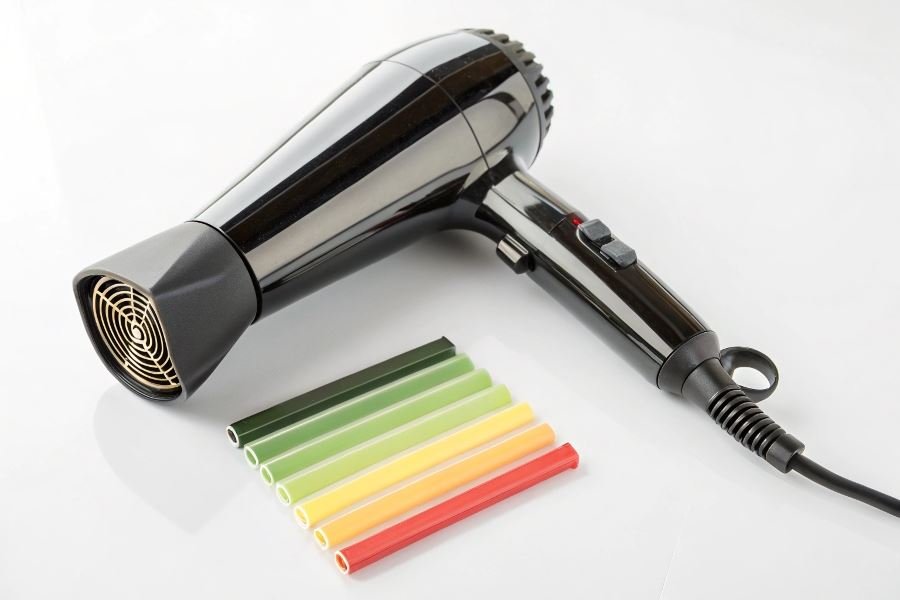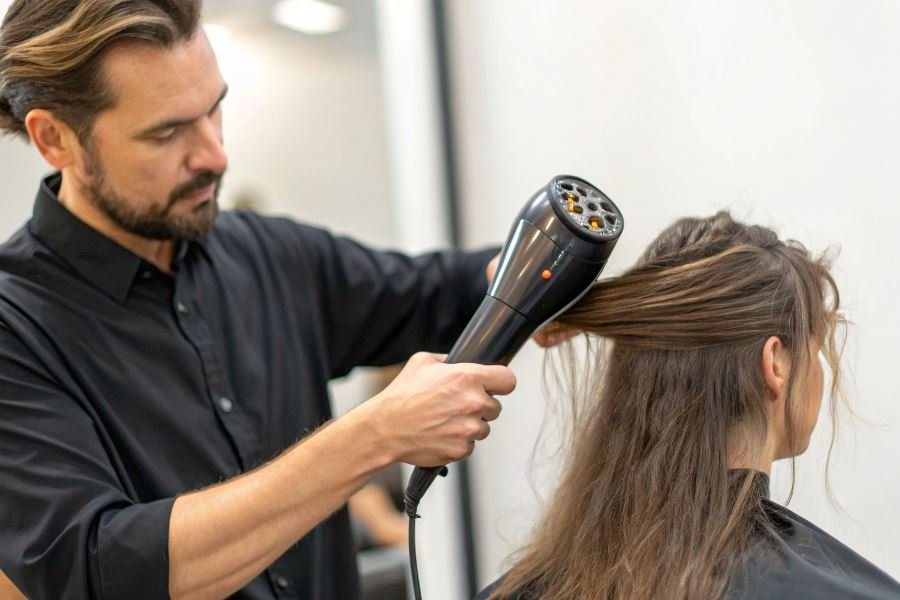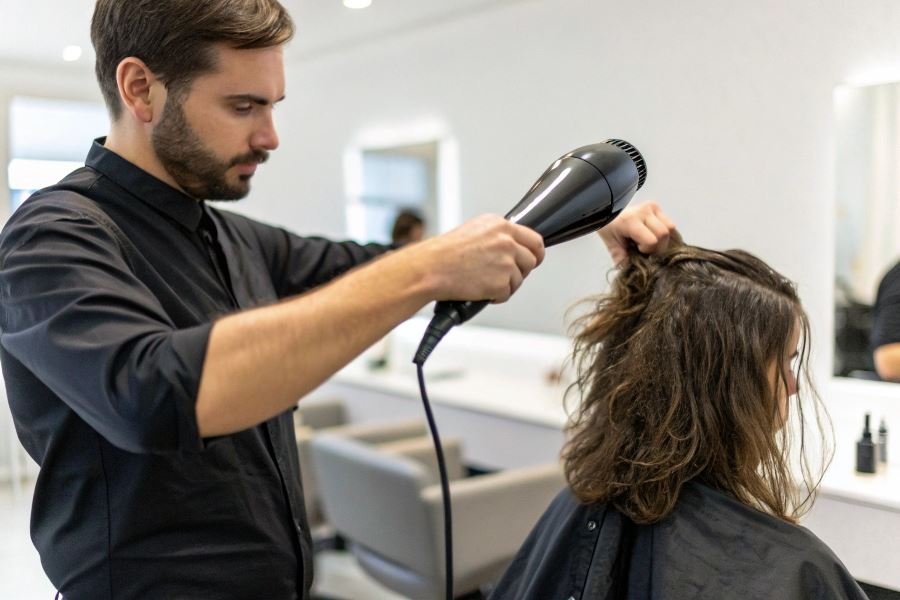
Ever watched a stylist transform wet, lifeless hair into a masterpiece in minutes? Behind that magic lies a crucial tool that separates salon results from bathroom disappointments: the professional hairdryer.
When clients pay premium prices for salon services, they’re investing in expertise—and the tools that make that expertise shine. Choosing the right professional hairdryer isn’t just about purchasing equipment; it’s about investing in your salon’s reputation and your stylists’ capabilities.
Professional hairdryers aren’t simply louder, prettier consumer models. The differences run deep into their engineering. While consumer dryers typically offer 1800-1875 watts of power, professional models deliver 1875-2300+ watts, reducing drying time by up to 50%. Professional models also feature:
- Commercial-grade motors designed for 800-1000 hours of operation versus 200-400 for consumer models
- Advanced ionic technology that seals cuticles for dramatically reduced frizz
- Precision heat control with multiple settings rather than just “hot” and “warm”
- Ergonomic design that prevents stylist fatigue during all-day use
Critical selection factors for salon success
The selection process requires balancing several competing priorities. Weight matters tremendously when stylists use the tool continuously—a difference of just 2 ounces can mean the difference between comfort and carpal tunnel syndrome over time.
Motor type also significantly impacts longevity. AC motors provide the durability salons need, often lasting 5+ times longer than the DC motors found in most consumer models, though they add weight. Meanwhile, the newest brushless motors offer the best of both worlds: lightweight construction with professional durability.
Your choice ultimately reflects your salon’s unique needs—your stylists’ techniques, client base, and service menu should all influence this critical investment.
Technical Specifications That Make or Break a Salon Hairdryer
When selecting professional equipment for your salon, understanding the technical backbone of hairdryers separates the workhorses from the paperweights. The process of how to choose a professional hairdryer for a hair salon requires attention to specifications that directly impact stylist performance, client satisfaction, and your bottom line. Let’s dive into what truly matters under the hood of these essential styling tools.
Power That Performs Under Pressure
Professional-grade hairdryers demand significantly more muscle than consumer models. The sweet spot for salon performance starts at 1800 watts, with top-tier models pushing 2000-2200 watts. This isn’t about bragging rights—it’s about efficiency.
A Dyson Supersonic Professional operating at 1600 watts often outperforms a generic 1800-watt dryer due to superior motor technology. The difference? High-quality AC motors that maintain consistent power output even during marathon styling sessions.
Key performance indicators:
- 1800-2200 watts for optimal drying efficiency
- AC motors for longevity (1000+ hours of operation)
- Quick-cool technology to prevent overheating
Salon dryers with lower wattage force stylists to spend more time per client, reducing your chair turnover and ultimately affecting revenue.
Ergonomics: The Hidden Productivity Factor
Weight distribution makes or breaks stylist endurance. The average stylist handles a dryer for 4-6 hours daily—that’s equivalent to holding a small dumbbell while performing precise movements.
| Feature | Standard Requirement | Premium Benchmark |
|---|---|---|
| Weight | Under 1.1 lbs | Under 0.9 lbs |
| Cord Length | Minimum 9 ft | 11+ ft |
| Handle Design | Textured grip | Balanced weight distribution |
The BaBylissPRO Nano Titanium exemplifies ergonomic excellence with its 1.8-pound frame and 9-foot cord that allows stylists to move freely without cord tension—a common cause of wrist strain.
Proper ergonomics aren’t luxury features—they’re productivity multipliers that prevent stylist fatigue and repetitive strain injuries.
Temperature Control and Airflow Technology
Modern salon dryers offer more than just “hot” and “hotter.” Look for models with:
- Multiple heat settings (minimum 3) for versatility across hair types
- Precise airflow control for detailed styling work
- Cool shot button with responsive action (not the afterthought found on consumer models)
Ionic technology has revolutionized professional drying by breaking down water molecules faster while sealing the cuticle. The result? Up to 40% faster drying times and significantly reduced frizz.
The ghd Helios Professional delivers 75mph airflow with acoustic balancing for quieter operation—critical when stylists need to communicate with clients during styling.
Temperature consistency separates professional models from pretenders. Budget dryers often fluctuate by 15-20°F during extended use, while professional models like the Elchim 3900 Healthy Ionic maintain temperature variance within 5°F, protecting hair integrity while delivering predictable results.
When evaluating heat technology, ceramic and tourmaline heating elements provide the most consistent heat distribution, while titanium offers the fastest heat-up times but requires more careful handling to prevent heat damage.
Remember: The technical specifications of your salon’s hairdryers directly impact service quality, stylist satisfaction, and operational efficiency—making them one of the most important equipment investments for your business.
The Salon Pro’s Guide to Hairdryer Selection
When equipping your salon, the humble hairdryer transforms from a basic tool into a critical investment. Professional stylists can log upwards of 2,000 hours annually with these devices in hand—making thoughtful selection absolutely essential for business success.
Built to withstand the daily grind
Professional hairdryers face punishing workloads in salon environments. Unlike consumer models designed for 5-10 minutes of daily use, salon dryers must perform flawlessly through 8+ hour shifts.
Material construction makes all the difference. Top-tier models from Dyson and BaBylissPRO feature aerospace-grade materials that dissipate heat efficiently while maintaining structural integrity. The difference becomes apparent after 6-12 months of heavy use when lesser models begin to falter.
Warranty coverage varies dramatically across manufacturers:
| Brand | Standard Warranty | Extended Options | Parts Coverage |
|---|---|---|---|
| Dyson | 5 years | Available to 7 years | Full coverage |
| BaBylissPRO | 3 years | Available to 5 years | Motor and heating element |
| Parlux | 2 years | Available to 4 years | Limited coverage |
Always factor warranty costs into your total investment calculation rather than focusing solely on purchase price.
The decibel factor matters more than you think
Noise pollution in salons represents both a client experience issue and an occupational hazard. Stylists exposed to continuous high-decibel environments report increased fatigue, communication difficulties, and even hearing damage over time.
Modern professional dryers have made significant advances in noise reduction:
Low-noise innovations include:
- Brushless digital motors (reducing mechanical noise)
- Sound-dampening materials in housing
- Aerodynamic air channels minimizing turbulence
The quietest professional models now operate at 75-80 decibels—approximately the volume of a normal conversation—compared to older models that could exceed 90 decibels. Valera and ghd have pioneered particularly effective noise-dampening technologies.
A 10-decibel reduction represents a perceived halving of noise volume, dramatically improving both stylist working conditions and client experience.
Attachment versatility expands your styling repertoire
The most versatile professional hairdryers accommodate specialized attachments that transform a single tool into a multi-functional styling system.
Essential attachments for comprehensive styling include:
- Concentrator nozzles (2-3 width options for precision work)
- Diffusers (bowl-shaped for curly hair, finger diffusers for volume)
- Comb attachments for textured hair
- Quick-dry nozzles for efficient water removal
Magnetic attachment systems from T3 and Elchim allow for single-handed switching between attachments—a seemingly small feature that saves precious minutes during styling sessions.
Compatibility between techniques and attachments determines workflow efficiency. The best professional dryers maintain consistent airflow and temperature regardless of which attachment is in use, preventing the performance degradation common in consumer models.
When evaluating attachment options, consider both current service offerings and potential future expansions to your styling menu.
By prioritizing durability, noise management, and attachment versatility, you’ll select a professional hairdryer that enhances both stylist performance and client satisfaction—a true business asset rather than a mere expense.
Discover what truly matters when selecting salon-grade hairdryers. Learn about essential power requirements, ergonomic features, and technology innovations that professional stylists rely on for all-day performance and superior styling results.
Discover what truly matters when selecting salon-grade hairdryers. Learn about essential power requirements, ergonomic features, and technology innovations that professional stylists rely on for all-day performance and superior styling results.