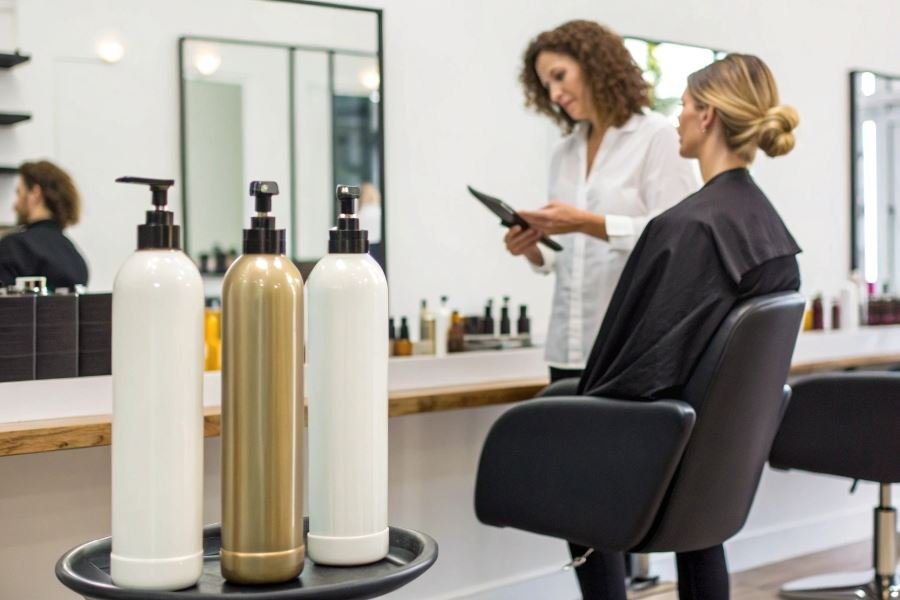
Ever wondered why your hair never quite looks like it did when you left the salon? The answer might be hiding in that humble bottle of shampoo on your shower shelf.
Professional hair care products represent a fundamentally different approach to treating your hair compared to what you’ll find in typical grocery store aisles. While mass market shampoos focus primarily on cleansing and creating immediate sensory effects (think lather and fragrance), professional formulations are engineered with a deeper understanding of hair structure and long-term health. They’re not just cleaning your hair—they’re treating it.
The science behind salon-quality
Professional shampoos typically contain higher concentrations of active ingredients and significantly fewer fillers and harsh detergents. A 2023 industry analysis revealed that salon products contain up to 3x more specialized conditioning agents and 70% fewer sulfates than their mass market counterparts. This isn’t just marketing—it’s chemistry.
“The difference between professional and mass market products is like comparing a tailored suit to fast fashion. One is designed specifically for your needs; the other is made to appeal to everyone.” — Hair Science Institute
Why the growing shift toward professional products?
The interest in salon-quality hair care has surged dramatically as consumers become more educated about ingredient quality. Social media has amplified this trend, with before-and-after transformations showcasing the visible difference professional products can make.
Your hair’s health isn’t just about appearance—it reflects overall wellness. Professional formulations recognize this connection, offering targeted solutions rather than one-size-fits-all approaches. The investment in higher-quality ingredients pays dividends in hair that not only looks better but is genuinely healthier from cuticle to core.
The Science Behind Professional Hair Care
When you examine professional shampoos alongside mass market options, the differences become immediately apparent—not just in price, but in performance and hair health outcomes. Professional products aren’t simply luxury versions of drugstore brands; they represent fundamentally different approaches to hair care formulation.
Superior Ingredient Profiles
Professional shampoos distinguish themselves through ingredient quality that dramatically outpaces mass market alternatives. While drugstore brands typically use sodium lauryl sulfate (SLS) as their primary cleanser, salon-quality formulations feature gentler surfactants like sodium laureth sulfate (SLES) or cocamidopropyl betaine. These cleansers remove dirt without stripping natural oils.
The concentration of active ingredients creates another significant divide in professional shampoos: differences from mass market products become evident when examining their formulation sheets. Mass market products often contain between 10-15% active ingredients, while professional formulas boast 20-30% concentrations of specialized compounds like keratin, silk proteins, and botanical extracts.
Key ingredient differences:
| Ingredient Type | Professional Shampoos | Mass Market Products |
|---|---|---|
| Surfactants | Gentle SLES, cocamidopropyl betaine | Harsh SLS, ammonium lauryl sulfate |
| Conditioning agents | Quaternium compounds, natural oils | Silicones, minimal natural oils |
| Active ingredients | 20-30% concentration | 10-15% concentration |
| Preservatives | Paraben-free systems | Often contain parabens |
Advanced Formulation Technology
The technological sophistication behind professional shampoos represents decades of trichological research. Professional brands invest heavily in developing proprietary complexes that target specific hair concerns with precision.
pH balance stands as a critical differentiator. Human hair and scalp maintain a slightly acidic pH between 4.5-5.5. Professional formulations meticulously calibrate their pH levels to match this range, helping to seal the cuticle and preserve color. Mass market products often skew more alkaline (pH 6-7), which can leave hair cuticles open and vulnerable to damage.
The molecular architecture of professional formulas also enables time-released delivery systems that continue working hours after application, unlike mass market products that provide primarily immediate effects.
Rigorous Manufacturing Standards
The production environment for professional hair care adheres to pharmaceutical-grade protocols that exceed standard cosmetic requirements. Brands like Kérastase and Oribe implement multi-stage quality control processes, including:
- Raw material verification through spectroscopy
- Batch testing for microbial contamination
- Stability testing across temperature variations
- Performance validation through instrumental analysis
These stringent manufacturing standards ensure consistency between bottles—something mass market brands struggle to maintain due to high-volume production demands and cost constraints.
Manufacturing comparison:
- Professional: Small-batch production with extensive quality testing
- Mass market: High-volume manufacturing prioritizing efficiency and cost reduction
The quality control extends to packaging as well. Professional products utilize airless pumps and UV-protective bottles to preserve ingredient integrity, while mass market options typically employ standard packaging that may allow oxidation or contamination over time.
When you invest in professional hair care, you’re not simply paying for prestige—you’re accessing formulations developed with significantly higher standards for ingredient quality, technological innovation, and manufacturing excellence that deliver measurable differences in hair health and appearance.
Making the Right Choice: Professional vs. Mass Market Shampoos
When it comes to hair care, the decision between professional and mass market shampoos isn’t just about price—it’s about understanding what your hair truly needs and making investments that pay off in the long run. Let’s cut through the marketing noise and help you make choices that will have your hair thanking you.
Know your hair’s true needs
The first step in making an informed decision is understanding what your hair is actually asking for. Professional stylists don’t just recommend products at random—they assess:
- Hair porosity (how well your hair absorbs and retains moisture)
- Scalp condition (oily, dry, or balanced)
- Hair damage level (from heat styling, coloring, or environmental factors)
- Texture and density (fine, thick, curly, straight)
Before investing in any product, take time to evaluate your specific concerns. Is frizz your main battle? Color preservation? Volume loss? Identifying your primary hair challenges helps narrow down which professional ingredients might justify the higher price tag.
Wisdom nugget: The most expensive shampoo isn’t necessarily the right one for your hair. The right shampoo is the one formulated for your specific hair concerns.
The real cost equation
Professional shampoos typically cost 3-5 times more than mass market options. But calculating true value requires looking beyond the price tag:
| Factor | Professional Shampoos | Mass Market Shampoos |
|---|---|---|
| Initial cost | $25-45 per bottle | $5-12 per bottle |
| Usage amount | 1-2 pumps (concentrated) | Often 2-3x more product needed |
| Longevity | 2-4 months with proper use | 1-2 months with typical use |
| Supplemental products needed | Fewer additional products | Often requires multiple styling products |
Many users report that while the upfront investment is higher, professional products often last longer because:
- The formulations are more concentrated
- You need less product per wash
- They address problems at the source rather than masking them
Consider this: spending 35onashampoothatlasts3months(11.67/month) may actually be more economical than cycling through three 8bottlesinthesameperiod(24/month).
Spotting genuine professional products
The professional haircare market has become flooded with products claiming professional status. Here’s how to identify the real deal:
Authentic distribution channels
Professional products are primarily sold through:
Be wary of suspiciously discounted professional products on marketplace sites—they may be counterfeit or expired.
Ingredient verification
Genuine professional shampoos typically feature:
- Higher concentrations of active ingredients
- Fewer fillers and sulfates
- Specialized ingredients like keratin, argan oil, or bond-building technology
- pH-balanced formulations
Packaging integrity
Look for:
- Batch codes that can be verified
- Professional-grade packaging (often with pumps for precise dispensing)
- Clear ingredient lists with specialized components listed prominently
The ultimate test comes after consistent use. Professional products should deliver noticeable improvements within 2-3 weeks—if you’re not seeing results by then, you may need to reassess either the product’s authenticity or its match to your specific hair needs.
Discover why professional shampoos deliver superior results with higher-quality ingredients and specialized formulations. Learn the key differences that make salon products worth the investment for healthier, more vibrant hair.
Discover why professional shampoos deliver superior results with higher-quality ingredients and specialized formulations. Learn the key differences that make salon products worth the investment for healthier, more vibrant hair.