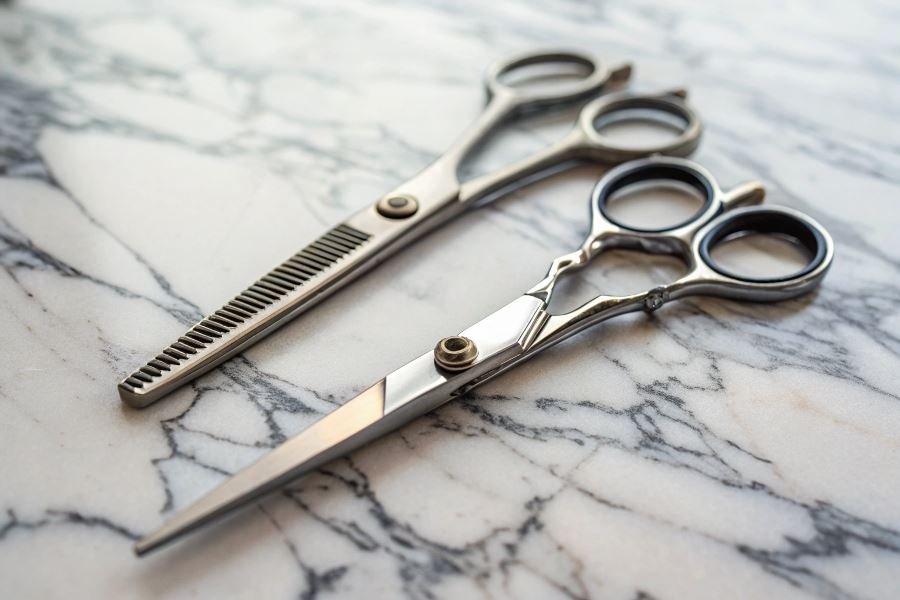
Ever held a pair of scissors that felt like an extension of your hand? That’s the difference between professional hair cutting scissors and the ones hiding in your kitchen drawer. The right pair doesn’t just cut hair—it empowers artistry.
When master stylists transform a client’s appearance, they’re not just wielding metal—they’re using precision instruments engineered for performance. Professional scissors feature specialized ergonomics, premium materials, and cutting-edge design that ordinary scissors simply can’t match. The difference becomes apparent with every snip, affecting everything from hand fatigue to the final look.
The evolution of excellence in hair cutting tools tells a fascinating story. Ancient Egyptians used sharpened bronze and copper implements, while the Romans refined metal-forging techniques for better cutting tools. The true revolution came in 1761 when Benjamin Huntsman developed crucible steel in Sheffield, England—creating stronger, sharper blades that transformed the craft. Japanese bladesmiths entered the scene in the early 20th century, introducing hand-forged scissors that remain the gold standard today.
“The difference between good and great hairstyling often comes down to the quality of your scissors.” – Industry wisdom that professional stylists live by
Modern professional scissors feature specialized components like convex edges, ball-bearing tension systems, and ergonomic handles—innovations that reduce wrist strain during long styling sessions. They’re typically crafted from high-carbon steel, Damascus steel, or cobalt alloys that maintain sharpness through thousands of cuts.
Choosing the right professional scissors isn’t just about spending more—it’s about investing in precision, comfort, and results that speak for themselves.
The Cutting Edge: Mastering Scissor Selection
Material Matters: Steel Quality Showdown
Professional hairstylists know that exceptional results begin with exceptional tools. When exploring how to choose professional hair cutting scissors, the material composition stands as the foundation of performance and longevity. Japanese and German steel represent the gold standards in the industry, each with distinctive characteristics that influence cutting experience.
Japanese steel (particularly from Hitachi and Takefu) delivers remarkable sharpness and edge retention. Typically forged from VG10 or ATS-314 steel with hardness ratings of 60-61 HRC, these scissors maintain precision through thousands of cuts. The higher carbon content (0.95-1.1%) creates a blade that stays sharper longer but requires more maintenance to prevent corrosion.
German steel scissors, crafted from materials like 440C stainless steel, offer slightly lower hardness (56-58 HRC) but exceptional durability and corrosion resistance. Their slightly softer composition makes them easier to resharpen while providing remarkable resilience against drops and impacts.
| Steel Type | Hardness (HRC) | Edge Retention | Corrosion Resistance | Price Range |
|---|---|---|---|---|
| Japanese | 60-61 | Excellent | Good | $300-1,200 |
| German | 56-58 | Very Good | Excellent | $200-800 |
Ergonomics: The Handle on Performance
The handle design dramatically impacts comfort during extended cutting sessions. Three primary configurations dominate the professional landscape:
Offset handles position the thumb handle lower than the finger handle, creating a natural cutting position that reduces wrist strain. This design allows the elbow to remain lower during cutting, making it ideal for stylists who perform detailed cutting techniques requiring precision and control.
Crane handles feature an elongated thumb handle that curves like its namesake bird, creating a more open hand position. This configuration excels for stylists with larger hands or those who prefer a more relaxed grip during cutting.
Opposing grip handles (symmetrical) represent the traditional scissor design with evenly aligned finger and thumb rings. While less ergonomic for extended sessions, they offer superior control for certain specialized cutting techniques.
The right handle isn’t about price or prestige—it’s about how your hand feels after the eighth client of the day.
Blade Configurations: Purpose-Built Precision
Different cutting techniques demand different blade profiles, each engineered for specific hair textures and styling approaches:
Convex blades feature a slight outward curve along the cutting edge, creating an extremely sharp edge that slices through hair with minimal resistance. The hollow-ground design reduces weight while maintaining structural integrity. These premium blades excel at slide-cutting and point-cutting techniques on fine to medium hair.
Beveled edge blades incorporate a straight cutting surface with an angled edge (typically 45°). This design creates a more durable edge that excels at blunt cutting and working with thicker hair textures. The increased durability makes these blades ideal for stylists who perform high-volume cutting.
Serrated blades feature micro-teeth along one blade that grip hair during cutting, preventing slippage when working with wet hair or creating textured effects. These specialized blades excel at creating texture and removing bulk without creating harsh lines.
The intersection of material quality, ergonomic design, and blade configuration creates scissors that function as extensions of a stylist’s artistic vision. By understanding these essential factors, professionals can select tools that enhance their technical abilities while reducing physical strain during long cutting sessions.
The Precision Game: Advanced Scissor Selection
Size and weight that transforms technique
Professional haircutting isn’t just an art—it’s a physical discipline where your tools become extensions of your hands. The difference between a 5.5-inch and 6.5-inch scissor isn’t merely a measurement—it’s the difference between precision detail work and efficient cutting through larger sections.
Shorter scissors (4.5-5.5 inches) offer superior control for detailed techniques like point cutting and texturizing. Their reduced weight minimizes hand fatigue during intricate work. Meanwhile, longer blades (6-7 inches) excel at line cutting and slice-cutting techniques, allowing smooth, continuous cutting motions through larger sections.
Weight distribution matters as much as overall heft. Premium scissors like the Mizutani DB-20 feature balanced weight distribution that reduces strain during eight-hour cutting sessions. The sweet spot for most professionals falls between 1.8-2.5 ounces—heavy enough for momentum through dense hair, light enough to prevent repetitive strain injuries.
The right size-weight combination should feel like it disappears in your hand, leaving only your creative intention and the hair.
Tension systems that evolve with you
The cutting tension of your scissors—how the blades interact—is perhaps the most overlooked yet critical specification. Modern professional scissors feature three primary tension systems:
| System Type | Advantages | Maintenance Needs |
|---|---|---|
| Flat Screw | Simple, affordable, traditional | Regular adjustment (weekly) |
| Click-dial | Precise incremental adjustments | Moderate (monthly check) |
| Ball Bearing | Ultra-smooth action, consistent tension | Annual professional service |
The Hattori Hanzo HH05 exemplifies how advanced ball-bearing systems maintain consistent tension even after 100,000 cuts. This translates to predictable performance that doesn’t drift during critical cutting sequences.
Your tension adjustment strategy should evolve with your scissors. New scissors typically require adjustment every 2-3 days as they “break in,” while established pairs settle into a 2-3 week maintenance rhythm. Professional sharpening services should be scheduled every 8-12 months depending on volume.
The true economics of excellence
Professional scissors represent an investment decision, not merely a purchase. When analyzing the long-term economics, consider the complete lifecycle:
A $300 entry-level professional scissor might last 3-4 years with proper maintenance, while a $1,200 premium option from Hikari SHH can deliver 12-15 years of service. The premium option’s per-year cost actually becomes lower despite the higher initial investment.
The hidden costs of inferior scissors extend beyond replacement frequency. Subpar cutting performance leads to longer appointment times, reduced client satisfaction, and potential repetitive strain injuries that can sideline your career.
The most successful professionals maintain a strategic collection: primary cutting scissors, dedicated thinning shears, and specialized scissors for specific techniques. This approach maximizes both tool longevity and cutting efficiency.
Quality scissors don’t cost—they pay. The difference between good and exceptional tools isn’t measured in dollars but in decades of comfortable, precise cutting.
Discover how to select premium hair cutting scissors with our expert guide covering materials, ergonomics, and blade types. Learn what professionals prioritize when investing in high-quality shears for precision cutting and styling.
Discover how to select premium hair cutting scissors with our expert guide covering materials, ergonomics, and blade types. Learn what professionals prioritize when investing in high-quality shears for precision cutting and styling.