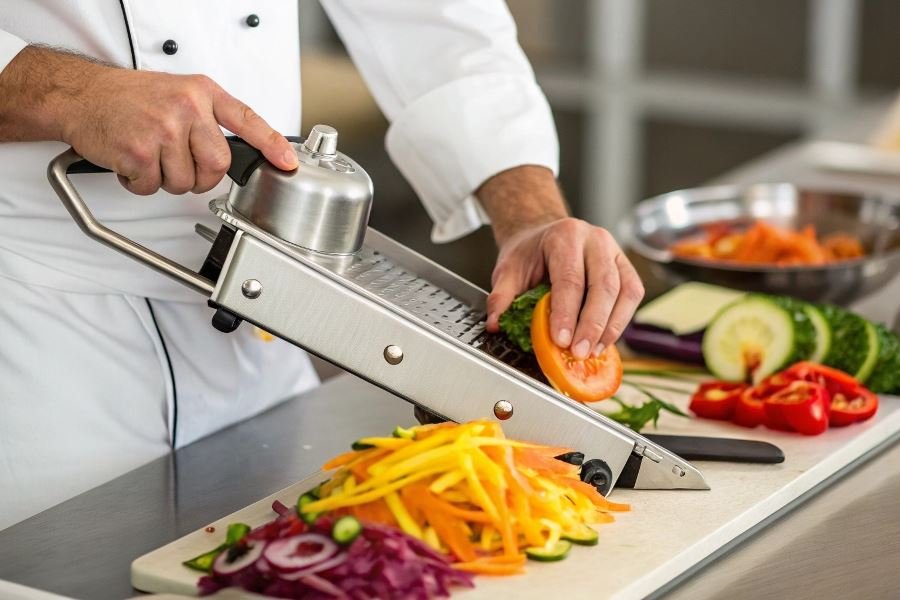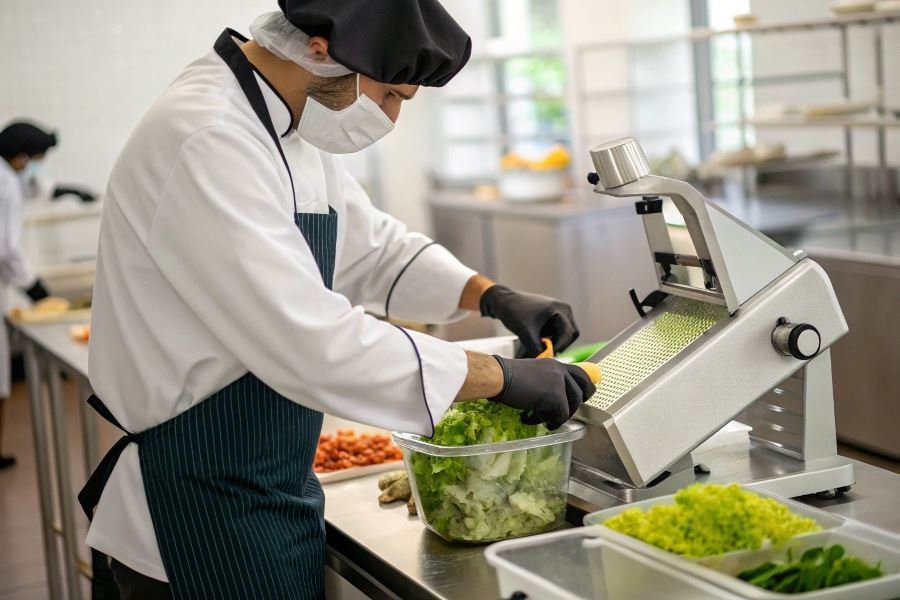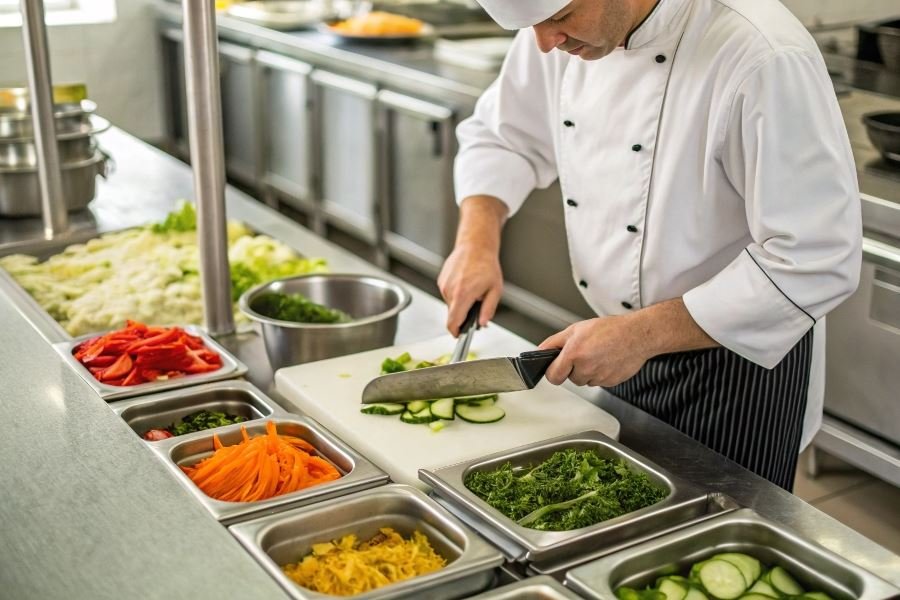
Ever watched a chef’s knife blur across a cutting board, transforming vegetables into perfect, uniform pieces in seconds? That precision isn’t just impressive—it’s profitable. For small food businesses, the difference between struggling and thriving often comes down to operational efficiency, and few tools impact this more directly than quality vegetable slicers.
Time equals money in food preparation. When your small bakery, food truck, or catering service spends hours on manual vegetable prep, you’re literally cutting into profits. Professional-grade vegetable slicers can reduce prep time by up to 75%, allowing your team to focus on what truly matters: creating exceptional food experiences and serving more customers.
The efficiency revolution in your kitchen
Quality vegetable slicers deliver three immediate benefits that transform small food operations:
-
Consistency perfected – Uniform cuts aren’t just visually appealing; they ensure even cooking and predictable yield calculations, reducing food waste and improving quality control.
-
Safety enhanced – Professional slicers minimize knife handling, reducing the risk of kitchen injuries that can devastate small businesses without dedicated HR departments or worker’s compensation infrastructure.
-
Scalability unlocked – The right slicer grows with your business, handling increased volume without proportionally increasing labor costs.
“The vegetable slicer I invested in paid for itself within three weeks through labor savings alone. It’s been the single most important equipment purchase for my catering business.” — Artisan caterer from Portland
When selecting your first professional slicer, prioritize versatility, durability, and ease of cleaning. The ideal starter model offers multiple cutting options while remaining straightforward enough for new staff to master quickly.
Slicing Success: Top Vegetable Processors for Your Food Business
Starting a food business means making smart equipment choices that balance quality, efficiency, and budget. Vegetable slicers for small businesses: optimal models for beginners represent a critical investment that can dramatically impact your food prep workflow, consistency, and bottom line. Let’s dive into the most practical options that deliver professional results without breaking the bank.
Manual Slicers That Punch Above Their Weight
Manual vegetable slicers offer remarkable value for new food entrepreneurs. The Benriner Japanese Mandoline ($65-85) remains the industry standard with its razor-sharp blades and four interchangeable cutting options. What makes this tool exceptional is its ability to produce paper-thin to 1/4-inch slices with remarkable consistency.
For businesses prioritizing versatility, the OXO Good Grips V-Blade Mandoline ($39.99) delivers four cutting styles (straight, wavy, julienne, and french fry) with a straightforward dial system that eliminates the need for blade swapping. Its non-slip feet and hand guard make it particularly suitable for busy kitchen environments.
Budget-conscious operators should consider the Mueller Austria V-Pro Multi-Blade Adjustable Mandoline ($29.99), which offers five interchangeable blades and adjustable thickness settings in a dishwasher-safe package.
Electric Slicers That Maximize Efficiency
When volume demands increase, electric slicers deliver consistent results while reducing labor costs. The Robot Coupe CL50 Ultra ($1,995) represents the gold standard with its 1.5 HP motor processing up to 880 pounds of vegetables per hour. Its 23 available cutting discs make it adaptable to virtually any menu requirement.
For mid-range operations, the Hobart EDGE12 ($1,299) offers commercial-grade durability with a more accessible price point. Its continuous feed design and 1/2 HP motor efficiently handle medium-volume production needs.
Small businesses with limited counter space might prefer the Waring Commercial WFP14SC ($599), which combines food processing and vegetable slicing capabilities in a compact footprint. Its 3.5-quart bowl and continuous feed chute make it ideal for restaurants serving 50-75 covers per service.
Multi-Functional Systems That Grow With Your Business
Multi-functional slicers provide the greatest adaptability for evolving menus. The Hallde RG-100 ($1,795) exemplifies this category with its ability to handle over 40 different cutting styles from basic slices to specialized cuts like crimping, julienne, and brunoise. Its feed cylinder accommodates everything from delicate herbs to dense root vegetables.
For businesses seeking premium versatility, the Dynamic Dynacube ($899) offers interchangeable grid systems that produce perfect cubes, sticks, and slices in one efficient unit. The tool’s distinctive advantage lies in its ability to process both raw and cooked vegetables with equal precision.
Budget-conscious operators should investigate the Vollrath Redco Instacut 3.5 ($299), which delivers 25 different cutting options through interchangeable blade assemblies. Its wall-mountable design conserves valuable counter space while still processing up to 50 pounds of vegetables per hour.
When selecting your vegetable slicer, consider your daily volume, menu requirements, available space, and growth projections. The right equipment investment will enhance product consistency, reduce prep time, and ultimately contribute to your business’s profitability and reputation for quality.
Making the Right Investment: Vegetable Slicers That Grow With Your Business
When launching a food-based venture, equipment selection can make or break your operational efficiency. Vegetable slicers represent one of those critical investments that directly impact your prep time, product consistency, and ultimately, your bottom line. Let’s dive into what truly matters when selecting this essential piece of equipment.
Features that drive kitchen efficiency
The difference between a professional-grade vegetable slicer and a home-use model isn’t just about durability—it’s about precision, speed, and versatility. When evaluating options, prioritize these game-changing features:
-
Blade variety and quality: Look for slicers offering interchangeable blades made from high-carbon stainless steel. The Robot Coupe CL50 commercial food processor comes with over 20 blade options, allowing you to transition from paper-thin cucumber slices to perfect julienne carrots without missing a beat.
-
Processing capacity: Consider both hourly output and feed tube size. The Hobart FP100 can process up to 700 pounds of vegetables per hour—overkill for most startups, but illustrative of the scaling potential.
-
Adjustability: The ability to fine-tune slice thickness (typically from 1-12mm) transforms one machine into multiple tools. This precision directly translates to product consistency your customers will notice.
-
Safety mechanisms: Features like automatic shutoff when opened and blade guards aren’t just about preventing injuries—they’re about maintaining operational continuity when training new staff.
Maintenance economics and longevity
The true cost of a vegetable slicer extends far beyond the initial purchase price. Smart business owners consider:
| Maintenance Factor | Budget Models | Commercial Grade |
|---|---|---|
| Parts Availability | Limited (1-3 years) | Extended (10+ years) |
| Cleaning Time | 15-20 minutes | 5-10 minutes |
| Service Intervals | 3-6 months | 12-18 months |
| Warranty | 1 year typical | 3-5 years typical |
The most expensive slicer you’ll ever buy is the one you have to replace twice.
Commercial-grade models from manufacturers like Waring Commercial feature removable, dishwasher-safe components that dramatically reduce cleaning time. This seemingly small detail can save 30+ minutes daily in a busy kitchen—translating to approximately $2,700 in labor costs annually.
Scaling potential that matches your growth
The ideal vegetable slicer grows alongside your business without becoming obsolete. Consider these scaling factors:
Modular systems offer the ability to add attachments rather than replacing entire units. The Sammic CA-41 vegetable prep machine allows businesses to start with basic cutting capabilities and add specialized discs as menu offerings expand.
Motor power reserves indicate how well a machine handles increased workloads. A 1 HP motor with thermal protection will maintain consistent performance during high-volume periods without overheating.
Footprint efficiency becomes increasingly important as your operation grows. Vertical feed designs maximize processing capacity while minimizing counter space requirements—a critical consideration when every square inch generates revenue.
Smart operators select equipment that balances immediate needs with three-year growth projections. The Hallde RG-100 might seem excessive for a startup producing 50 meals daily, but becomes the perfect fit when that number reaches 200—without requiring additional investment.
By focusing on these critical selection criteria, your vegetable slicer investment becomes a strategic asset rather than a recurring expense, providing the foundation for consistent quality and operational efficiency as your business evolves.
Discover the top 5 vegetable slicers perfect for small food businesses just starting out. Compare manual, electric, and multi-functional models to boost efficiency, ensure consistent results, and scale your food preparation operations effectively.
Discover the top 5 vegetable slicers perfect for small food businesses just starting out. Compare manual, electric, and multi-functional models to boost efficiency, ensure consistent results, and scale your food preparation operations effectively.