
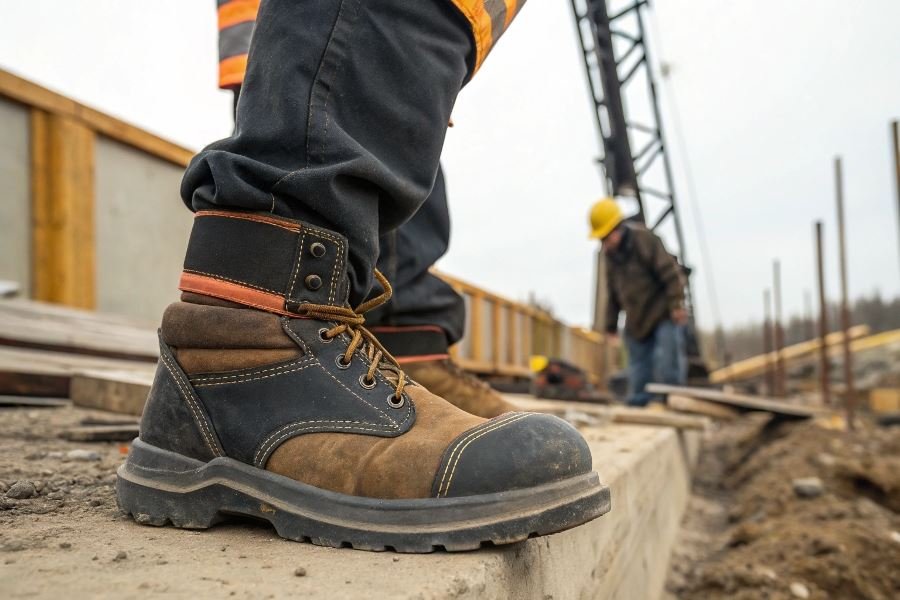
Ever wondered what stands between your toes and a 75-pound falling object? For millions of workers, it’s a seemingly simple innovation that prevents thousands of injuries every year: the protective toe cap.
Safety footwear isn’t just another piece of equipment—it’s often the last line of defense when things go wrong. Work ankle boots with protective toe caps represent specialized footwear designed to shield the most vulnerable part of your foot from compression, impact, and puncture hazards. These boots combine the mobility and support of an ankle-height design with reinforced toe areas typically made from steel, composite materials, or aluminum.
The protective elements don’t stop at the toe cap. Quality safety boots feature puncture-resistant soles, electrical hazard protection, slip-resistant outsoles, and metatarsal guards—all working together to create a comprehensive safety system.
Meeting rigorous safety standards
Safety footwear isn’t just manufactured—it’s engineered to meet specific standards. In the United States, the American Society for Testing and Materials (ASTM) sets the benchmarks through ASTM F2413, which establishes minimum requirements for impact resistance, compression resistance, and other safety features.
Most protective footwear carries ratings like:
| Rating | Protection Level | Impact Resistance |
|---|---|---|
| I/75 | Impact protection | 75 foot-pounds |
| C/75 | Compression resistance | 2,500 pounds |
| Mt/75 | Metatarsal protection | 75 foot-pounds |
The Occupational Safety and Health Administration (OSHA) further mandates employers provide appropriate protective footwear when workplace hazards exist.
From steel to space-age composites
The evolution of protective footwear tells a fascinating story of innovation. The first steel toe caps emerged in the early 20th century, becoming standardized during World War II when industrial safety became paramount to the war effort.
By the 1970s, as workplace safety regulations formalized, steel toe boots became mandatory in many industries. The technology remained relatively unchanged until the 1990s when composite materials revolutionized the field—offering comparable protection with significant weight reduction and without the thermal conductivity issues of metal.
Today’s protective footwear bears little resemblance to its clunky predecessors, with advanced materials and ergonomic designs providing protection without sacrificing comfort or performance—proving that safety and functionality can indeed walk hand in hand.
Where Protective Toe Cap Boots Become Essential
In high-risk work environments, the right footwear isn’t just about comfort—it’s about survival. Every year, thousands of workplace foot injuries occur that could have been prevented with proper protection. The critical decision of when to implement work ankle boots with protective toe cap depends entirely on the hazards present in your specific workplace environment.
Construction sites represent ground zero for foot protection requirements. When heavy materials, sharp objects, and moving equipment create a perfect storm of foot hazards, protective footwear becomes non-negotiable. Work ankle boots with protective toe cap: when they are necessary becomes evident the moment a worker steps onto a jobsite where falling objects, compression risks, or puncture hazards exist. OSHA standards mandate appropriate foot protection when working in areas where there is danger of foot injuries due to falling or rolling objects, or objects piercing the sole.
Construction and Heavy Industry Protection
The construction industry demands maximum foot protection due to multiple simultaneous hazards:
- Falling object protection: Steel beams, tools, and building materials create constant overhead dangers
- Compression resistance: Heavy equipment and materials can crush unprotected feet
- Electrical hazard protection: Many sites require boots with electrical hazard ratings
On demolition sites, the protective toe cap becomes even more critical as unpredictable debris and structural components create heightened risk scenarios. Premium work boots like the Timberland PRO series offer ASTM-certified protection while maintaining all-day comfort.
Manufacturing and Warehouse Safety Requirements
Manufacturing facilities and warehouses present unique challenges that make protective footwear mandatory:
Manufacturing environments combine multiple risk factors:
| Risk Factor | Protection Needed | Common Industries |
|---|---|---|
| Heavy machinery | Impact-resistant toe caps | Automotive, appliance manufacturing |
| Moving parts | Metatarsal guards | Metal fabrication, assembly lines |
| Slippery surfaces | Slip-resistant outsoles | Food processing, chemical production |
Warehouse operations involve constant material handling where toe protection prevents injuries from falling inventory, pallet jacks, and forklifts. The Wolverine Overpass work boots provide carbon-fiber toe protection that’s 30% lighter than traditional steel while meeting all safety standards.
Specialized Field Requirements
Some professions face unique hazards requiring specialized protective features:
Electrical work demands boots with:
- Non-conductive materials
- Electrical hazard (EH) certification
- Secondary protection features
Welders require boots that resist sparks, molten metal splash, and extreme heat while maintaining toe protection integrity. The Red Wing King Toe series offers aluminum toe protection with 44% more toe room, critical for professionals who spend long hours in protective footwear.
Utility workers face changing environmental conditions while dealing with heavy equipment and tools. Their footwear must provide waterproof protection alongside impact resistance. The composite toe caps in Carhartt Force work boots offer protection without the cold transfer of steel, making them ideal for outdoor work in varying temperatures.
When selecting protective footwear for specialized applications, look beyond the basic toe cap to ensure all relevant hazards are addressed. The right boot combines appropriate protection ratings with ergonomic design to prevent both immediate injuries and long-term musculoskeletal issues.
Making the Right Choice: Work Ankle Boots with Protective Toe Caps
Critical selection factors for safety footwear
Selecting the perfect work ankle boots with protective toe caps isn’t just about checking a safety requirement box—it’s an investment in your daily comfort and long-term wellbeing. When evaluating options, focus first on the certification standards. ASTM F2413 or ANSI Z41 ratings aren’t just alphabet soup—they’re your guarantee that boots can withstand specific compression and impact forces.
The protective toe cap material deserves careful consideration. Steel toe caps offer maximum protection against crushing hazards (up to 2,500 pounds of compression), while composite toe caps provide similar protection with less weight and no metal detection issues. Aluminum toe caps split the difference with excellent protection at 30-50% lighter than steel.
Comfort features become increasingly important during those 10-hour shifts. Look for boots with:
- Shock-absorbing midsoles
- Cushioned insoles (preferably removable)
- Moisture-wicking linings
- Padded collars and tongues
The boot’s construction method significantly impacts durability and comfort. Red Wing and Thorogood utilize Goodyear welt construction, allowing for resoling and extended life, while Timberland PRO often employs direct-attach methods for immediate comfort with less break-in time.
Extending boot lifespan through proper care
Work boots face brutal conditions, but proper maintenance can triple their service life. Implement this care routine:
- Daily cleaning: Remove surface dirt with a brush before it becomes embedded
- Regular conditioning: Apply appropriate leather conditioner monthly to prevent cracking
- Proper drying: Never place wet boots near direct heat—stuff with newspaper and dry at room temperature
- Rotation system: Alternate between two pairs to allow complete drying between wears
| Care Product Type | Application Frequency | Benefits |
|---|---|---|
| Leather cleaner | Weekly | Removes embedded dirt and salt |
| Leather conditioner | Monthly | Prevents drying and cracking |
| Waterproofing treatment | Quarterly | Maintains water resistance |
| Boot oil | As needed for rough leather | Restores flexibility and water resistance |
For composite toe boots, avoid petroleum-based products that can degrade synthetic materials. Nikwax offers specialized products for technical footwear that won’t compromise protective elements.
When protective toe caps become non-negotiable
Protective toe cap work boots transition from “beneficial” to “absolutely necessary” in specific workplace scenarios. They’re essential when:
- Working around heavy objects that could fall or roll (construction, warehousing)
- Operating equipment with pinch points near foot level (manufacturing)
- Handling materials where impact hazards exist (shipping/receiving)
- Working in environments with puncture hazards (construction, demolition)
- Following industry-specific regulations (mining, certain manufacturing)
The financial calculation is straightforward: a quality pair of protective boots costs $150-300, while a foot injury can result in thousands in medical bills and lost wages. Beyond the obvious safety benefits, modern protective footwear offers remarkable comfort innovations that make them practical for all-day wear.
The best safety boot is the one you’ll actually wear consistently. Prioritize fit and comfort alongside protection standards.
When selecting work ankle boots with protective toe caps, remember you’re not just buying footwear—you’re investing in a critical piece of personal protective equipment that stands between you and potentially life-altering injuries.
Discover when OSHA-compliant work boots with protective toe caps are essential for workplace safety. Learn about industry requirements, safety standards, and how to choose the right protective footwear for construction, manufacturing, and specialized trades.
Discover when OSHA-compliant work boots with protective toe caps are essential for workplace safety. Learn about industry requirements, safety standards, and how to choose the right protective footwear for construction, manufacturing, and specialized trades.