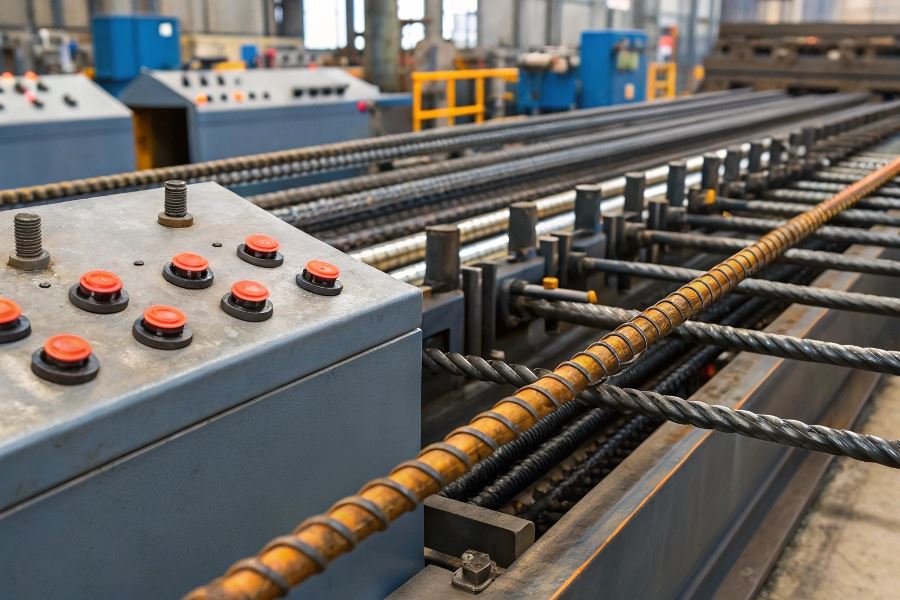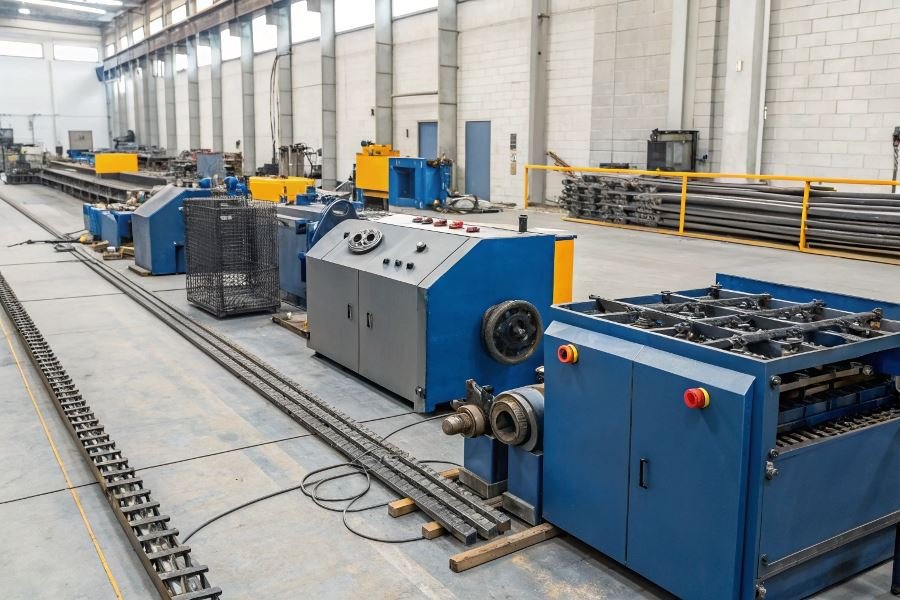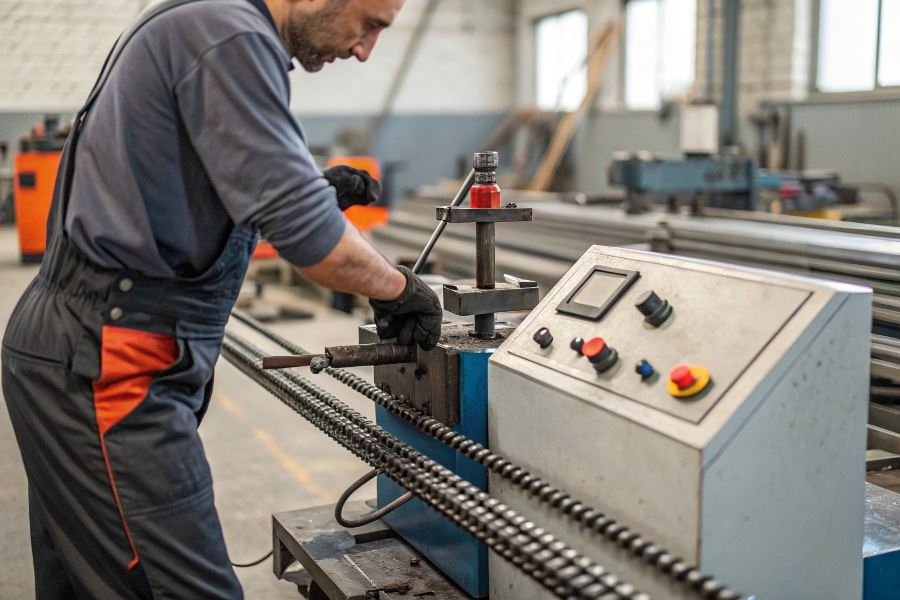
Ever watched a construction site and wondered how they determine exactly how much rebar they can process in a day? The difference between a profitable project and a financial disaster often comes down to one critical factor: accurately calculating your reinforcement equipment productivity.
When we talk about productivity in reinforcement processing, we’re measuring the volume of material your equipment can handle within a specific timeframe. It’s the heartbeat of your operation—the metric that determines schedules, labor requirements, and ultimately, your bottom line.
Defining productivity in concrete terms
Reinforcement productivity isn’t just a vague concept—it’s a precise calculation that measures output capacity, typically expressed in tons per hour or linear feet per shift. This calculation considers:
- Machine cycle times: The seconds required to complete one operation
- Material handling efficiency: How quickly reinforcement moves through your workflow
- Downtime factors: Maintenance, setup changes, and unexpected interruptions
Why precision matters more than you think
Miscalculating productivity by even 10% can cascade into scheduling nightmares. A project manager who recently shared his experience with me had underestimated processing time by just 8%, resulting in $42,000 in unexpected labor costs and a two-week delay.
Equipment landscape: Know your options
The reinforcement processing world offers diverse equipment options, each with distinct productivity profiles:
| Equipment Type | Typical Productivity Range | Best Application |
|---|---|---|
| Bar benders | 2-5 tons/hour | Custom angles, complex shapes |
| Shearing machines | 3-8 tons/hour | High-volume cutting operations |
| Mesh welders | 1-4 tons/hour | Standardized panel production |
Understanding these fundamentals creates the foundation for accurate planning that keeps projects on time and within budget.
The Essential Factors That Drive Reinforcement Equipment Productivity
When investing in reinforcement processing machinery, understanding the true productivity potential is critical for project planning and profitability. The difference between theoretical and actual output can make or break your construction timeline. Let’s dive into the core factors that determine how much reinforcement your equipment can realistically process.
Calculating the productivity of equipment for working with reinforcement requires a systematic approach that accounts for machine capabilities, material characteristics, and human factors. The most successful contractors don’t just look at manufacturer specs—they develop comprehensive productivity models that reflect real-world conditions.
Machine Specifications: Beyond the Brochure
Rated capacity serves as your baseline, but it’s rarely the complete story. When evaluating rebar cutting machines, for instance, the tonnage rating indicates maximum force, but doesn’t account for cycle times between cuts.
A professional assessment should include:
- Cycle time analysis – How many complete operations per hour?
- Power requirements – Is your power supply adequate for peak performance?
- Hydraulic system efficiency – Often the limiting factor in high-volume operations
Modern Gensun and Schnell reinforcement processing systems offer digital productivity tracking, allowing real-time monitoring against rated capacities.
Material Properties: The Hidden Productivity Killer
The physical characteristics of reinforcement materials dramatically impact processing speeds—sometimes by up to 40%.
| Material Property | Impact on Productivity | Adjustment Factor |
|---|---|---|
| Steel grade (yield strength) | Higher grades require more force | 0.7-0.9× for high-strength |
| Bar diameter | Exponential relationship to processing time | 0.5× for each doubling of diameter |
| Surface condition | Rust/coating increases friction | 0.8-0.95× for heavily rusted bars |
The relationship between material properties and machine performance is often underestimated until production is already underway.
Operational Efficiency: The Human Element
Even the most advanced reinforcement processing equipment requires skilled operation and proper maintenance protocols.
Setup time represents a significant productivity factor, particularly for fabrication shops handling diverse order specifications. Modern CNC bending machines from EVG can reduce setup times by 70% compared to manual adjustment systems.
Maintenance intervals directly impact annual productivity:
- Preventive maintenance typically reduces capacity by 5-8%
- Unplanned downtime can slash productivity by 15-30%
- Lubrication quality affects both speed and precision
Operator skill level creates substantial productivity variations. Experienced operators typically achieve:
- 25% faster setup times
- 15% higher continuous operation speeds
- 40% fewer quality-related stoppages
The most accurate productivity calculations incorporate all three domains—machine specifications, material properties, and operational factors—into a unified model. By analyzing these elements systematically, you’ll develop realistic expectations that support effective project planning and resource allocation.
Calculating Reinforcement Equipment Productivity That Drives Profit
When managing construction projects or fabrication operations, understanding your equipment’s true productivity isn’t just about numbers—it’s about unlocking profitability. Let’s dive into the methods that separate theoretical calculations from real-world performance when working with reinforcement processing equipment.
Standard Productivity Calculation Formulas
The foundation of any productivity assessment starts with standard formulas that give you baseline expectations. For reinforcement processing equipment, the basic productivity formula follows:
Productivity = Output Rate × Operating Time × Efficiency FactorWhere:
- Output Rate represents the manufacturer’s stated capacity (tons/hour or pieces/hour)
- Operating Time is the actual hours the equipment runs
- Efficiency Factor accounts for standard operational variables
For cutting machines, the theoretical productivity can be calculated as:
| Equipment Type | Base Formula | Example Calculation |
|---|---|---|
| Bar Cutter | Cuts per minute × 60 × operating hours | 40 cuts/min × 60 × 8 hrs = 19,200 cuts/day |
| Bending Machine | Bends per hour × operating hours | 300 bends/hr × 8 hrs = 2,400 bends/day |
| Mesh Welding | Square feet per hour × operating hours | 500 sq.ft/hr × 8 hrs = 4,000 sq.ft/day |
These formulas provide the theoretical maximum—what your equipment could produce under perfect conditions. But perfect conditions rarely exist.
Real-world Adjustment Factors
The gap between theoretical and actual productivity is where profit margins live or die. Key adjustment factors include:
Material Variables: Different rebar grades and diameters affect processing speed. Heavy-duty equipment like the Schnell line might maintain 90% efficiency across various diameters, while budget options could drop to 60% efficiency with larger bar sizes.
Operator Skill Level: An experienced operator can maintain productivity rates 15-25% higher than novices. This translates directly to your bottom line.
The most overlooked factor is setup and changeover time, which can consume up to 30% of available production time when processing varied reinforcement specifications.
Realistic productivity calculations must include:
Actual Productivity = Theoretical Productivity × Material Factor × Operator Factor × Maintenance Factor × Setup Time FactorProductivity Monitoring and Optimization
Transforming productivity calculations from paperwork to profit requires systematic monitoring and optimization:
Digital Tracking Systems: Modern reinforcement processing equipment from manufacturers like Pedax includes production monitoring software that tracks actual output against theoretical capacity in real-time.
Performance Benchmarking: Establish baseline performance metrics for each:
- Equipment type
- Material specification
- Operation type
Optimization Strategies:
- Batch Similar Work: Reducing changeovers can increase daily productivity by 10-15%
- Preventive Maintenance: Schedule maintenance during non-peak periods
- Operator Training: Invest in regular skills development—a 5% improvement in operator efficiency often yields a 3-4% increase in overall productivity
Productivity insight: The highest-performing reinforcement fabrication operations maintain an Overall Equipment Effectiveness (OEE) of 75-85%, compared to the industry average of 60-65%.
By applying these calculation methods and adjustment factors, you’ll move beyond theoretical numbers to actionable insights that drive equipment investment decisions and operational improvements—turning productivity calculations into profit calculations.
Learn how to accurately calculate reinforcement equipment productivity with our comprehensive guide. Discover key factors affecting output, practical calculation methods, and optimization strategies for better project planning and efficiency.
Learn how to accurately calculate reinforcement equipment productivity with our comprehensive guide. Discover key factors affecting output, practical calculation methods, and optimization strategies for better project planning and efficiency.