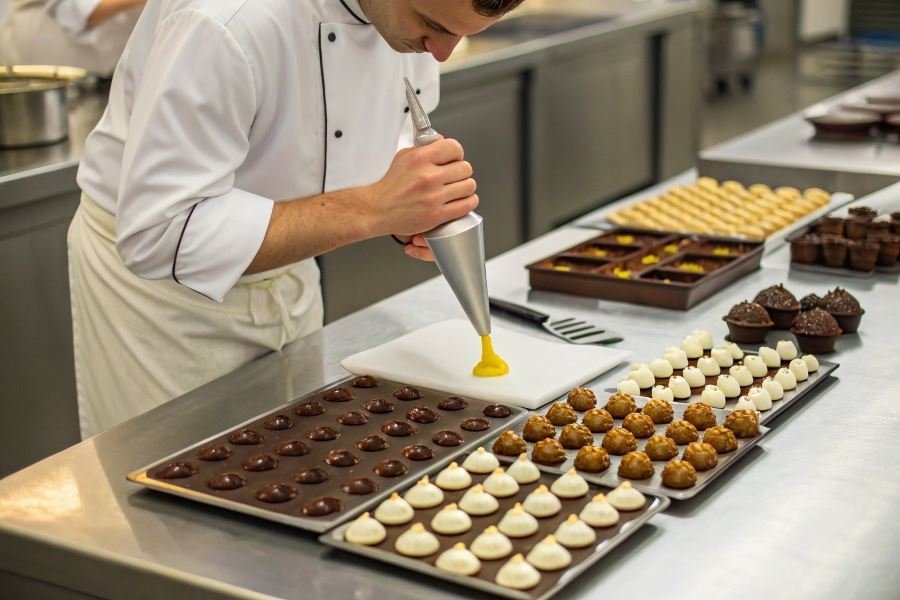
What’s the secret weapon in every successful pastry chef’s arsenal? It might be sitting right under your flour-dusted fingertips.
Professional pastry preparation demands precision, and temperature control stands as the unsung hero in this delicate art. Pastry tables with integrated cooling systems have transformed how artisans create everything from croissants to chocolate showpieces, offering a perfect marriage of workspace and temperature management.
At their core, refrigerated pastry tables are specialized workstations featuring temperature-controlled surfaces and storage compartments. These ingenious units maintain optimal temperatures—typically between 33°F and 41°F—creating the ideal environment for working with temperature-sensitive ingredients like butter, cream, and chocolate.
“Temperature control isn’t just a luxury in pastry work—it’s the difference between perfection and disaster.”
The benefits extend far beyond convenience. Proper cooling dramatically extends ingredient shelf life, maintains dough elasticity, and prevents bacterial growth. For chocolate work, these tables are nothing short of revolutionary, allowing tempered chocolate to remain workable without crystallizing prematurely.
The market offers remarkable variety, from compact units starting around $1,800 for small operations to sophisticated models with digital controls and multiple zones reaching $7,500+ for high-volume production. Granite-topped models command premium prices but deliver unmatched thermal stability and durability.
Investment considerations should include not just initial cost but energy efficiency, maintenance requirements, and configuration options. The right table becomes not just equipment but a cornerstone of quality production and operational efficiency.
Essential Features That Define Quality Pastry Tables
When selecting refrigerated equipment for your bakery operation, understanding the critical features that separate exceptional pastry tables from mediocre ones can dramatically impact your production quality and efficiency. The market offers numerous options for pastry tables with cooling capabilities, but identifying which specifications truly matter requires insider knowledge.
Temperature control represents the cornerstone of any cooling pastry table system. Precision cooling technology makes the difference between perfectly tempered chocolate and a frustrating mess. Most professional-grade units offer temperature ranges between 33°F and 41°F (0.5°C to 5°C), but the differential matters just as much as the range. Look for systems with temperature variance of ±2°F or less to maintain consistent conditions for delicate dough work.
Temperature Management Systems That Deliver
Modern cooling tables employ several distinct refrigeration approaches:
- Forced-air circulation – Provides even cooling throughout the workspace
- Static cooling – Offers gentler temperature control for sensitive items
- Hybrid systems – Combines technologies for customizable environments
The refrigeration compressor quality directly correlates with performance longevity. Industry leaders like True Manufacturing and Turbo Air utilize heavy-duty compressors rated for continuous commercial operation, while budget options often incorporate residential-grade components that struggle under professional demands.
Workspace Dimensions That Work For You
Size considerations extend beyond simple measurements. The most functional pastry tables with cooling features balance three critical spatial elements:
- Usable surface area – Typically ranging from 48″ to 96″ in width
- Storage capacity – Both refrigerated and ambient storage options
- Ergonomic height – Standard 36″ height with adjustable options
| Table Size | Surface Area | Storage Capacity | Ideal For |
|---|---|---|---|
| 48″ Width | 12-15 sq ft | 6-8 cubic ft | Small bakeries, limited space |
| 72″ Width | 18-22 sq ft | 10-12 cubic ft | Medium operations |
| 96″ Width | 24-30 sq ft | 14-18 cubic ft | High-volume production |
Consider your production volume and workflow when determining optimal dimensions. A table that’s too small creates bottlenecks, while oversized equipment wastes valuable kitchen real estate.
Construction Quality That Stands The Test Of Time
Material selection dramatically impacts both performance and longevity. Food-grade stainless steel (304 grade minimum) should form the foundation of any quality pastry table. The thickness of this steel, measured in gauge, determines durability—look for 18-gauge or heavier for surfaces that will endure daily use without warping.
Insulation quality directly affects energy efficiency and temperature stability. Premium models utilize CFC-free polyurethane foam at 2″ thickness minimum, creating a thermal barrier that maintains consistent internal temperatures while reducing operational costs.
The undercarriage construction reveals much about overall quality. Examine:
- Corner reinforcements – Should be fully welded, not spot-welded
- Leg construction – Adjustable heavy-duty legs with cross-bracing
- Caster quality – If mobile, look for locking casters rated at 300+ lbs each
Investment in superior construction materials typically commands a 15-30% premium upfront but delivers exponential returns through extended service life and reduced maintenance costs. Quality pastry tables with proper care routinely provide 10+ years of reliable service, making material selection perhaps the most consequential decision in the purchasing process.
Investing Wisely in Pastry Tables with Cooling
The true cost of ownership
When evaluating pastry tables with cooling systems, looking beyond the sticker price reveals the true investment value. Professional-grade units from manufacturers like True Refrigeration or Turbo Air typically range from $2,500 to $7,000 depending on size and features—but this initial outlay tells only part of the story.
The real calculation must include energy efficiency ratings, which can save bakeries $300-500 annually in operating costs. Units with Energy Star certification typically consume 20% less electricity than standard models, translating to approximately $4,000-6,000 in savings over a 10-year lifespan.
The cheapest option rarely delivers the best value. A quality pastry table with proper cooling will typically provide 8-12 years of reliable service when properly maintained.
Consider also the production capacity increase—a well-designed pastry table with efficient cooling can boost output by 15-25% through improved workflow and consistent dough temperature control, directly impacting your bottom line.
Maintenance matters
The hidden costs of ownership often emerge in maintenance requirements. High-quality pastry tables with cooling systems demand:
- Quarterly condenser cleaning
- Bi-annual gasket inspection and replacement as needed
- Annual refrigerant level checks
- Monthly drain line cleaning
These maintenance tasks typically cost $200-400 annually but prevent catastrophic failures that could cost thousands in emergency repairs and lost production time.
Self-contained cooling systems generally require less maintenance than remote systems, though they generate more ambient heat in your workspace. Remote systems offer better temperature stability but demand professional service technicians for most repairs.
Your selection roadmap
When making your final decision, this checklist ensures you’ve covered all critical factors:
| Selection Criteria | Key Considerations |
|---|---|
| Workspace dimensions | Allow 36″ clearance for staff movement |
| Production volume | 1-2 ft³ of refrigerated space per dozen pastries |
| Energy efficiency | Look for EER ratings above 12.0 |
| Temperature range | Must maintain 33-40°F consistently |
| Construction material | 304 stainless steel for food contact surfaces |
| Warranty coverage | Minimum 2-year parts, 5-year compressor |
| Service network | Local technician availability within 24 hours |
The most successful bakeries match their equipment to both current needs and growth projections. A pastry table that’s 20-30% larger than your immediate requirements provides room for business expansion without premature replacement costs.
Remember that cooling system placement significantly impacts performance. Compressors need adequate ventilation—at least 6 inches of clearance from walls—and should be positioned away from other heat-generating equipment like ovens.
The wisest investment balances upfront cost against long-term operational efficiency. When properly selected and maintained, a quality pastry table with cooling becomes not merely an expense but a cornerstone of production excellence and profitability for your bakery operation.
Discover how to select the ideal pastry cooling table for your business with our comprehensive guide. Learn about temperature control features, workspace considerations, and quality materials to maximize efficiency and preserve pastry freshness.
Discover how to select the ideal pastry cooling table for your business with our comprehensive guide. Learn about temperature control features, workspace considerations, and quality materials to maximize efficiency and preserve pastry freshness.