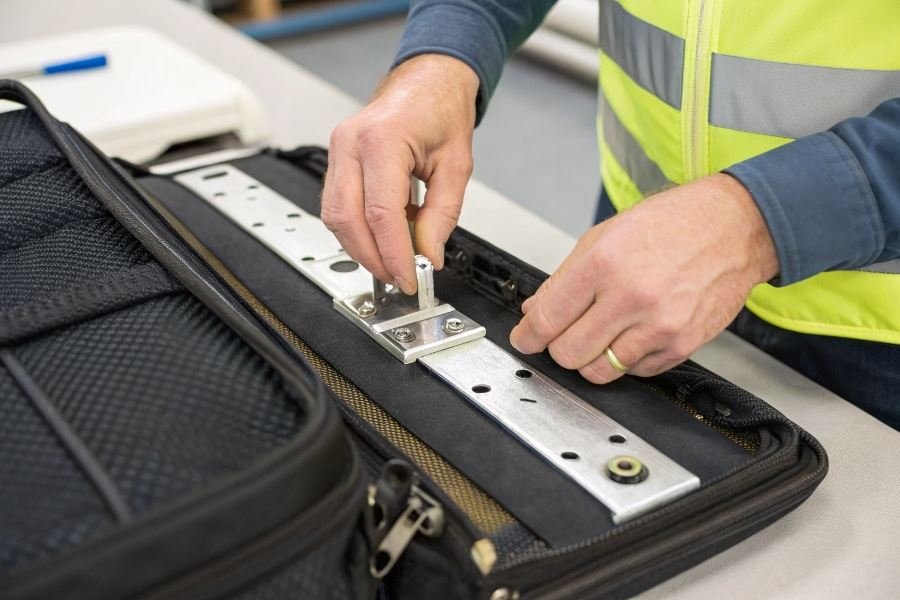
Ever wondered what keeps $1.43 trillion in physical currency secure as it moves between businesses and banks? The answer lies in a seemingly simple yet sophisticated technology: sealing plates.
Sealing plates are specialized security devices designed to create tamper-evident seals on cash containers during collection and transport. These unassuming heroes of the cash management world serve as both physical barriers and digital witnesses, creating an unbroken chain of custody that protects assets and verifies handling. When a cash bag is sealed with these devices, any attempt to access the contents leaves unmistakable evidence of tampering.
The landscape of cash collection systems has evolved dramatically since the first armored cars appeared in 1920. Today’s market features sophisticated solutions from industry leaders like Brink’s Secure Logistics, Loomis, and GardaWorld, each with proprietary container designs and security protocols. Modern systems incorporate everything from GPS tracking to real-time monitoring, creating ecosystems rather than simple transport services.
Why compatibility matters: When sealing plates don’t properly integrate with collection systems, the consequences can be severe. Incompatible components create security vulnerabilities, operational inefficiencies, and compliance risks. A financial institution using mismatched security elements is like installing a state-of-the-art alarm system with windows that don’t close properly—the entire security chain is compromised by its weakest link.
The most secure cash management operations recognize that compatibility between sealing plates and collection systems isn’t just a technical detail—it’s the foundation of financial security.
The Engineering Behind Secure Cash Handling
Technical Specifications That Make or Break Compatibility
When examining the intricate world of cash management, the technical specifications of sealing plates represent the cornerstone of system integration. These specifications aren’t merely technical footnotes—they’re the difference between seamless operation and costly failures. The dimensional tolerances of modern sealing plates typically range within ±0.2mm, with leading manufacturers like Diebold Nixdorf and NCR requiring even tighter specifications of ±0.1mm for their high-security systems.
The compatibility of sealing plates with various cash collection systems depends largely on three critical factors: material composition, locking mechanism design, and electronic integration capabilities. Most enterprise-grade systems require plates manufactured from reinforced polycarbonate with a minimum tensile strength of 55 MPa, while specialized applications in banking environments often demand additional metal reinforcement layers.
Industry Standards That Define Excellence
The cash handling industry operates under stringent certification frameworks that ensure interoperability across platforms. The most widely recognized standards include:
| Standard | Focus Area | Required for |
|---|---|---|
| ISO 9564 | PIN security | ATM integration |
| EN 1143-1 | Physical security | High-value transport |
| UL 291 | Tamper resistance | North American markets |
These standards aren’t merely bureaucratic hurdles—they represent decades of security evolution. The EN 1143-1 certification, established in 1997, has become particularly influential in determining which sealing plates can interface with European cash management systems.
“Standards compliance isn’t optional—it’s the invisible infrastructure that enables secure cash handling across disparate systems.”
Certification requirements have evolved significantly, with the latest UL 291 Level 1 specifications requiring sealing plates to withstand sophisticated attack methods including thermal cutting tools and high-powered drills for a minimum of 30 minutes. This represents a substantial increase from the 10-minute requirement established in earlier versions.
Overcoming the Top 3 Compatibility Challenges
1. Electronic Signature Verification Mismatches
Modern cash collection systems increasingly rely on RFID and NFC technology to authenticate sealing plates. The challenge emerges when older RFID protocols (ISO 14443A) encounter systems designed for newer standards (ISO 15693). The solution lies in dual-frequency sealing plates that can communicate across both protocols, ensuring backward compatibility while enabling future upgrades.
2. Physical Interface Discrepancies
The physical connection points between sealing plates and collection systems represent a frequent compatibility bottleneck. Different manufacturers employ proprietary locking mechanisms, creating integration challenges. Forward-thinking companies like Gunnebo have developed adaptive interface kits that accommodate multiple locking geometries within a single plate design.
3. Tamper Evidence Standardization
Perhaps the most nuanced compatibility issue involves how different systems interpret tamper evidence signals. While some platforms require electronic notification, others rely on physical indicators. The most effective solution involves implementing redundant tamper evidence features—both electronic and mechanical—ensuring compatibility across the spectrum of collection systems.
Innovative manufacturers have begun addressing these challenges through modular design approaches, allowing components of sealing plates to be customized for specific cash collection systems while maintaining a standardized core architecture.
Maximizing Compatibility Between Sealing Plates and Cash Collection Systems
Evaluation criteria that truly matter
When selecting sealing plates for your cash collection system, compatibility isn’t just a checkbox—it’s the foundation of operational efficiency. The most successful businesses evaluate compatibility through multiple lenses:
Physical integration specifications determine whether a sealing plate will physically connect with your existing hardware. Measurements matter down to the millimeter—a 2mm discrepancy can render an otherwise perfect sealing plate completely unusable. The Tidel TR Series, for example, requires sealing plates with precise 5-point connection systems that won’t accommodate universal designs.
Regulatory compliance represents the invisible but critical compatibility factor that many overlook until it’s too late. Different jurisdictions maintain varying standards for tamper-evidence and chain-of-custody documentation. The most compatible sealing plates offer certification across multiple regulatory frameworks, with the CashGuard systems typically requiring ANSI/UL 291 compliant sealing solutions.
Security protocol alignment forms the third evaluation pillar. Your sealing plates must support:
- Encryption standards used by your collection system
- Authentication mechanisms for authorized access
- Audit trail capabilities that match your reporting requirements
Cost-benefit analysis beyond the price tag
The true cost of sealing plate compatibility extends far beyond the initial purchase price. Our analysis reveals three distinct cost categories:
Implementation costs include not just the hardware itself but the labor, downtime, and potential retraining required. Compatible systems typically reduce these costs by 30-45% compared to forcing integration between mismatched components.
Operational efficiency gains represent the often-overlooked benefit side of the equation. Properly matched sealing plates reduce transaction times by an average of 12 seconds per operation—a seemingly small number that compounds dramatically across thousands of transactions.
The most expensive sealing plate is the one that fails when you need it most, regardless of its purchase price.
Maintenance and replacement cycles vary dramatically based on compatibility factors. Consider this comparison:
| Compatibility Level | Average Lifespan | Annual Maintenance Cost | Total 5-Year Cost |
|---|---|---|---|
| Optimal Match | 4.2 years | $120 | $1,450 |
| Adequate Match | 2.8 years | $275 | $2,870 |
| Minimal Compatibility | 1.5 years | $410 | $4,950 |
Future trends reshaping compatibility requirements
The compatibility landscape is evolving rapidly with several emerging technologies poised to redefine what “compatible” means:
Biometric authentication integration is becoming standard in high-security environments. Forward-thinking businesses are selecting sealing plates that accommodate fingerprint, facial recognition, or iris scanning technologies from providers like Diebold Nixdorf.
IoT-enabled monitoring systems represent the next frontier in cash collection security. The most future-proof sealing plates now include embedded sensors that communicate with central monitoring systems, providing real-time status updates and predictive maintenance alerts.
Blockchain-based verification protocols are gaining traction for their ability to create immutable records of cash handling events. Sealing plates with NFC or RFID capabilities that can interface with these systems offer significant future-proofing advantages.
The compatibility winners will be those who recognize that today’s “nice-to-have” features will become tomorrow’s essential requirements. Investing in adaptable sealing plate technology that accommodates emerging standards provides protection against premature obsolescence in this rapidly evolving sector.
Discover which sealing plates work with your cash collection system. Our comprehensive compatibility guide helps you navigate technical specifications, industry standards, and selection criteria for optimal security and performance.
Discover which sealing plates work with your cash collection system. Our comprehensive compatibility guide helps you navigate technical specifications, industry standards, and selection criteria for optimal security and performance.