Ever wondered why some stores feel effortless to navigate while others leave you frustrated before checkout? The humble shopping cart—that wheeled companion guiding you through retail journeys—plays a far more strategic role than most realize.
The shopping cart’s journey began in 1937 when Sylvan Goldman introduced the first folding cart in his Oklahoma grocery store. What started as a simple metal basket on wheels has transformed into a sophisticated retail tool engineered for specific environments and customer behaviors. Today’s retail landscape features an impressive array of cart designs—from traditional wire baskets to specialized configurations for electronics, home improvement, and luxury retail.
The strategic impact of cart selection
Choosing the right cart type isn’t merely a logistical decision—it’s a critical business strategy. The perfect cart balances operational efficiency with customer satisfaction, directly influencing purchasing behavior. Studies show that customers with comfortable, maneuverable carts spend up to 40% more time in stores and purchase 15-20% more merchandise.
Customer experience by design
The shopping cart creates the physical framework for customer experience. Consider how different designs serve different needs:
- Depth perception: Shallow carts make purchases appear substantial, while deeper carts can make shoppers feel they haven’t selected enough
- Maneuverability: Four-wheel versus two-wheel designs dramatically change navigation through narrow aisles
- Specialized compartments: Dedicated spaces for fragile items or temperature-sensitive products reduce customer anxiety
The right cart doesn’t just transport products—it subtly guides the entire shopping journey, turning casual browsers into confident buyers.
Physical Shopping Cart Types That Define Retail Experiences
The humble shopping cart—a retail workhorse that rarely gets the recognition it deserves. Yet these mobile baskets fundamentally shape how we shop, how much we buy, and even how stores operate. Understanding the various types of shopping carts: features and differences helps retailers make strategic decisions that impact everything from customer satisfaction to their bottom line.
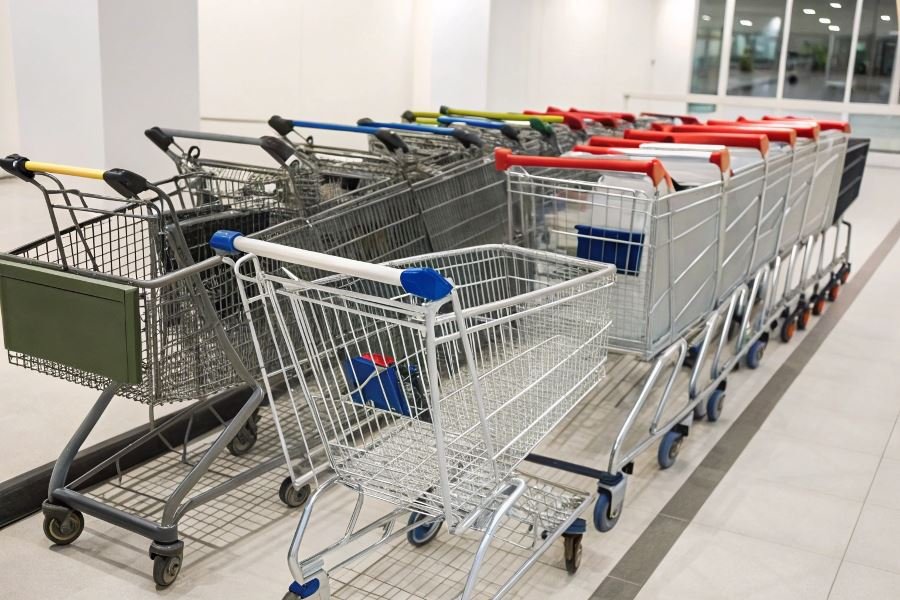
Traditional Wire Carts: The Retail Workhorses
Traditional wire shopping carts remain the gold standard in supermarkets and big-box stores for good reason. These metal marvels typically hold between 12,000 to 15,000 cubic inches of merchandise—approximately $300-400 worth of groceries.
Durability advantages:
- Galvanized or chrome-plated steel construction withstands years of abuse
- Open design prevents moisture buildup and allows easy cleaning
- Modular components mean parts can be replaced rather than scrapping entire carts
The nested design pioneered by Sylvan Goldman in 1937 revolutionized retail by allowing stores to store dozens of carts in the space previously required for just a few. Modern wire carts feature innovations like ergonomic handles, quieter wheels, and anti-theft systems that lock wheels when carts leave designated areas.
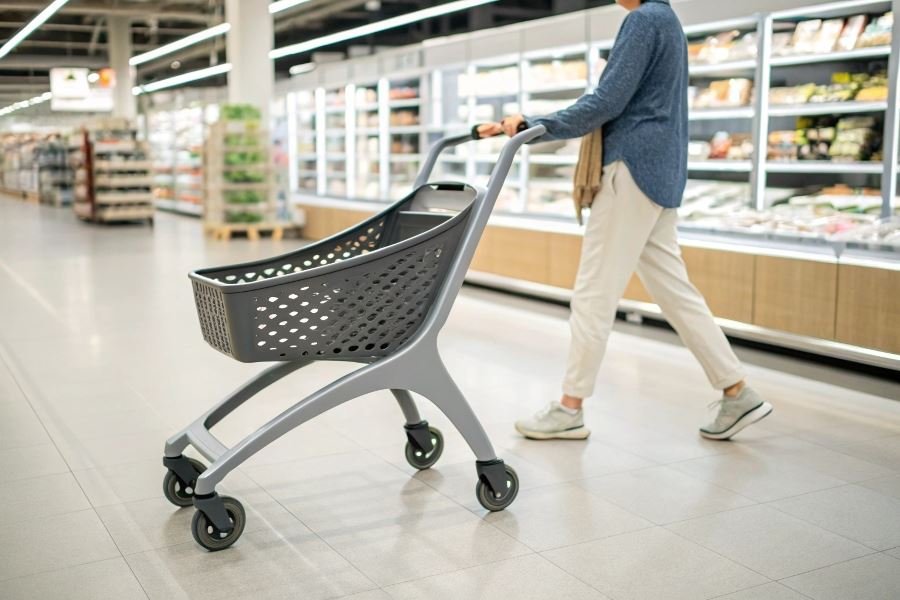
Plastic Shopping Carts: The Modern Alternative
Plastic shopping carts have gained significant market share, particularly in specialty retail, pharmacies, and upscale grocery stores.
These lightweight alternatives typically weigh 15-20 pounds less than their wire counterparts while offering several distinct advantages:
| Feature | Benefit |
|---|---|
| Seamless construction | No sharp edges to snag clothing |
| Quieter operation | Enhanced shopping experience |
| Customizable colors | Brand reinforcement opportunities |
| UV-resistant materials | Maintains appearance longer |
| Non-rusting | Reduced maintenance costs |
Maintenance for plastic carts is substantially different from wire models. While they don’t rust, they can crack under extreme stress or temperature changes. However, their smooth surfaces make them easier to sanitize—a feature that gained renewed appreciation during recent health concerns.
Specialty Shopping Carts: Designed for Specific Needs
The evolution of retail has spawned numerous specialty cart designs addressing specific shopping scenarios and customer needs.
Compact carts have found their niche in urban markets and smaller-format stores. These space-efficient models typically offer 30-40% less capacity than standard carts but enable easier navigation through narrow aisles. Target has successfully deployed these in their small-format urban locations.
Accessibility-focused designs represent one of the most important innovations in shopping cart technology. These models feature:
- Lower baskets for wheelchair users
- Hand brakes for those with mobility challenges
- Seats for shoppers who need rest periods
- High-contrast colors for visually impaired customers
Child-friendly options go beyond the basic child seat found in traditional carts. Modern kid-centric designs from companies like Shopping Cart USA include:
- Car-shaped carts that entertain children while parents shop
- Double-seat models for families with multiple young children
- Carts with attached infant carrier mounts
- “Shop-along” mini carts that allow children to participate in the shopping experience
The diversity of shopping cart designs reflects retailers’ growing understanding that the right cart doesn’t just hold merchandise—it enhances the entire shopping experience, influences purchase behavior, and communicates brand values.
Digital Shopping Cart Solutions That Drive Conversions
E-commerce Platform Shopping Carts
The backbone of any online store isn’t its products—it’s the shopping cart system powering the purchase journey. Platform-integrated carts like those from Shopify and WooCommerce offer seamless integration with your existing business infrastructure.
What separates exceptional platform carts from mediocre ones? Integration depth. Top-tier solutions connect with:
- Payment processors (30+ options on average)
- Inventory management systems
- CRM platforms
- Marketing automation tools
- Analytics engines
The user experience of platform-based carts has evolved dramatically. Modern systems incorporate one-click purchasing, saved payment methods, and intelligent product recommendations that can increase average order value by 15-25%.
The difference between a good and great shopping cart often comes down to checkout friction—every additional step reduces conversion rates by approximately 10%.
Platform carts excel in customization capabilities, allowing businesses to maintain brand consistency throughout the purchase journey. However, they sometimes sacrifice mobile optimization for feature richness.
Mobile Shopping Cart Applications
As mobile commerce surges (accounting for 72.9% of e-commerce sales), specialized mobile cart applications have become essential business tools. Apps from Shopify Mobile and BigCommerce Mobile lead this category with standout convenience features.
Key mobile cart innovations include:
- Biometric checkout authorization
- Camera-based credit card scanning
- Location-based inventory checking
- Push notification order updates
- Offline browsing capabilities
Cross-device functionality represents the gold standard for mobile carts. The ability to start a purchase on a smartphone and complete it on a desktop—with all cart contents preserved—reduces abandonment rates by up to 30%.
Mobile carts typically offer streamlined interfaces with fewer steps to purchase, optimized for smaller screens and on-the-go shopping. This simplicity comes at a cost: fewer upsell opportunities and limited customization options.
Top Shopping Cart Software Solutions
When evaluating standalone shopping cart software, three solutions consistently outperform competitors:
| Solution | Standout Features | Starting Price | Scalability |
|---|---|---|---|
| Shopify | 100+ payment gateways, abandoned cart recovery, unlimited products | $29/month | Enterprise-grade with Shopify Plus |
| BigCommerce | No transaction fees, B2B features, headless commerce options | $29.95/month | Scales to $400M+ in sales |
| WooCommerce | Open-source flexibility, WordPress integration, extensive plugin ecosystem | Free (plus hosting) | Limited only by hosting infrastructure |
Shopify dominates with user-friendly interfaces and comprehensive support, making it ideal for businesses prioritizing simplicity. BigCommerce offers superior built-in features without requiring additional apps, reducing total cost of ownership for feature-hungry merchants.
WooCommerce provides unmatched customization potential but demands more technical expertise. Its open-source nature means businesses aren’t locked into proprietary systems—a significant advantage for companies with specific requirements or existing technology investments.
Each solution offers distinct pricing structures beyond monthly fees. Shopify charges transaction fees for external payment gateways, while BigCommerce automatically upgrades plans based on annual sales volume. WooCommerce’s costs scale with hosting requirements and premium extensions.
The ideal cart solution ultimately depends on your specific business model, technical capabilities, and growth trajectory—not just feature lists or initial pricing.
Discover the essential features and differences between physical and digital shopping cart types to optimize your retail or e-commerce business. Compare traditional, specialty, and software options for improved customer experience and operational efficiency.
Discover the essential features and differences between physical and digital shopping cart types to optimize your retail or e-commerce business. Compare traditional, specialty, and software options for improved customer experience and operational efficiency.